
Let’s talk about shooting from the shadow side, where light rakes across your subject at an angle, transforming ordinary photos into cinematic images by adding dramatic contrast and dimensional depth.
Dancing With Light and Shadow
There's an old saying among photographers: "Follow the light." The truth, however, is that genuine magic can often be discovered in the shadows instead. Although our natural tendency may be to shoot our subjects illuminated with bright, even light, the most intriguing images may arise when we choose to stand in the shadows, allowing light to touch our subjects from behind or from an angle, while shadows shape the narrative.
What Makes an Image 'Cinematic'?
A cinematic photograph is the visual language of cinema. By using dramatic lighting and contrast, it cultivates a specific mood, while shadows are skillfully used to enhance depth and dimension. This approach elevates the aesthetic impact and invites viewers to engage more deeply with the image.
The Power of Contrast: Our Eyes Crave Drama
Shooting from the shadow side does not necessarily mean shooting into the light. The light could be falling from an angle and is often most appealing that way. When you shoot from the shadow side, several things happen to your image:
-
You create natural depth. The light hits one side of your subject while the other falls into shadow, instantly giving a three-dimensional quality to what is actually a flat photograph. This side lighting creates more prominent shapes, outlines, or silhouettes that flat lighting would completely hide.
-
Shadows act as visual anchors.
-
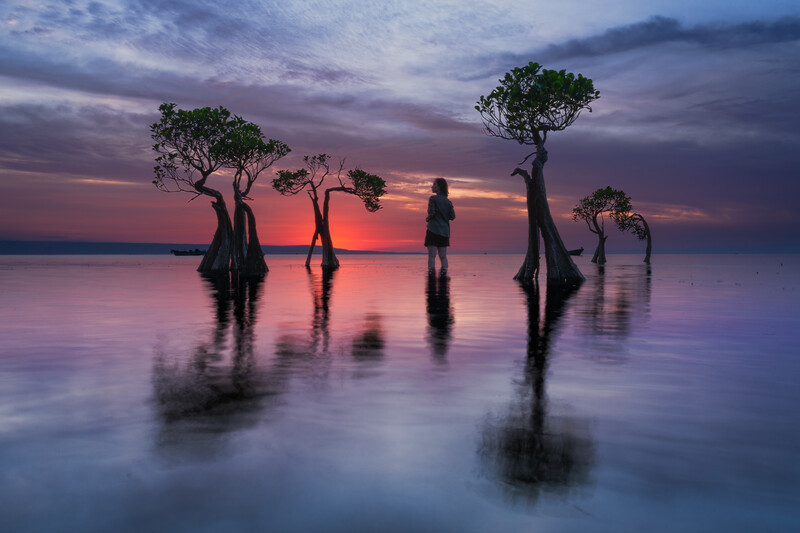
The approach automatically creates a sense of separation. Instead of everything blending into a similar brightness, you get distinct layers of light and dark, as depicted in the image of the mangrove trees from Indonesia below.
-
Shadows also hide unnecessary details while highlighting what matters most.
Technique Across Genres: From Portraits to Landscapes
What makes shadow-side shooting so valuable is that it applies to all types of photography, from intimate portraits to sweeping landscapes.
The Human Element
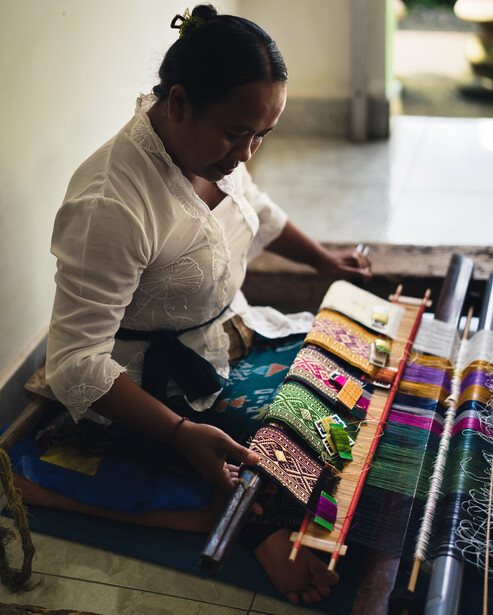
In the weaving scene below, notice how the back light illuminates the artisan's face and hands from one side, while leaving the other half in gentle shadow. I had an hour-long photo session with this lady, and I started from the shadow side on purpose, instead of worrying about the lack of a reflector or flash. For me, shadow and light work together here to foster intimacy and nostalgia, enhancing the timeless quality of the art of weaving.
Landscapes That Breathe
Take a look at the dramatic scene below, where jagged rocks emerge from misty waters. The side lighting creates depth between the illuminated edges and shadowed faces of the rocks. Without these shadows, the rocks would appear flat and uninteresting. Instead, they feel monumental.

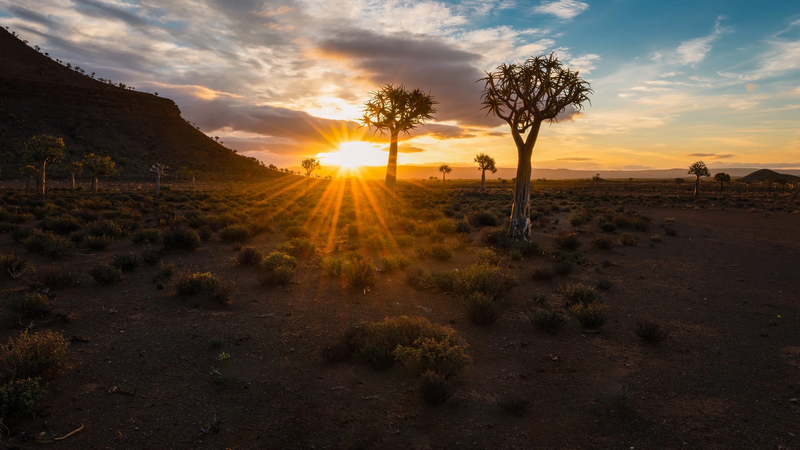
This quiver tree image illustrates shadow-side photography in landscape images. Shot directly into the setting sun, the camera captures the unlit side of the trees, turning them into striking silhouettes with subtle rim-lit areas that separate them from the bright sky. By positioning the camera to face the light source, trees, shrubs, and terrain cast shadows that create high contrast and dimensional depth, defining cinematic imagery.
Of Philosophy and Art
Photography from the shadow side embraces the Japanese concept of "ma": negative space, or the power of what's not shown. Watercolor artists use this extensively by allowing shadows to obscure parts of their subjects and inviting viewers to complete the image with their imagination.
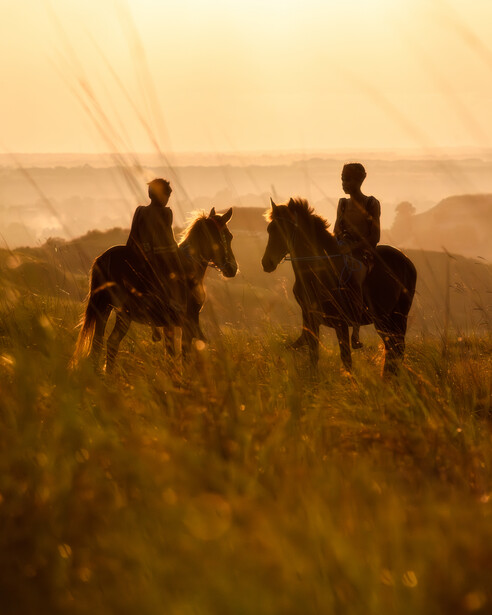
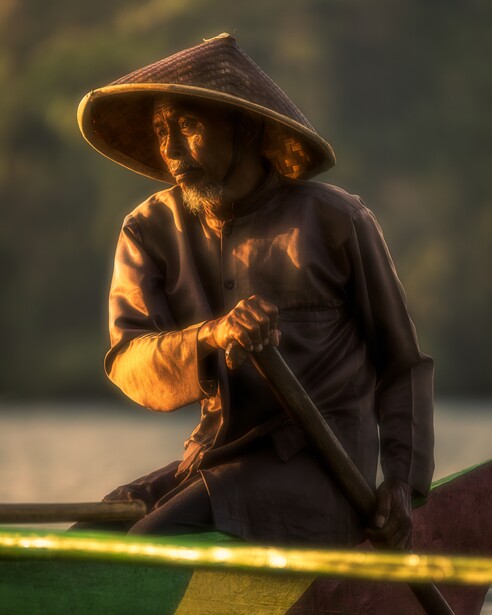
We don't need to see every detail of the fisherman's face, the weaver's face, or the Sumba horses to understand their story. Sometimes, what we don't show is more powerful than what we do. Artists throughout the Renaissance and Baroque periods discovered and utilized this effect to dramatic mastery, and one need only think of Caravaggio to get the idea of how to create a similar sense of theater or “cinema,” as it may be.
A Word of Caution
Before you run off shooting everything from the shadow side like some sort of photographic Batman, press the brakes a bit. This technique is powerful, but it's not always appropriate.
Don't fall into this trap when shooting corporate portraits (unless the CEO specifically wants to look like James Bond), product photography where detail is crucial, real estate photography (buyers want to see the room, not ponder its mysteries), and professional headshots (casting directors need to see faces, not artistic interpretations).
Sometimes, flat lighting is exactly what's needed. The key is knowing when drama serves your purpose and when it doesn't.
Practical Tips for Shadow-Side Success
-
Golden hour is your friend: Early morning and late afternoon provide the angular light that makes shadow-side shooting most effective.
-
Look for natural reflectors: Even when shooting from the shadow side, a bit of fill light from reflective surfaces helps. For example, a wall behind me reflected toward the weaver’s face in our example above. This gives subtle details to the shadow side and avoids complete black pixels.
-
Expose for the highlights: Let the shadows fall where they may. You can often recover shadow detail in post, but blown highlights are gone forever.
-
Move your feet: The difference between good and great often comes down to a few steps to the left or right to find the perfect angle where shadows and light create maximum impact.
Conclusion
Shooting from the shadow side is a mindset shift. By embracing shadows, we add contrast, depth, and that elusive cinematic quality to our photographs. Shadows aren't the absence of light; they are light's creative partner. A wise man once said, “If you're not casting a shadow, you're probably standing in the wrong spot.”

Join the Fstoppers community for free
-
Post comments and join in the discussions
-
Browse the site ad-free
-
Share your work and get featured in the community
-
Compete in the photo contests for fun and prizes
8 Comments
This was so helpful but I still struggle with settings.As suggested please advise on settings.Look forward to hearing from you.Thank you so much!
Yolanda R.
Hi Yolanda,
Thank you, I am glad to hear that you found the article useful.
For the photos of people and the horses, I shot in aperture priority mode. The reason is that these are action shots. As the fisherman moves or the weaver does her work, you don't have time to think about settings. So, my rule is to shoot in aperture priority mode, set the aperture I want, choose an ISO value based on a few test shots to see if the shutter speed calculated by the camera is not under- or overexposing, and then just keep shooting, occasionally checking the results.
For landscapes, it's much more forgiving and less intense. I either shoot in aperture priority mode on a tripod or in full manual mode. For example, the long exposure of the rocks in the ocean was in full manual mode. Whereas the girl standing in water between the trees was in aperture priority mode. Having said that, I was keeping an eye on the shutter speed so that the girl's movement wouldn't be recorded. She stood still, which was good for me, but I made sure the shutter speed was high enough to keep her in focus without a blur.
I hope this helps; there isn't a one-size-fits-all rule, and mostly it comes with practice. Feel free to ask more questions, and I will do my best to answer.
Kind regards,
Muji
Hi Muji.... The video in your portfolio about quitting your corporate job caught my eye, and yes, I made it through to the end... twice. Having posted that a little over a year ago, I'm wondering how the life you're living now has, or has not, fulfilled your expectations of being a full-time, self-employed creative?
I took the same step about nine years ago, and while it's nice to get up in the morning with the freedom to pursue whatever path I choose, there are moments now when it seems like life without a purpose, and the money doesn't allow for the same fine dining experiences that it used to. The world doesn't seem to care about one more creative. Competition in the field of photographic art is endless. And after all these years putting my heart and soul into making exceptional photographs, it's hard to find anyone who cares, much as less pull out a credit card and buy something. So in some ways, the experience of total freedom has lost a bit of luster over the years.
I'd love to hear more about how quitting a corporate job has affected your life now that you're further along on that journey. Quitting a corporate job, part two, perhaps?
Hi Ed,
Thank you for your reply and for sharing your experiences. I wrote an article about my one-year retrospective, which I will share below.
The first year has been full of learning. I made many mistakes, experimented a lot, and I am now more focused. I couldn't cover my expenses through creative income, but my savings and some investments I made before quitting my job helped greatly. However, I don't want my savings to decrease. At the same time, I am fortunate to have a very supportive partner.
I'll let you read the article below. Actually, I am recording a video about it today, which will appear on my channel next week if you are interested. It's a slightly updated version of the article below, featuring my most recent wins that aren't included in the article.
How do I feel about it? While I have experienced emotional lows, I am not discouraged or disheartened. I do not regret my decision. I had a lot of travel in the first year, along with plenty of content creation, excitement, new connections, and exposure. However, travel did disrupt my flow. Now that I have decided not to travel unless hired, I am more focused. I analysed my finances from last year up to this week and cut back on several costly items. Although I reviewed my finances monthly, reaching the one-year milestone gave me a clearer overall perspective. It also showed that my income in the last six months has actually increased, and hopefully, this month will be my biggest yet. Overall, there is progress, but I still have a long way to go.
Yes, without the salary, the freedom to buy and do things the way you're used to diminishes, but I don't mind that. Actually, before I quit, I was already cutting down quite a bit on my expenses (Netflix and other subscriptions were cancelled, dining out was reduced to only once in a while; I'm not a minimalist, but I got rid of clothes I hadn't worn for some time. I also discarded camera gear I hadn't used and started adopting simpler habits). There's a video on my channel about "how I quit" as well (it followed the 'I Quit' video). The only considerable expense I have now is having coffee at my favourite coffee shops. Oh boy, I am guilty of that.
I hope you find my one-year reality check useful, but it's not meant to discourage, but to give only a real picture.
https://fstoppers.com/education/one-year-later-my-reality-check-full-ti…
Thank you once again for sharing your thoughts and experiences.
Kind regards
Muji
Thank you. I'm not sure how I missed that article. It's the kind of story I love to read. I actually quit a corporate job when I was 25 years old and started a printing and graphic design business, which was my career work until selling that at age 62 and turning solely to photography for work. But everything about the nature of doing business was dramatically different in 2016 than it was in 1979. In present day 2025, I often feel like a character from Star Trek trying to find my way in an uncharted galaxy. I could write a book about my experience as an entrepreneur... will write more over on your "one year later" article.
I would love to learn more about your experiences. Thank you for sharing additional details. You are right, the competition is tough out there, and things are always changing. I still feel like I’m exploring uncharted galaxies every day, even after a year. I suppose that's the beauty of it all as well.
As a maternity and newborn photographer, I found this article very insightful. I appreciate the way it encourages us to work from the “shadow side,” using angled or side lighting to add depth and dimension rather than relying solely on flat, uniform illumination. In my studio work with softbox flashes, I sometimes forget how much power there is in contrast and subtle shadows — yet this guide reminds me that shadows aren’t the absence of light, they’re a way to shape a mood, to sculpt forms, to give a sense of space and intimacy.
This resonates strongly with my own approach: even with artificial light, I try to sculpt softly, letting shadows gently define the curves and tiny details of a newborn — the roundness of a cheek, the delicate folds, the quiet serenity of a sleeping baby. When used thoughtfully, shadows can become a storytelling tool, helping to draw attention to the essential: emotion, tenderness, quiet moments.
For portraits, especially those charged with emotion (newborn, maternity, family), I believe using shadow creatively deepens the atmosphere. It invites the viewer into a space that feels real, intimate. This article is a useful reminder to balance light and shadow — to see shadow not as a problem to correct, but as an ally to reveal what matters.
Thank you for sharing your experiences, Nada. I am glad to hear that this article will help you. Isn't this the beauty of sharing knowledge? I have learned a bit more about newborn photography through your detailed feedback.