
When I was young and took my first driving lesson, the instructor explained to me what was happening with the gearbox and engine when I changed gear, and how what I did controlled the vehicle’s speed. I learned in a manual (stick shift) car. We all did back then in the UK.
I learned things like the importance of changing to a lower gear when going down a hill, to avoid using brakes. This gave me more control of the vehicle and therefore was safer too. Years later, automatic gearboxes became more popular and took away some of the effort required to drive. Jump forward to the present—cars are so full of technology they can drive themselves, and you don’t have to do much. We’ve got to the point where people have no idea what the car is actually doing and don’t know how to control it when they run into a problem. Photography went the same way.
Recently I acquired a collection of cameras and lenses, all from around 2012. A guy had collected them, became ill, and sadly died. His daughter sold them to me. I put them on Facebook Marketplace individually to sell and had hundreds of inquiries. I sold camera and kit lens combos for Canon, Sony, etc., for a very reasonable price. They were bought by people on a budget looking to get into photography.
The huge realization—from talking to so many people—was no one knew anything about photography, and they didn’t want to know. They just wanted to press the shutter and get a photo. I was asked by numerous people if I would teach them. Not teach them photography—just how to use the camera to get a result.
With modern cameras, you don’t need to understand the principles of photography. And this, I believe, is a huge problem for beginners. A camera with AI scene detection, smart exposure algorithms, subject tracking, and autofocus modes does the shooting for you.
Modern cameras are too complicated. I don’t use 90% of the technology in my cameras or even understand how it works. Do you? But I understand photography. I know what different shutter speeds and apertures can do for me. I know where to focus and how to focus for different situations. I’m in complete control, using my camera in manual mode, often with manual focus too. Everything I do with my camera is centered around my creativity. What if a beginner wants to intentionally shoot something in silhouette or use a motion blur technique? A beginner has no knowledge in order to be in control, so can’t improve his or her photography through creative experimentation, which is a huge disability.
The Solution
It’s pretty simple. Get an old film camera and learn how to use it.
If you want to become a pilot, you learn in a simple Cessna 172 Skyhawk, not a technologically laden Lockheed Martin F-35 Lightning II.
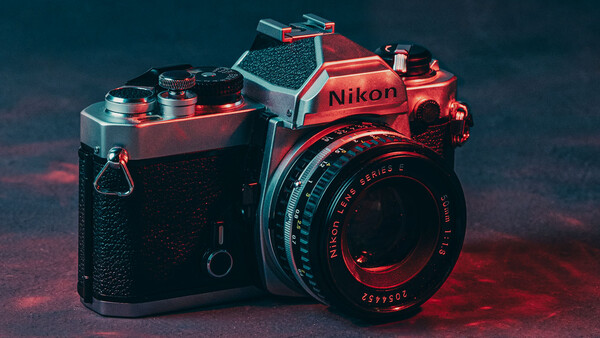
I learned photography on a Nikon EL2, which was made in the late 1970s, and I bought it secondhand. I put the film in and set the ISO. From there, I turned a dial to change the shutter speed and turned the aperture ring to change my depth of field. It was manual focus, so I turned the focus ring to get focus. Easy to grasp. Manually setting those three things became second nature in no time, so from there I didn’t need to think about the camera. I just concentrated on looking for interesting things to photograph and looking for great light. I was in control, and everything was about how to communicate an idea, share a story, and/or create beautiful art.
'The dark side is not stronger; it is quicker, easier, more seductive.'
Wise words from Master Yoda there, and he’s spot-on, because with digital photography today, there are too many quick hacks and easy ways to do things. We’ve become lazy.
Can’t focus properly and your photo is a little soft? Don’t worry about practicing focusing to improve—buy an app to fix it instead!
Photography should be hard. It should require effort to develop skills and years of practice and experimentation, from lighting setups to image editing. If we don’t need to learn anything or develop skills and let technology do it for us, what’s the point?
Also, the technology in all modern cameras does the same thing and gives everyone the same results. That’s why so many photos we see all look the same. We’re just sheep when we let technology do the work for us, stand at the same popular locations that everyone else does, and then apply the same trending color presets too.
For client work, having technology to help me improve my workflow can have its uses. But from a personal perspective, as someone who loves the craft of photography and enjoys the process of being in complete control of my creative vision and the process, I’m at the stage where I’ve dusted off my old film camera and loaded up some HP5+ like the good old days. The fun factor is huge.
There is an impressively large resurgence for an analog experience, and old film cameras that couldn’t be given away a few years ago are in high demand. Despite this, you can still find a perfectly good film camera and lens for less than $100—a great starting point to learn photography.
I encourage anyone new to photography to learn the craft, not the hacks.
You must commit to learn. “Do or do not, there is no try.”
You must believe in your intentions to create. You must have faith in your creative vision and expression. If not, “That is why you fail.”
We will all screw up often, but don’t fear it. “The greatest teacher, failure is.”
I bet you didn’t know Yoda was a photographer.
“Pass on what you have learned.” This is why I write these opinion pieces. Thanks for reading.



Join the Fstoppers community for free
-
Post comments and join in the discussions
-
Browse the site ad-free
-
Share your work and get featured in the community
-
Compete in the photo contests for fun and prizes
103 Comments
It's like someone in music who practices scales and arpeggios ad nauseum BUT can't improvise a single progression. Everything is sterile. Cold.
The danger of rote practice.Souless.
Then they get insanely furious when confronted with the facts.
Enjoyed reading this. I don't fully disagree but do think there is a larger context to consider and analogies that are false equivalents.
There has not only been a resurgence in film but a huge resurgence in point and shoot cameras or entry level ILCs. This not only helps companies remain competitive and innovate but ensures continued higher end models coming out for professionals like you or enthusiasts like me.
If the point and shoot, new film users, or others just want to put it on auto I see no problem. I do see a good proportion getting hooked into a hobby or maybe profession where they will get a little frustrated with the limitations of an auto mode which will necessitate learning about the importance of the physics of light. Once you need to concern yourself with light, you have no choice but to learn about ISO, Shutter Speed, Aperture, environmental conditions or supplementing with a flash or other sources. There's no way around it.
What you don't need to do to achieve this is first get an old film camera and learn that. Because the question is how far back are you going? Should we all have to learn Nicephor Niépce's heliographic process? Same goes for the car analogy and pilot.... Build our own airplanes like the wright brothers or those before? Or the car analogy? They all boil down to some basic science and engineering.
I agree that skipping leaning the basics will usually lead to failure, don't buy a A1II when you have only used a cellphone, don't fly an F22 until you've learned on something safer and in simulation, but you don't need to drive stick to drive auto.
It is also specific to your subject. For landscapes, family purposes, model shoots, product shoots, one could argue weddings, you can pickup a digital camera from the 2010s and take excellent photographs. Auto or manual. Only the most high level professional may get a little more out of Manual versus Auto for these.
For sports, wildlife, photojournalism, where action matters, shutter speed is crucial, you don't have time to compose, subjects are distant, you really have no choice but to use the current (3-5years) of cameras on the market and will not take decent photos without understanding the physics controlled by the shutter, aperture, and the effects of ISO.
With the caveat of understanding the physics of light and learning how to adjust in the camera, that the technology doesn't make it easier for many of us but allows us to spend more mental resources on taking even better photographs with creativity or being able to obtain moments never available before. I have images of falcons knocking out a bird in mid air then others of that falcon handing off the food to a juvenile mid air or two eagles talons locked together mid air while a fish is falling in the same shot. That wasn't feasible for me just a decade ago, and prior to digital photography and better autofocus was something reserved to only the highest level pros with unlimited film on week/month long shoots paid for by national geographic etc.... now it's taken for granted.
Justin wrote:
"I have images of falcons knocking out a bird in mid air then others of that falcon handing off the food to a juvenile mid air or two eagles talons locked together mid air while a fish is falling in the same shot. That wasn't feasible for me just a decade ago"
You are so right, Justin!
Before modern state-of-the-art autofocus, no one could get bursts of this type of erratic action framed tightly with each shot in the burst being in perfect focus. Photographers in the 1900s did not come away from these action sequences with hundreds of perfect images. They zone focused and hoped that a few of the frames would be sharp enough for publication. And even then, don't scrutinize the images too closely, because often the talons or a wing would be in sharper focus than the falcon's eye. Even the full page shots in National Graphic had technical shortcomings back in those days. They would be considered failed images by today's standards.