
When I was young and took my first driving lesson, the instructor explained to me what was happening with the gearbox and engine when I changed gear, and how what I did controlled the vehicle’s speed. I learned in a manual (stick shift) car. We all did back then in the UK.
I learned things like the importance of changing to a lower gear when going down a hill, to avoid using brakes. This gave me more control of the vehicle and therefore was safer too. Years later, automatic gearboxes became more popular and took away some of the effort required to drive. Jump forward to the present—cars are so full of technology they can drive themselves, and you don’t have to do much. We’ve got to the point where people have no idea what the car is actually doing and don’t know how to control it when they run into a problem. Photography went the same way.
Recently I acquired a collection of cameras and lenses, all from around 2012. A guy had collected them, became ill, and sadly died. His daughter sold them to me. I put them on Facebook Marketplace individually to sell and had hundreds of inquiries. I sold camera and kit lens combos for Canon, Sony, etc., for a very reasonable price. They were bought by people on a budget looking to get into photography.
The huge realization—from talking to so many people—was no one knew anything about photography, and they didn’t want to know. They just wanted to press the shutter and get a photo. I was asked by numerous people if I would teach them. Not teach them photography—just how to use the camera to get a result.
With modern cameras, you don’t need to understand the principles of photography. And this, I believe, is a huge problem for beginners. A camera with AI scene detection, smart exposure algorithms, subject tracking, and autofocus modes does the shooting for you.
Modern cameras are too complicated. I don’t use 90% of the technology in my cameras or even understand how it works. Do you? But I understand photography. I know what different shutter speeds and apertures can do for me. I know where to focus and how to focus for different situations. I’m in complete control, using my camera in manual mode, often with manual focus too. Everything I do with my camera is centered around my creativity. What if a beginner wants to intentionally shoot something in silhouette or use a motion blur technique? A beginner has no knowledge in order to be in control, so can’t improve his or her photography through creative experimentation, which is a huge disability.
The Solution
It’s pretty simple. Get an old film camera and learn how to use it.
If you want to become a pilot, you learn in a simple Cessna 172 Skyhawk, not a technologically laden Lockheed Martin F-35 Lightning II.
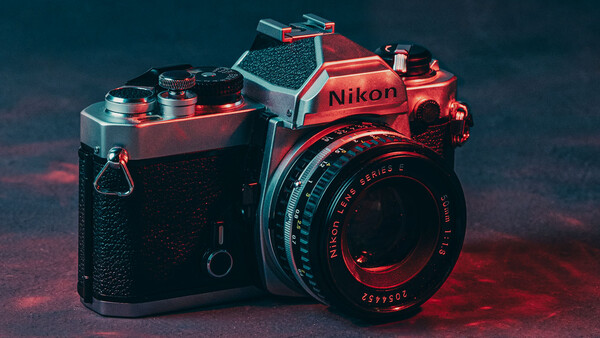
I learned photography on a Nikon EL2, which was made in the late 1970s, and I bought it secondhand. I put the film in and set the ISO. From there, I turned a dial to change the shutter speed and turned the aperture ring to change my depth of field. It was manual focus, so I turned the focus ring to get focus. Easy to grasp. Manually setting those three things became second nature in no time, so from there I didn’t need to think about the camera. I just concentrated on looking for interesting things to photograph and looking for great light. I was in control, and everything was about how to communicate an idea, share a story, and/or create beautiful art.
'The dark side is not stronger; it is quicker, easier, more seductive.'
Wise words from Master Yoda there, and he’s spot-on, because with digital photography today, there are too many quick hacks and easy ways to do things. We’ve become lazy.
Can’t focus properly and your photo is a little soft? Don’t worry about practicing focusing to improve—buy an app to fix it instead!
Photography should be hard. It should require effort to develop skills and years of practice and experimentation, from lighting setups to image editing. If we don’t need to learn anything or develop skills and let technology do it for us, what’s the point?
Also, the technology in all modern cameras does the same thing and gives everyone the same results. That’s why so many photos we see all look the same. We’re just sheep when we let technology do the work for us, stand at the same popular locations that everyone else does, and then apply the same trending color presets too.
For client work, having technology to help me improve my workflow can have its uses. But from a personal perspective, as someone who loves the craft of photography and enjoys the process of being in complete control of my creative vision and the process, I’m at the stage where I’ve dusted off my old film camera and loaded up some HP5+ like the good old days. The fun factor is huge.
There is an impressively large resurgence for an analog experience, and old film cameras that couldn’t be given away a few years ago are in high demand. Despite this, you can still find a perfectly good film camera and lens for less than $100—a great starting point to learn photography.
I encourage anyone new to photography to learn the craft, not the hacks.
You must commit to learn. “Do or do not, there is no try.”
You must believe in your intentions to create. You must have faith in your creative vision and expression. If not, “That is why you fail.”
We will all screw up often, but don’t fear it. “The greatest teacher, failure is.”
I bet you didn’t know Yoda was a photographer.
“Pass on what you have learned.” This is why I write these opinion pieces. Thanks for reading.

Join the Fstoppers community for free
-
Post comments and join in the discussions
-
Browse the site ad-free
-
Share your work and get featured in the community
-
Compete in the photo contests for fun and prizes
103 Comments
You don't have to understand horsepower by leaning to drive on a horse and cart.
Bothering to learn some skills, you'll find you "can do basic shit like focusing", without the help of autofocus and lots of computer-aided tech!
Actually, focusing isn't always basic. Do you understand hyper-focal distance and zone focusing? And can your camera do that for you? More importantly, are you happy not understanding what it's doing, and why, while it's creating your "art"?
I'm not saying you can't learn photography on a digital camera, but with a simple film camera, you only need to set your aperture and shutter speed, and focus. This allows you to concentrate on looking for great compositions, without the camera getting in the way to slow you down.
Yes, you can set a digital camera to manual, but all those buttons and dials, and menu options, confuse people. I've seen this first-hand dozens of times, hence my thoughts about staring with absolute basics and film camera.
"The less technical knowledge the better". Interesting concept.
I would argue understanding how different shutter speeds create different results in terms of sharpness and motion, and how different apertures can completely change the photo through depth of field, IS something you should bother to learn, as it will allow YOU to be in control of your art, and not a computer chip.
As for a boomer take. 1 - No need to try and be rude. 2 - I'm not a boomer. 👍
Off-subject here, but, I am a Boomer and I'm glad we had something which defined a generation, and had such a huge impact on the world. Think about all the societal changes that took place then... sex, drugs and rock and roll, for starters. If none of that was your idea of something good, appreciate that single women could not get a credit card of their own until the 1970s. We couldn't even wear blue jeans to school until I was a sophomore in highschool. And how many worldwide conflicts do we get involved with nowadays without comparing it to the potential quagmire of Vietnam. Boomers fought the war, and fought against the war and rigid establishment at home. Government transparency took on a new dimension in the 1960s and 70s because of Boomer's fierce determination for the right to know the truth. The nation took a collective gasp when we found out politicians were liars.
Sorry to disappoint Jon and others who feel like the title Boomer is an insult. I just smile when it happens, embrace it, knowing that every generation since the begining of time has thought their elders were idiots. I'm just now realizing that my parents were much wiser than I ever imagined. I only wish I had taken advantage of it while they were alive and shut up long enough to ask for their opinions.
I've never understood why someone younger saying "boomer" thinks they're being insulting to someone older. On the other side of the coin, I wonder if someone younger feels insulted when someone older calls them "entitled" or a "delicate snowflake"? 🤔
I doubt younger kids are so obsessed with names. I certainly wasn't at that age... too busy thinking about girls to care much about what anyone called me. Hippies was sort of deragatory, although other than my outward appearance of long hair, my lifestyle was fairly conservative. But, like Boomer, the label never bothered me. In the case of millennials, they'd have to be listening to older people in the first place (something they probably never do) to hear the word "entitled."
.
Simon wrote:
"I'm not saying you can't learn photography on a digital camera, but with a simple film camera, you only need to set your aperture and shutter speed, and focus. This allows you to concentrate on looking for great compositions, without the camera getting in the way to slow you down."
Simon, you seem to be oversimplifying just how difficult and complex focusing and setting exposure can be. Setting shutter speed, setting aperture, and focusing take far more than the 1.3 seconds that we usually have before the subject we just discovered dashes off. With digital, we don't even have to do those 3 things, so we actually have a wee bit of time to compose the image before the subject dashes off or turns its head away.
Simply needing to focus on my subject has cost me many thousands upon thousands of great images over the years.
And needing to adjust exposure settings has also cost me many, many great shots over the years.
For some of us, "getting the shot" isn't really our objective. I do not merely want to get "the" shot. I want to get ALL of the good shots that one can possibly get. That means when a bird flies erratically, and is flying by at super close range, I want to rip off a 12 frame per second burst and get every frame in perfect focus, on the bird's eye, not on some other part of its head, or on its breast or wing or feet. If the bird is flying at 30 miles per hour, and passes me at a distance of just 15 feet, well, there is no way that any human could ever shoot a 4 second long burst and get every one of the 48 frames perfectly focused on the bird's eye. But modern autofocus technology can.
Doing things manually does keep us from capturing every shot that could possibly be captured, and for some of us that is heartbreaking. There is limited satisfaction in coming away with an amazing shot ..... if I know that there were another 2 or 3 amazing frames that I didn't manage to capture.
To be completely honest, I do not enjoy the process of photography at all. But I enjoy the resultant images immensely. I "put up with" having to do the technical things, and understand the technical things, in order to be able to capture the images that bring me so much fulfillment.
You seem to approach photography from an entirely different mindset. You seem to enjoy the process of taking photos, perhaps even more than the results. You enjoy interacting with the camera. You enjoy thinking about the aperture and the dynamics of focusing, and the different ways the exposure triangle can be used to arrive at different results. All of that is interesting to you. Am I correct in assuming these things about you?
I do photography because I want the photos. The end result is everything to me, and the process is just a necessary evil that I honestly don't enjoy. You do photography because ..... you enjoy photography. So it is no surprise that you would emphasize interaction with the technical things about the craft, and not having them automated for you.
.
"Simply needing to focus on my subject has cost me many thousands upon thousands of great images over the years." May I suggest you try zone focusing. That makes all the difference when needing to capture a fleeting moment.
I don't believe I am over-simplifying focusing, and using shutter speeds and apertures. it's very simple to grasp, particularly when you're holding a basic mechanical camera with just a shutter speed dial, and an aperture and focus ring on the lens.
You say you don't enjoy the process of photography, so there lies your problem. If we don't enjoy something, and can't get excited about it, we tend not to learn and understand so easily.
My mindset? I enjoy looking for interesting things to capture, and stories to tell. I don't let a camera get in the way of it. The camera—and lenses I use—are tools that I am in complete control of, because I understand what they are doing, and why. Understanding a camera brings down a barrier between you and your intentions. Understanding the how (science), allows you to more easily focus on the why (art).
Some people love using a camera in full auto mode, some prefer manual. It doesn't matter at all, so long as you enjoy yourself and get the images you want.
Zone focusing? Ha!
I shoot most often at 600mm thru 800mm. And I often shoot wide open at f5.6 or 6.3, and I like to shoot TIGHT. Like often, if the eye of the animal is in focus like it should be, then the nose is soft. Or if the eye of a bird is in focus, then the wing is soft. Absolutely precise focus on the eye itself is of the utmost importance, and often depth of field is super thin, and the animals are moving. I have no idea how zone focus would allow me to get the eye in perfect focus when I shoot burst sequences of moving animals.
I think you do a very different kind of photography than I do. Either that or your expectations about how precise focus must be are different than mine. I am basically shooting moving subjects through a telescope where DOF is incredibly thin.
Do your subjects often give you several seconds to prepare for the shot? I mean, when you see something that interests you, and you want to create images of it, is it usually something that will still be there in 10 or 15 seconds? In a minute? In 5 minutes? If so, then I can understand why you feel the way you do about setting aperture and shutter speed manually, and focusing manually. If the things you desperately wanted to photograph were only "in place" for 0.5 seconds, or 1.2 seconds, or 2.7 seconds, you may feel quite differently than you do about doing things manually .... especially if you were wielding a huge heavy supertelephoto, depth of field were critically thin, and anything less than absolute focus perfection renders the shot a complete failure.
Ah, you shoot wildlife, you should have said. Auto-focus tracking is your friend 👍
I shoot with wider lenses and my subjects are close, and I need to capture that decisive moment instantly, so manual zone focusing works best for that. Auto-focus tracking rarely works well.
I used to shoot with very long lenses professionally, at show jumping events. In full manual mode. Auto-focus tracking didn't exist back then, so we had to learn some good old-fashioned skills to capture that horse in mid-jump in the precise position. 😎
You've moved on to talking manual versus auto. That was not the point of my article. Both have their place.
Interesting perspective, Tom. Not surprising though given your passion for wildlife. I'm a little surprised, however, to hear you say that you don't enjoy the process of photography at all. Makes me wonder why you bother with trying to make pictures, given that you enjoy birding for the sake of simply observing. Seems like it would be less stressful than managing a bunch of camera gear with great expectations for a perfect photograph.
Anyway, for sure, you and I are total opposites in that regard. You'll travel hundreds, or a thousand miles or more "hunting" wildlife to make a picture. I rarely leave home to make a picture anymore. For plants, flowers, and other forms of still-life photography, I take great pleasure in the process of finding a subject, arranging its position, combining it with secondary elements, lighting, determining focal point and depth-of-field, brightness/contrast, editing and printing. It can turn into hours or days making one photograph, so, yes, obviously there are differences in our approach which demand thought for camera settings. For you, the camera seems to be a necessary evil... one that you would gladly replace with something more technologically advanced if it eliminates decision points. For me, camera settings represent numerous individual creative decisions which combine to make the picture what it is.
Where you and I undoubtedly agree, is that the digital process is highly advantageous over film for getting from one step to the next. To the extent that every photographer, no matter how advanced, is forever in the learning stage, digital technology offers so many more options and features from which to achieve one's desired results. I got so frustrated with trying to excel at photography in the 1990s with a film camera that I gave up. I can't image someone trying to learn photography today with a modern camera, despite all its complexities, getting more frustrated than I was with a film camera (to the point of Simon's article). I could understand the basics of aperture and shutter speed (the basic principles are pretty easy to comprehend), but I could never put it all together for composing anything more than what we now call a snapshot. I did not have unlimited funds for experiments. However, digital cameras revived my interest and I could explore the creative side for no additional cost. In fact, I truly became addicted to photography at that point, which has continued to this day.
Wow, Ed ..... that book image is beautifully arranged!
I especially appreciate that the upper left corners of the pages are against a dark, detail-less part of the mid-ground. If they were overlapping a more illuminated or more detailed portion of that row of books, the image would not be nearly as pleasing as it is.
One thing causes me to wonder a bit ..... the candle, and the way the edges of it are aligned with the books behind it. The left side of the candle seems to be ever so slightly - about an eighth of an inch - off of the seam between the Portrait ... book and the City of Light book, and that looks good! The other side of the candle falls almost right on the seam between the Isabell book and the Historian book .... was that intentional, or would you have preferred that it be a bit more off of the seam, the way the left side is?
These are the types of tiny little details that drive me crazy with my wildlife photography, and after I get the images downloaded and view them on the big monitor, there are always wee little things that I wish were a bit different, and that kind of robs me of the joy I would otherwise experience with my photos of wild animals. If only they would stay put indefinitely, the way inanimate objects do!
Thank you, Tom. I hadn't given the placement of the candle relative to the seams of the books any thought at all. For sure, little details keep popping up that we wish we had done differently. If they become too big of a deal, the picture goes in the trash. Otherwise I forget about it and move on to the next project. And there's always a new project in the works. Thanks again for the comment.
Ed wrote:
"little details keep popping up that we wish we had done differently"
Oh yes, I relate to this so much! And I think this is why I am so obsessive about over-shooting a subject in those situations where a subject gives me a lot of time to work with it.
For example, I captured a rattlesnake last week, and on Saturday I took her out to do some sessions. I took her to 4 different areas with rocky habitat that looks like classic rattlesnake habitat. I would get her to calm down enough to stay still for a few moments, in a pleasing pose, and then shoot her from as many angles and positions as possible before she started to move. Then I would grab her and calm her down again, and she would end up in a slightly different position, and then I would shoot her again from as many positions as possible before she would once again start to move. I repeated this about a dozen times at each of the 4 locations we visited. At the end of the day I got home and downloaded the pics and found that I had 600 of them. And yet, I only liked about two dozen of those 600, and don't REALLY LOVE any of them.
There are a bunch of "good" photos, perhaps a couple dozen "very good" photos, but no "great" photos that I am really satisfied with.
Why?
Because of all the tiny little aspects of composition that pop up without me even realizing it, as I am shooting. I do not see all of these tiny things until I get home and download the photos and have a chance to scrutinize them on a nice big high resolution monitor.
What would have elevated a picture to something you would have really loved? If I can put my finger on what I'm trying to improve upon, I can maybe see it better when the next opportunity comes around. Not always obvious nor easy to do though.
I like the way its head is framed by the shadow to make it stand out. You wouldn't get me within 50 feet of her.
Ed wrote:
"What would have elevated a picture to something you would have really loved?"
At least two elements ...... really dramatic scenery in the surroundings/background, that could almost stand alone as a strong landscape/scenic image, as well as the snake being in a dramatic and most aesthetically pleasing pose. Also, a snake with a bit punchier more contrasty color than this one (although Northern Pacific Rattlesnakes with much better color than this are extremely uncommon).
Admittedly, I was up against the limits of my optics, as the 100mm macro I was using just doesn't capture a wide enough slice of the surroundings to get the kind of image I would've liked.
However, even if I had been using a more capable lens, the areas where I took the snake aren't really dramatic or beautiful enough to have been able to give me the look I wanted. I mean I can find a small patch within the habitat that looks good, but the broader view in any of the 4 areas I shot her at just isn't cool looking or dramatic or distraction-free enough. I really need to spend more time driving further from home to try to find areas that are dramatic and pristine enough for the type of snake images I want to make.
Some snake photographers create stunning images with wide angle macro lenses, but they spend tons of time scouting locations all through the year so that when snake season arrives they already know exactly where to take the snakes for photo sessions. And they also know how to use artificial lighting really well and set up multiple strobes, the way a fashion photographer would on a set. Using technology like that is way over my head, but I sure do love the results those folks get.
Ed wrote:
"I'm a little surprised, however, to hear you say that you don't enjoy the process of photography at all. Makes me wonder why you bother with trying to make pictures, given that you enjoy birding for the sake of simply observing."
I bother trying to take pictures because I love the results! Or at least I love the results that I am forever chasing, even if most of them never become reality. Every once in a great while I will manage to create a photo that almost entirely pleases me, and I will love that photo so much that I just stare at it for sevearal minutes at a time, over and over and over, for years. The desire to get another image of that caliber is what keeps me going, what fuels the inner fire.
I actually love 90% of the entire process of wildlife photography. I love seeing photos of a species of mammal or bird or herp and then thinking, "that is so cool looking! I want to photograph them". And so then I Google the species, or search for their hashtag on Instagram, to see more photos of them, and to see what part of the country they live in. Then I contact people who are familiar with that species - other wildlife photographers, or university professors in the wildlife biology sector who have based their career on studying that species. Then I start researching what time of year is best for that animal's peak appearance and behavior. Then I start to research the region in which the species lives, to learn about the logistics of a trip there, where affordable lodging is, how to access the habitat, where to eat out and where to buy groceries, how to drive around that area in a way that avoids tolls, etc. Then I do more research to learn about other species in that area that are at their photographable peak at the same time of year.
Then eventually I go to the area for a week or three or four and set out to find the animal(s) and photograph it/them. I love searching the habitat for the target species, getting out and searching afoot, driving around and searching from roadsides with binoculars ..... whatever it takes. And I love finding the target species and thinking about which types of images will be possible and strategizing about how to get into position for those photos that are developing in my mind's eye. Then when I finally manage to get into close enough range and in a good enough position, I love to position myself in ways that line the animal up with the background that looks the best, look for ways to incorporate foreground elements into the composition, etc.
So I love all the research and seareching. I love the process of conceiving images in my mind's eye and then doing what it takes in real life to make those images happen. And once I am there with a subject right in front of me, I love composing the scene by moving about and seeing how different alignments and camera positions result in different aesthetics.
BUT ..... I do NOT like needing to interact with the camera. Of course I know how to do that. I know my gear intimately and know exactly what every little change in setting is going to do to the final image. But I do not like having to make those setting adjustments, because it takes time and thought power away from the subject interaction, and away from the process of composition. And focusing is a nightmare because depth of field is SO DAMN THIN and I am SO DAMN PICKY about the eye itself being the very sharpest part of the entire subject. Hence the part of wildlife photography I do not enjoy at all is the part that involves the camera, because the camera does have limitations and I need to waste a precious second or three of my time trying to offset those limitations. I wish the damn camera would just see the scene the way I envision it, and not need me to do things to it to get it to see it that way. I wish the camera could just do its job, without needing me to help it do its job. That way, I would be completely free to do my job of finding subjects, envisioning images, and positioning the camera, and composing the scene. If I could do those 4 things, and the camera could do focusing, depth of field, and exposure, then we would be good. But the camera can not do those things without my assistance, and therein lies the problem.
Jon the Baptist wrote:
"When the camera can do basic shit like focusing automatically, the user only needs to think about composition and lighting. It lets them experiment more and be creative."
I very much agree, Jon.
For me, "real photography" is more about the art of image-making than the science of image-making. That technical stuff is not "crucial to being an artist". Rather, it is stuff that gets in the way of visual creativity because it requires one's attention and focus, one's time, and one's brain power ...... which leaves a bit less of those resources to go into camera positioning, subject engagement, compositional dynamics, etc.
The mundane, non-creative things, like getting the subject in focus and getting a workable exposure, are things that are better left to the camera to figure out. Yes, of course I can do them, but doing so does take away from my ability to create the images I want to create, because my subjects are wild and often uncooperative, and I often only get a second or two to do everything before the shutter is pressed. If I spend a half second focusing on my subject, and a full second adjusting the settings that affect exposure, then I am not able to align my subject up with various background elements to see how it looks this way and that way, because my subject is only going to hold still for a fleeting moment and then the opportunity to photograph it is gone forever. In fact, I may not get any frames off at all if I need to take a half-second or three quarters of a second to adjust a setting. Let the camera do the mindless stuff so that I am free to make the important decisions. And yes, focus and exposure are indeed mindless, and are NOT creative choices ....... or at least for 99% of the types of photography I want to do, it is this way.
Been using my reconditioned Nikon FE for the last 35 years. With me all the time.
Reading this makes happy 🙂
Mostly when I'm using my digital camera I'm in manual mode everything. I don't let it think for me. After using manual focus lenses I learned and different focus then the camera. I love my Canon EOS 90D it's a upgrade from my 80D. I focus on composition, watching my background, and getting eye level with my shots. The rule of 3rd and rain drops. It a art for me not just photography 😞
I'm not sure I agree with using learning to drive a car as an analogy for learning photography. One is a creative art form, the other is a modern convenience to get you from A to B. I don't know the ins and out of how a microwave, or washing machine works, but I know enough to warm up food and clean my clothes.
Photography is different. It is a creative outlet. Okay, some people want to point, shoot, and share memories with something better than their phone. Leaving the camera in auto is fine for this (although I'd argue a modern smartphone is more than capable). If they want to get creative and learn more about photography, then they have a great tool to do so. There's nothing wrong with starting with automatic and then learning manual. There's no rule to say you should learn the basics first.
As a musician, I'd rather teach someone who wanted to learn the guitar a handful of chords that they can then play numerous songs with than start by teaching them rudiments and theory. That's no fun, and there's no immediate gratification. Get them interested first, and the theory can come later.
Yes, and there's nothing wrong with that. But if you want to create a fabulous image, not understanding what the camera is doing and how to control it, will mean you may get one by luck. But certainly not by intention or design. That's the difference so many people aren't quite grasping.
From the day's of the Kodak Brownie there were myriad camera users who had little to no interest in learning the fundamentals of photography and just wanted to take pictures in an effortless manner.
"Today", there are still many of those types, but now they own highly sophisticated camera's, yet they still want to use them like a Point & Shoot, so instead of being inspired to learn more, they keep demanding more "AUTO" settings, so they don't have to strain themselves by thinking.
And there's absolutely nothing wrong with that.
"You Press the Button, We Do the Rest" was an advertising slogan coined by George Eastman, the founder of Kodak, in 1888. Photography has been dumbing down ever since! But that has also enabled it. If Eastman (and others) hadn't harnessed the mass market there wouldn't have been the revenue to invest in R&D to make better emulsions. A century later film was basically idiot proof by comparison.
Bottom line: If you think using late 20th century film and cameras is "real" photography you need to "man up" and go back another 100 years to learn the craft! Just kidding :)
Here's one I prepared earlier. A scan of a whole-plate silver gelatine glass negative. I cut and cleaned the glass myself. I made the silver gelatine emulsion myself from raw ingredients. I exposed it in a 1900's camera that I had restored myself.
My wet-plate and my silver-gelatine phases were wonderful experiences and I learned a lot but I now do tend to shoot with shop bought film or sometimes digital.
Photography has and always will be an enigma. I'm pretty certain that it is 99% vanity mirror. The first thing people did was photograph themselves or their trophy families. This was quickly followed by "look where I've been" photographs and the "look what a great photographer I am" photographs - like I'm doing here - pure puffery :)
I really enjoy this image. It has such a very long curve that makes it glow.
There is a very short statement from John Lennon that was recorded on the classic White Album..." I ve got blisters on my fingers "...
You're deluding yourself if you think a desire for one-click results is somehow new or related to digital tech. It isn't. Hence the existence of every point-n-shoot, disposable and Polaroid film camera ever sold. Very few people want or need to understand the exposure triangle. They just want to capture snaphots of daily events and move on with their life. If someone is truly motivated to learn the art and science of photography, they can read a few basic books that have remained relevant for decades.
I am quite aware of people's desire to just click and get a result, without learning and understanding what they are doing. There is nothing wrong with that. My point is without an understanding and ability to control a camera, we limit ourselves and our creativity. Thanks for the comment.
el Jefe wrote:
"If someone is truly motivated to learn the art and science of photography, they can read a few basic books that have remained relevant for decades."
You recommend books for someone who has a passion for both the art of photography and the science of photography.
What do you recommend for someone who has an immense love for the art of photography, but absolutely zero interest in the science of photography?
Two in my collection:
The Art of the Photograph
Art Wolfe
Photographically Speaking
David duChemin
As Bob Marley said a while back, "if the cap fits, wear it." In my case the 'boomer' cap clearly fits and I wear it proudly. Having made that confession, I think many of what seem to be disagreements here are differences as to the medium not so much the mechanics, I freely admit that film presents a number of hurdles that can seem insurmountable. I personally enjoyed my time shooting film and was lucky enough live in photogenic places and capture some of it on film, My favorite camera was (and it still up the rankings) is the Rolliecord IV my dad left me. A 6x6 Kodachrome image is hard to beat.
To make a good image, I argue, requires a basic understanding of what is going with the process. One needs a good grasp of the exposure triangle, what each leg does and how to manipulate them to achieve the desired result. Then one needs to understand who to operate to camera to carry out their vision. Modern introductory digital cameras follow the Eastman directive incredibly well. They make it so easy, in many cases they seem to steer new photographers to use P mode or to select one of the plentifful "scene" modes If that satisfies their itch, wonderful. But it's not what i think of when I say photography.
That requires substituting M mode for P. High end MILC cameras can make that quite tedious. I can't count the number of new Z8 and Z9 owners I've encountered that looked the menu systems, the programmable buttons and panicked. That's unfortunate. If they give up they'll never have experiences such as we've enjoyed. I'm certainly not suggest every one switch to film. I still enjoy using it from time to time. From I read I think most are cool with that. For a long time I deeply wished I could buy a digital back for my SRT. I still do.
Fabulous comment!
Great column. I understand the debate in the comments but the essence of your essay is understanding the basics of ISO, shutter speed and aperture allows creativity. My first slr a Mamiya with 50 mm lens. Setting aperture and shutter speed with max of 1/500 became routine. Now have a Sony 6100 that makes manual simple again. It is the difference between a snap shot and a photography, A social media instagram image sharer and a photographer.
Thanks for sharing your insight and experiences.
For me, the "process", is the creative process. I'm interested in sharing my ideas and observations through photographs. So the thought process is how can I best express an idea or tell a story. How can I make the best of the light available, and compose the scene in front of me in an aesthetically pleasing way. This is what I teach, or preach.
I have very little interest in the technology and science behind photography. I would teach someone about how depth of field can improve a composition, and how shutter speed is essential for getting a sharp image or blurred image. And a few basic focusing tips. That's it. I quickly move on to the intention and creative expression of photography. Mood, feeling, communication objectives—these are the things that matter with great photography, whether documenting or producing fine art.
If you have a passion for creating something because you have something to say, then the process of getting to the final photo should be enjoyable. Well, in my opinion, anyway. So that's what I teach—to enjoy the process. And the importance of controlling every aspect of that process. From lens choice, to doing your own color grading and not buying someone else's color presets.
Curiosity is an essential ingredient for gaining all knowledge, but I've never known anyone who learned to be curious. Seems like people who naturally ask "why," from even a young age, become more accomplished musicians, woodworkers, or whatever craft they choose to devote their life to. You raise an interesting point, though. Remaining curious over any length of time is sort of like remaining motivated or inspired to keep challenging ourselves... and that can come and go.
I think Simon is right... I think we have to have some degree of passion about the process of what we make, whether it's a picture or a line of code in a piece of software. Something which blurs the line between work and play. A sincere and strong desire to learn and succeed, no matter the task, will produce great things. I just don't think you can teach motivation, other than encourage someone to find a job or hobby that really excites them.
My first SLR, a totally Manual Minolta SRT-102 necessitated attending a local Photography class, in order to use it, later, upgrading to an XD-11 offered both Aperture or Shutter priority, and I relied on Aperture priority up through my not to distant DSLR days.
Currently, with my EOS R5, though I take advantage of many of it's Auto functions, what I favor most about a MILCH camera is the ability to use "M" Manual Mode with far more assurance, and control, due to seeing what the sensor can capture, along with a real-time Histogram.
A few months back, a friend had acquired a NIKON FM2 film camera, and aware of my film days experience, asked me to check it out. With a Minolta it would have been a breeze, but with the NIKON, it took Google, and some time on my hands, to comprehend it's baffling (to me) lens setup configuration.
The histogram is one piece of relatively new technology that I love. I have my camera in manual mode, and the ability to see the histogram through the viewfinder to make sure highlights aren't being clipped, is fantastic. I can't trust the camera to figure out the perfect exposure in auto mode, but the histogram never lies.
Thanks for commenting!
Good time to say thank-you to Simon for another thought-provoking article. You're my favorite Fstoppers writer. With so many comments in return, you find a way to engage readers, and people have responded with great opinions generally free from insults. We don't always agree, but that's probably the best part. I get another perspective. I wrote once initially thinking it would be my one and only comment, but then I think of something else to say nearly every time another comment gets posted. Great work, Simon... just don't tell those beginners to go buy a film camera. :-) Just tell them their camera is like a TV remote... 99% is useless, and all they need to find are a few critical buttons like where to change the channel.
Haha, thank you Ed, appreciate the kind words and all your valuable insights and input around the topic. 🙂
Brilliant piece. Thanks. Best regards from Nigeria.
"The importance of changing to a lower gear when going down a hill, to avoid using brakes."
If you are braking with your engine then you are braking with your engine's valves. They are important, buried inside your engine, and terrifically expensive to repair or replace. Brake pads, on the other hand, are made to do exactly the job of braking, are extremely easy to access, and are inexpensive to replace. Unless you are guiding a giant truck down a hill so long that your brakes may overheat, just use the equipment that was expressly designed to slow down your vehicle. There is no world in which NOT using the brake - to brake - gives you "more control of the vehicle" and "is safer."
Yeah, I agree .... it is a bad practice to downshift and have the car in gear as a way to slow one's descent. Doing so transfers wear and tear from the brakes to the drivetrain. When something goes wrong with any part of the drivetrain, I usually cannot afford to have it repaired, so I then have to have the car scrapped and buy another car, which is horrible compared to just replacing brake pads once every year or two.
Good to know.
Agreed, brake shoes are way cheaper and easier to replace than engine valves.
Using the engine to control downhill speed applies to heavy trucks, when sustained braking can cause the brakes to overheat and fail.
Is the camera taking the photo or is the photographer. I think most people who profess to want a 'good' camera really want better photos but with the ease of their phone's camera. You can have all creative intention in the world but until you understand at a basic level what the camera is doing you can't necessarily share your intention. For those that really want to learn photography it's an incredibly rewarding journey.
.
Art Meripol asked:
"Is the camera taking the photo or is the photographer?"
The answer, of course, is "both".
The photographer is taking the photo through the camera (and lens), and thus is subject to both the limitations and capabilities of the camera (and lens).
.
Went out for a walk around the neighborhood this evening, Tom. Brought my camera thinking there might be some flower pictures in the community garden, but the deer kept asking for their picture to be taken....
What a nice surprise for you, Ed!
I especially like how the two deer are aligned, relative to one another, in the first image.
It's been almost 9 months since I've photographed a Colorado Mule Deer, and I miss them.
The camera takes the photograph; the photographer makes the photograph.