
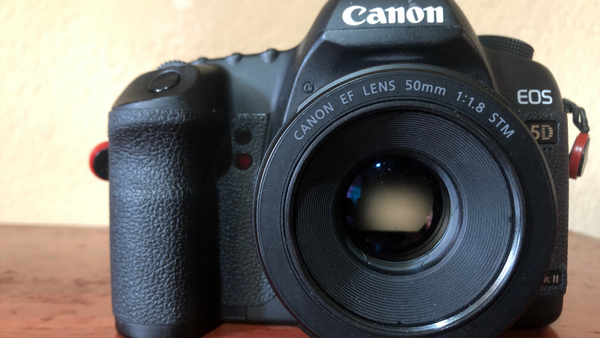
There are cameras people buy because they are new, and cameras people keep because they matter.
I think the Canon 5D belongs to the second category. Long after mirrorless systems took over conversations, long after spec sheets became the dominant language of photography, the 5D series continues to occupy a strangely untouchable space. Not merely respected. Not simply remembered. Mythologized. And perhaps that is the real story, because the Canon 5D was never just a camera. It was a permission slip.
The Camera That Changed the Rules
When Canon released the original 5D in 2005, photography looked very different. Full-frame sensors were still largely reserved for professionals with serious budgets and highly specialized needs. Digital photography was progressing fast, but there remained a visible divide between professional tools and cameras considered accessible.
Then came the 5D Classic. It did not arrive screaming technological revolution. It looked conservative, almost understated. But beneath that modest shell was something radical: a relatively affordable full frame DSLR capable of producing files with a look photographers immediately recognized as different.
The 12.8-megapixel sensor of the 5D Classic was not remarkable by today's numerical standards, of course. Yet numbers rarely explain why certain cameras become legendary. The files had depth, like film depth, in some way. Skin tones felt natural. Shadows rolled softly. Images carried a certain looseness and organic quality that many photographers still struggle to describe with technical precision.
It is not a mystery why the 5D Classic quickly became a reference point for portrait photographers, wedding photographers, documentary shooters, and travel photographers. It was robust without being intimidating. Professional without appearing exclusive. It democratized a visual language. For many photographers, the first encounter with full-frame photography came through this camera, and first loves tend to leave permanent marks.
Then Came the Mark II
If the 5D Classic opened the door, the Canon 5D Mark II kicked it off its hinges. Released in 2008, the Mark II entered photography history with almost accidental force. Its 21-megapixel sensor represented a major leap, but what truly disrupted the industry was something Canon itself probably did not fully anticipate: video.
The 5D Mark II became a filmmaking revolution disguised as a still camera. Independent filmmakers, documentary creators, journalists, and experimental visual storytellers suddenly gained access to cinematic depth of field without Hollywood budgets. Entire careers emerged from that possibility.
But even for photographers who never pressed the movie-record button, the Mark II became something else entirely: a workhorse. Reliable. Solid. Honest. Not perfect, certainly. Autofocus limitations existed. High-speed performance was not its strongest territory. But photographers rarely fall in love with perfect cameras, also because there are no perfect cameras. Photographers fall in love with cameras that show up.
And the 5D Mark II showed up everywhere: weddings, war zones, editorial assignments, street photography, fashion shoots, newsrooms. For an entire generation, it became less a model and more a default language.
My Own 5D Story Began Late
I bought my Canon 5D Mark II in 2024. Late, perhaps, according to contemporary photographic logic. By then the industry had already declared mirrorless superiority. Endless online conversations insisted older DSLRs belonged to the past.
I bought one anyway. Not out of nostalgia, and not to perform some retro-photography ritual. I bought it because certain cameras continue making sense long after the market stops advertising them, and because I need a reliable companion for assignments.
Within months, that camera became tied to one of the most meaningful chapters of my photographic life. With that 5D Mark II, I began working for L'Équipe. This alone would have made the camera unforgettable, but the connection deepened further. Using that same camera, I obtained my first cover with an international magazine.
That matters. A milestone in my career. I made it, of course, but I made it with the Canon 5D Mark II, a camera that is used to make international magazines.
Photographers often pretend cameras are irrelevant, that only vision counts. There is truth in that statement, but not the entire truth. Certain tools become witnesses. They accompany moments of transformation. The 5D Mark II became that for me, not because it magically created photographs, but because it was there when photography stopped being merely personal and became professional in a new and concrete way. That changes the emotional geometry between photographer and machine.
The Strange Second Life of the 5D
Most digital cameras disappear quietly. Their life cycle follows a predictable pattern: launch, excitement, replacement, obsolescence. The 5D series somehow ignored that script. Today, something unexpected is happening: the cameras are returning, not as museum pieces, but as active tools.
Spend time on YouTube and you notice it immediately. There are photographers deliberately seeking out the original 5D and early 5D bodies with genuine enthusiasm. Recently, I watched a creator travel to Japan with a very specific mission: buy a Canon 5D Classic paired with the humble 40mm pancake lens. That story says more than any technical review. Nobody travels across the world to purchase obsolete technology. They travel to reconnect with an experience.
And that is precisely what the 5D still offers. In an age increasingly dominated by algorithmic sharpness, computational perfection, and cameras that sometimes feel closer to computers than companions, the 5D represents something tactile and direct: a camera that asks for involvement, a camera that still feels mechanical enough to be trusted.
Why the Myth Endures
The mythology surrounding the Canon 5D series is not based on irrational nostalgia. It survives because the cameras delivered results in the real world. Photographers built careers with them. Books were made with them. Assignments were completed with them. Families were documented with them. History passed through them.
And unlike many cameras celebrated purely for specifications, the 5D earned emotional credibility through repeated use. That is a rarer achievement. Perhaps this explains why conversations about the 5D often sound less like gear discussions and more like stories. People rarely say, "I owned one." They say, "I still have mine." The difference matters.
Because legends are not necessarily the most advanced tools. They are the ones people refuse to forget. And nearly two decades after the first model appeared, the Canon 5D series still refuses to leave photography behind. Or perhaps photography refuses to leave it behind.


Join the Fstoppers community for free
-
Post comments and join in the discussions
-
Browse the site ad-free
-
Share your work and get featured in the community
-
Compete in the photo contests for fun and prizes
18 Comments
Interesting article, I started my career in the film era, I climbed the ladder with the 8008s, F4s and F5 before moving to medium format. The Mamiya 645, Pentax 67II and finally the RZ ProII produced beautiful images and then came digital. I think that I owned a couple 1D Series bodies then the 1Ds, 1DsII, 1DsIII then the 1Dx before I got tired of carrying the kit through airports. In '17 I bought my first "new" bodies with two 5DVI's and never looked back. I specialize in Food and Lifestyle images and the R Series doesn't really appeal to me, I work on a tripod for 90% of my shoots and I'm invested in those L Series lenses.
Thank you, Tony for this comment sharing your experience. Wow, you did have a lot of cameras and so nice to read you still trust in your DSLR cameras.
Blast from the past! As a young man, I made quite a bit of money with my 8008 and a handful of lenses. I still have it, somewhere. Thanks for the memory! (I also owned the RZ67 ProII — what a coincidence).
Thanks to you, for sharing here. So good when some piece "makes us earn money" too!
I’m kinda the same about Nikon DSLRs. I learned photography in high school in the 90s on a Nikon F2, went through various film cameras, and then got into Pentax DSLRs because I wanted IBIS with the relatively affordable back catalog of K-mount lenses. Photography was a hobby for me, so I switched to Olympus M43 in 2013 to reduce the size & weight of my kit. When I made photography my occupation in 2022, at first I expanded my M43 kit, but I found myself wanting to use older glass with a full frame sensor so I bought a Nikon D810. I was so blown away with how much I enjoyed the SLR optical viewfinder and felt the resulting images were much improved that I ended up with a huge amount of Nikon full frame gear. That D810 has been sold but I now have a D5, D850, D780, and a Z6 III for my video body. I continue To prefer my SLR OVFs for shooting stills, but the Z6 III is admittedly a much better video camera. My dream is if someone made a DSLR with a fixed pellicle mirror like the Canon EOS 1n RT with modern mirrorless guts so I could shoot video with an OVF but I doubt that’ll happen. Sony used pellicle mirrors in their SLT models but those had EVFs. Oh well.
I think camera manufacturers should listen more the final users, photographers I mean. Because the trend on sales is going down more and more. The easiness of use is highly underrated. The mirrorless cameras can be a good solution but I would suggest to make them more photographic and less computational, otherwise smartphones win.
I owned the 5D, bought when it first arrived. What a great camera, my second DSLR after the 10D, it was a tank that made great images. I'm not particularly kind to my equipment as a nature photographer and it survived all the abuse. The only issue I really had was that the thing was a dust magnet, not matter what I did, the sensor would not stay clean and with no self cleaning mechanism it required a lot of attention [yes, I could have been kinder and i'm sure I was a small part of the problem]. I still curse a bit when I need to use one of the files from that camera because it needs so much dust removal. I finally had to sell it after a pin broke in the card slot and upgrading to 50megapixels. The 5Ds is truly a photographer's camera. it may not be a high speed sports machine or have all the video settings in the world, what it does have is 50.3mp of glorious resolution. When I've worn this one out, I'll likely look for a simple replacement of another 5Ds especially since I have a good set of EF L series lenses.
I have never been an equipment collector. The camera was simply a tool, a means to an end. My experience with the Canon 5D series helps me to understand why it is such a great system. The 5D Mk III performs beautifully over a wide range of assignments, and I could not be more well pleased. The 5D is not a myth though. It is reality.
All over the years I changed several ecosistems so I am not a loyal brand collector. Everytime I given priority to easy of use. I can see that as a constant when I am looking for a camera, not even depending if a new camera on the market. Since several years I am purchasing in the second hand market.
And that is me coming from a film background, and I still use a large format 4x5 camera for most of my landscape photography as long as I can drive to the destination. Shipping large format back and forth, and dealing with TSA and film is just too much to deal with. The Canon 5D MkIII solves most of those problems for me. And, in answer to an earlier statement here, the auto focus system on the 5D Mk III is lightning fast. The fly in the ointment is that a darkroom produced 16x20 or 20x24 still has an aura that cannot be duplicated by an inkjet print - yet. I am certain that will change in the future, and I hope so. Darkroom paper has gone up in price so much that it has become untenable with Fiber Based 16x20 Ilford Classic paper at $10.00 per sheet. Wish I had bought a couple of pallets of it when it was $1.50 a sheet, and that was only two or three years ago.
I owned both the original 5D and 5D II and really enjoyed them. But...they shared an AF system that was accurate, but not very quick. I eventually moved on to a mirrorless system with a much better AF system. But the IQ from both of those cams was excellent.
David, I understand what you mean: for sure the AF on the 5D Mark II is certainly not fast by today's standards, and I can see why someone would eventually move to mirrorless for that reason.
But I also wonder if we've become a little too accustomed to photographic systems that are too much, I mean... surgically precise. Modern autofocus and computational photography have made it possible to produce technically perfect images with remarkable consistency, but technical perfection isn't the kind of image I want. In fact, part of what I enjoy about the 5D Mark II is precisely that it doesn't always give me that clinical level of precision. I like a certain softness and imperfection in an image. Sometimes even the limitations of the camera, including the way the AF behaves, become part of the aesthetic rather than simply being flaws to eliminate.
With that said, I am not affirming that older AF systems were better. But I think that a camera that leaves a little more room for uncertainty can sometimes produce images that feel more human. That's me and depending on what I want top produce, not pretending others share my idea.
For me and the subjects I shoot, well, I want sharp. So I moved on. But it's nice to have choices, no?
Fair enough. To anyone their own thing. Yes, I think is great to have choices. I think is fantastic that despite the digital and super-tech era, even the AI era there are still a lot of photographers, including the youunger generations, shooting film.
Though the 5D and 5D Mark II had consumer grade AF systems, the 5D Mark III and 5D Mark IV had pro-level AF systems. Though the firmware was slightly more limited, the 5D Mark III and the 1D X shared the same PDAF array part number. The 5D Mark IV and 1D X Mark II also shared the same PDAF array. It's no coincidence that the 5D Mark III was released at the same time the 1Ds Mark III was discontinued. While Canon claimed in 2012 the FF 1Ds and APS-H 1D series were "united" in the 18 MP 1D X, in truth the 22 MP 5D Mark III was the continuation of the 21 MP 1Ds Mark III line without the integrated grip and larger battery.
I'm still shooting with a 5D Mark IV as my primary body and a 5F Mark III as a second body at times. I also use a 7D Mark II with my 70-200/2.8 when more pixel density/reach is needed.
Most of the advantages of MILCs are most helpful for those who haven't already mastered getting the shot even with more limited AF and metering systems found in DSLRs.
Yes, you are right. Indeed we can consider the DSLR a bridge between the analog and digital world while the mirrorless cameras are a bridge between DSLR and computational photography.