
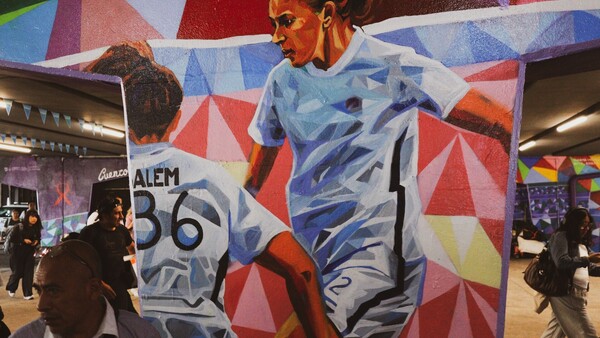
There is a particular kind of expectation that follows you when you say you are in a country hosting a World Cup. It is not always spoken out loud, but it sits there in the background of conversations, in messages, in assumptions that come almost automatically, as if geography alone were enough to place you inside the flow of the event.
You are here, therefore you are inside it.
It sounds logical until you actually walk through the city.
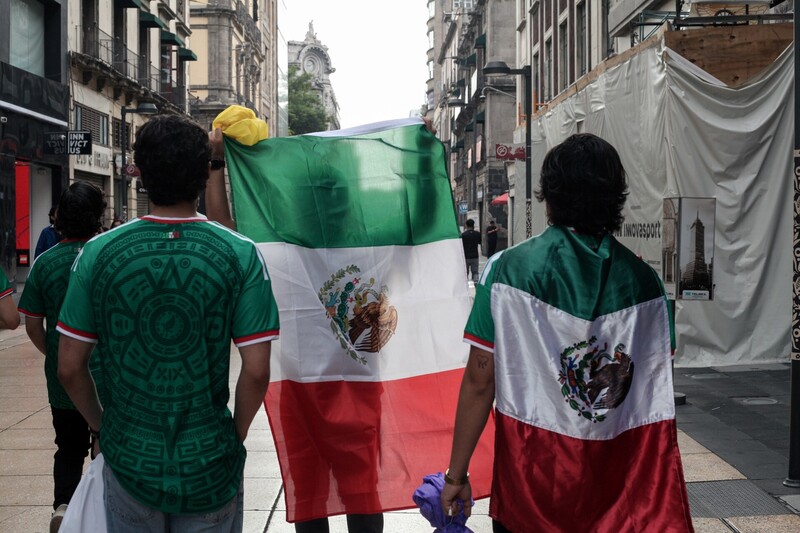
I am in Mexico City while the tournament unfolds, and yet most of the matches are happening elsewhere, across the border, in the United States, where the scale, the infrastructure, and the official center of gravity of this World Cup have clearly been established. Mexico and Canada exist in this structure, of course, but in a way that feels almost peripheral, like fragments of a larger machine that is running somewhere else and only occasionally reaches here through signals, screens, and passing references.
What remains on this side is something quieter than expected.
Not absent, not completely detached, but diluted in a way that is difficult to explain without sounding like you are describing something that should have been different. And I am not interested in that kind of narrative. I am not interested in disappointment or in comparing what is here with what I imagined might be here. It feels more honest to simply observe what is actually in front of me, even when it resists the shape of what I thought I would find.
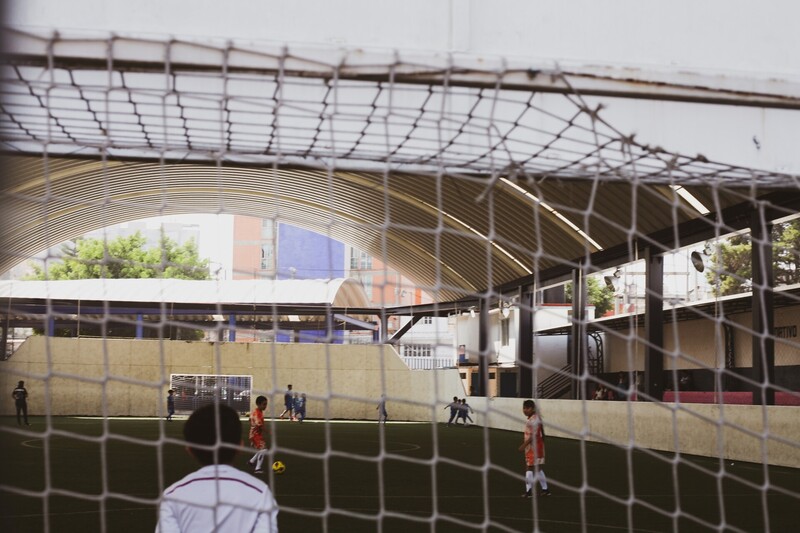
So I go out with my camera without any real intention of "covering" the World Cup.
That idea belongs to another system, another rhythm of photography, one that I know well enough through my past work with L'Équipe, through recent publications in L'Équipe and France Football, and even through the unexpected visibility of a cover image. Those things exist in my professional life, but they do not automatically translate into access, nor do they define what I am doing now.
I just walk the city.
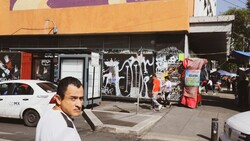
Not toward the stadiums, not toward fan zones, not toward the spaces that are supposed to concentrate the energy of the event, but through the ordinary texture of the city itself, where life continues with its own inertia, indifferent to the fact that somewhere else teams are playing matches that define headlines and schedules.
At first, there is a subtle expectation that something will reveal itself.
A sense that if you are attentive enough, if you stay outside long enough, the World Cup will eventually appear in fragments large enough to be photographed in a way that feels connected to the scale of what is happening. But that expectation slowly dissolves, not because nothing is there, but because what is there does not insist on being seen as part of anything larger. I do not feel connected.
There are moments, of course. These are traces, but they are not a scene in the way one might expect from a global tournament.
And then there are long stretches where nothing suggests that anything unusual is taking place at all.
The city continues as it always does, with its density, its noise, its unpredictability, but not with the thematic clarity that people tend to associate with a World Cup. There is no single atmosphere that can be pointed to. No dominant mood. Just layers of everyday life that occasionally intersect with the event in ways that feel incidental rather than structural. The FIFA Fan Festival, for its part, is a closed space. It sits in the main square, fenced off, with entry permitted only through security. That choice bothers me, and I say that as someone who loves football. A square that belongs to everyone has been converted, for the length of the tournament, into a controlled venue with a perimeter.
In this space, I notice something about my own way of working that becomes more evident the longer I am out there.
I do not move toward what is supposed to matter in the context of the event. Even when I recognize it, even when I know exactly where other photographers would go, I find myself drawn away from it, toward smaller situations, quieter interactions, moments that have no relationship to the official narrative of the tournament. Because my mantra is still the same: where the photographers go, I need to go somewhere else.
Often this is not a decision that I make consciously. It feels more like a direction that appears only after I am already walking.
And because of that, the World Cup becomes something I pass through rather than something I enter.
Not as a subject, not as a framework, but as a background condition that exists without fully organizing my attention.
There is a kind of freedom in that, but also a kind of distance that is not entirely about location. It is about how attention works when it refuses to align with expectation. About what happens when you are surrounded by a global event and still find yourself unable to orient your camera toward its center.
Over time, this creates a different understanding of presence.
The World Cup is not something that fills the city in a uniform way. It appears in pockets, in interruptions, in small collisions between everyday life and global spectacle. It does not replace the city. It sits inside it unevenly, sometimes visible, often not.
And I find myself working inside that unevenness.
Not documenting the tournament as an event with a beginning and an end, but observing how little of it actually becomes part of the space I am moving through.
There is no conclusion to this. No resolution. No moment where everything aligns and the image becomes clear in the way people sometimes expect from event photography.
Only the ongoing act of walking, looking, and noticing what remains when the idea of being "inside" something turns out to be more complicated than the assumption that started it.
Join the Fstoppers community for free
-
Post comments and join in the discussions
-
Browse the site ad-free
-
Share your work and get featured in the community
-
Compete in the photo contests for fun and prizes
4 Comments
Not being a follower of football I had no idea this was how the cup was being played. It’s hard to find a word for it that doesn’t sound negative so I suppose I’ll settle for disingenuous?
However, I love your photographs. Of course I haven’t/wasn’t there, so I don’t have a reference point for whether the colours are authentic but they feel ‘grounded’ rather than enhanced, appealing without being oversaturated 👏
My point of view can appear bitter. The point is that I was not able to make it as I expected. I am perfectly aware that is personal. I can see other colleagues were able to do their work. I question always myself and I tend to make analysis and over thnking and that often becomes an opportunity to write. In this World Cup I have developed a negative opinion of where they have moved the game of football. I happened to read an article yesterday by a sociologist that makes me think I'm not the only one who thinks this way. Football is a popular sport, not a place where you sip champagne, as we have seen this time. And football is not a four-half sport as seen with the hydration break, but they need to make that to satisfy the US audience. I am against that. Who knows about football is aware that is a sport where the flow is very important and if you stop the flow, well, it becomes another kind of sport.
It doesn’t come across bitter to me. To me it just read as reporting the facts.
I’ve known people state the refreshment breaks to be a safety thing, but to me as someone primarily employed in safety advising, doing it at a cooler time of day or year would have made more sense. Removing the risk rather than just reducing it.
Absolutely, Ed. And I am glad you get it. We are seeing some colleagues in sport photography as me didn't obtain accreditation for the FIFA 2026 matches and they started to photograph the matched directly on the TV screen, in particular a french photographers started that. And she became viral. Everyone metabolizes an exclusion in a different way. I am serene because before FIFA 26 I worked on assignment for a sport magazine and obtained important achievements. In this period I found even more myself by dedicating more time to my personal photography and I feel myself great for the things I realized this period.