
One of the arguments I hear most often against street photography has very little to do with photography itself.
"If you're going to photograph someone, why not just talk to them?"
Sometimes it comes from photographers who have never been interested in candid work. Sometimes it comes from people who are uncomfortable with the idea of photographing strangers in public at all. Sometimes the conversation drifts toward privacy, ethics, or consent, as if every photograph made in a public space begins with the assumption that someone has been wronged.
I've never found those arguments particularly convincing, but not for the reasons people usually expect.
I enjoy talking to people. I've met fascinating strangers because of photography. Some have become friends. Others have shared stories I still remember years later. And I do talk to many of the people I photograph, both as a photojournalist and as a portrait photographer.
The problem is that, once the conversation begins, I'm no longer looking for the same photograph.
Much of human communication never passes through words. We read each other through posture, movement, hesitation, distance, rhythm, and the countless small signals we exchange without noticing. Walk through any city and you'll see people acknowledging one another, avoiding one another, waiting, drifting, sharing the same space without ever speaking. That silent choreography is endlessly fascinating to me.
That's what I go out to photograph.
People often imagine candid street photographers as if they were hiding behind corners with long lenses, trying not to be seen. Part of that is the fault of many street photographers, particularly online, pushing the idea that a street photographer needs to be a ninja. My experience has almost nothing in common with that image. I'm usually standing in plain sight with a normal lens or a moderately wide one. People can see me. Sometimes they look at me for a second. Most of the time they simply continue with whatever they were already doing, because I'm not asking anything from them. In any case, I am not hiding my presence.
There is a difference between being present and becoming part of the event.
The moment I decide to stop someone, introduce myself, or ask for permission, the nature of the photograph changes. It doesn't necessarily become worse. It doesn't become less honest. It simply becomes something else. The picture is now about an interaction that includes me. My presence is no longer incidental. It has become one of the forces shaping the scene.
As a street photographer, that's not what I'm searching for.
I'm interested in the brief moments that belong entirely to the people living them. These moments don't exist because of me. If anything, my responsibility is to avoid interrupting them.
This is why I have never understood the idea that speaking to someone first is somehow a more authentic way of practicing photography. It may be more comfortable for some photographers. It may produce wonderful portraits. It may lead to unforgettable conversations.
But it leads somewhere else. I can be interested in that, but I am aware it will not be street photography. It will not be candid. It will be another thing entirely: a portrait, not a street photograph.
Photography is full of different paths, and I have no interest in deciding which one others should follow. I only know why I keep following mine. The photographs that have stayed with me over the years all have one thing in common. They happened before anyone felt the need to perform, explain themselves, or acknowledge the camera.
That fragile state disappears surprisingly quickly. Once it's gone, there is no technique capable of bringing it back.
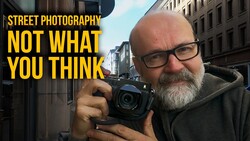
Recently, I decided to put these ideas into a free video masterclass on YouTube, not because I think I've found the only way to photograph the street, but because this question comes up again and again. Rather than answering it in a few sentences, I wanted to show exactly what I mean while walking through the city with a camera in my hands.
For me, street photography has never been about avoiding people.
It's about allowing life to remain itself for just long enough to become a photograph.
Join the Fstoppers community for free
-
Post comments and join in the discussions
-
Browse the site ad-free
-
Share your work and get featured in the community
-
Compete in the photo contests for fun and prizes
2 Comments
Call it street portrait photography.
No, because the photography I do is not asking for permission most of the time. To be present doesn't mean you are asking before to make a photograph.