A fisheye zoom is one of those tools that can either sit untouched for years or quietly become the reason your images look nothing like everyone else’s. The question isn’t whether distortion is “good,” it’s whether you can control it when the shot has real constraints like space, speed, and framing.
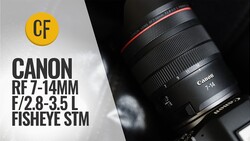
Coming to you from Gordon Laing, this methodical video breaks down what the Canon RF 7-14mm f/2.8-3.5 L Fisheye STM actually does across its range, and why “7-14mm” does not behave like a normal ultra-wide zoom. At 7mm on full frame, it’s not a typical edge-to-edge rectangle at all, it’s a full circular fisheye with black around the image circle. As you zoom, the circle grows until it turns into a diagonal fisheye that fills the frame, and then it tightens a bit more toward 14mm. Laing also puts real numbers and visuals to the field-of-view jump versus the older Canon EF 8-15mm f/4L Fisheye USM, so you’re not guessing whether the newer lens is meaningfully wider. If you’ve ever bought a specialty lens based on one dramatic sample image and regretted it later, this approach saves you from that mistake.
The video also makes you think about who this lens is really for, and it’s not just “people who like weird curves.” On an APS-C body, you lose the fully circular look, but you still get a diagonal fisheye once you’re in the safer part of the range, and Laing shows why that matters when you want a consistent result. There’s a limiter switch that can lock the lens to avoid the focal lengths where dark corners can creep in on crop sensors, which is more practical than it sounds when you’re shooting quickly. On full frame, that same limiter can lock the lens at 7mm so the circle stays a circle, even if the zoom ring gets bumped during a fast-moving shoot. This is the kind of detail that decides whether a lens feels usable in the field or feels like a fragile studio toy.
Where things get more interesting is how the lens behaves for video and how much of the “circular” promise depends on the camera mode. With standard 16:9 capture, the frame is cropped vertically, so the full circle can’t fit top to bottom. Pair it with a body that can record open-gate video, and you can capture the full sensor height and keep the circular look in motion, which is a very different creative tool than a cropped fisheye clip. Laing demonstrates this using the Canon EOS R6 Mark III, and the difference is immediate once you see the circle stop getting chopped. He also walks through the built-in drop-in filter setup and why a variable ND or circular polarizer is more than a nice-to-have on a lens that invites sky and reflections into nearly every frame. If you’ve only used front filters, this design changes how you plan a shoot, especially when you’re trying to hold a specific shutter speed.
You also get some early performance clues without the video turning into a lab report. Laing checks sharpness at both ends of the zoom and notes how little changes as you stop down, which may be exactly what you want from a lens you’ll use in unpredictable situations. He looks at sunstars and flare control by pointing straight into the sun and stepping through apertures, then shows how quickly the autofocus snaps between near and far subjects. There’s a blunt reality check about the hood too: it can vignette hard at shorter focal lengths, but you need it mounted to use the protective cap, so you’ll be taking it on and off depending on how you’re shooting. He also lays out the real alternatives, including the manual-focus Laowa 8-15mm f/2.8 FF Zoom Fisheye Lens (Canon RF) and the “skip fisheye entirely” route with rectilinear options like the Canon RF 10-20mm F4 L IS STM, Canon RF 14-35mm F4 L IS USM, and Canon RF 15-35mm F2.8 L IS USM, plus small primes like the Canon RF 16mm F2.8 STM and the Canon RF 14mm f/1.4 L VCM that launched alongside the fisheye. Check out the video above for the full rundown from Laing.


Join the Fstoppers community for free
-
Post comments and join in the discussions
-
Browse the site ad-free
-
Share your work and get featured in the community
-
Compete in the photo contests for fun and prizes
No comments yet