
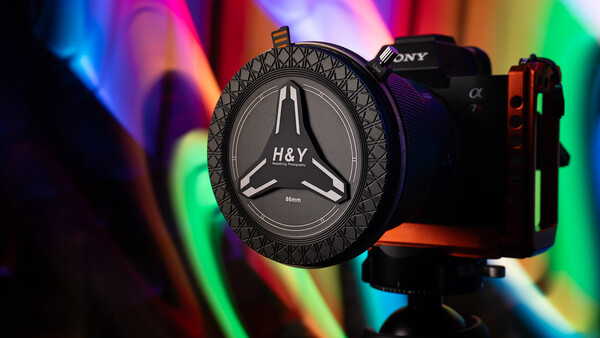
If you’re a photographer, admit it: there was something about variable ND filters that most of us hated. This new filter line from H&Y aims to fix exactly that.
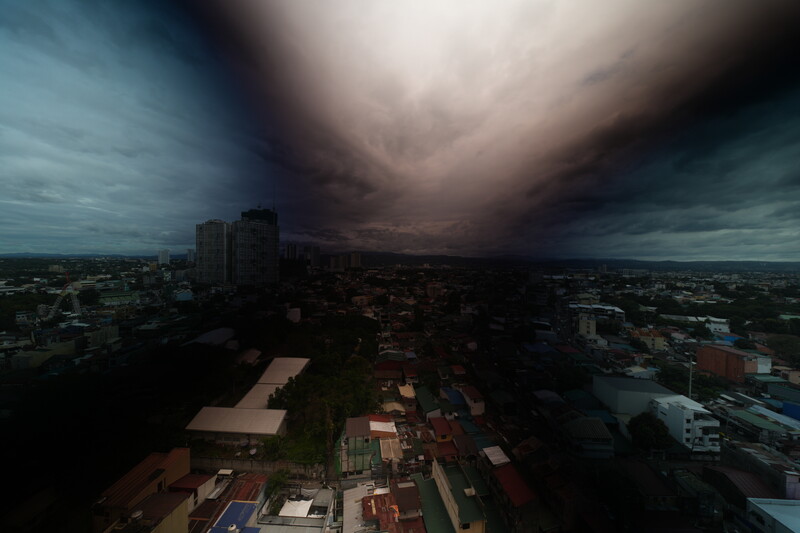
Variable ND filters were developed and have become popular because they let you adjust the effect without having to remove and replace filters. At the same time, because of how they are made, they also double as circular polarizers. However, when the need arises to go beyond a certain degree of the effect, an optical flaw can appear that can lead to ruined images if it isn’t immediately noticed. This is often called the “X artifact” or “cross polarization,” and it’s when an X mark fills the frame from corner to corner as a result of how variable ND filters work.
How Variable ND Filters Work
Variable NDs can be adjusted with more precise control because they are made by stacking two circular polarizers on top of each other. The combined effect of the polarizers also combines their light-reduction effect, which effectively leads to less light reaching the sensor. However, when using a CPL on wide lenses, there is a certain direction where a diagonal dark band can appear, and this is commonly referred to as over-polarization (though it’s technically not exactly that). In the same way, when the two polarizers are used as a variable ND on a wide lens, the glass layers can reach this same point, which results in two intersecting bands that form an “X.”
The appearance of this artifact depends on the focal length being used and the number of stops on the VND. The artifact becomes more apparent when using a wider focal length and when the filter goes beyond 5 or 6 stops. This is not an absolute constant, but commonly the limit for a 16mm lens is 6 stops, 7 stops for a 24mm, and 5 stops for a 12mm. Commonly, focal lengths past 35mm aren’t affected by a maxed-out variable ND.
The H&Y Nova VND + CPL
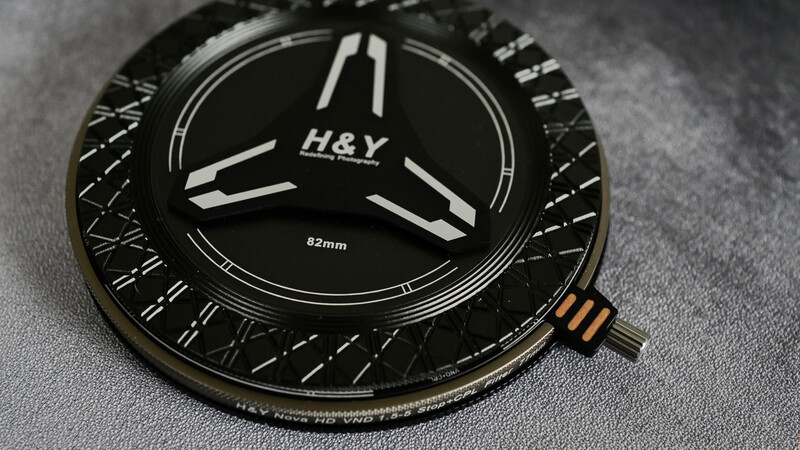
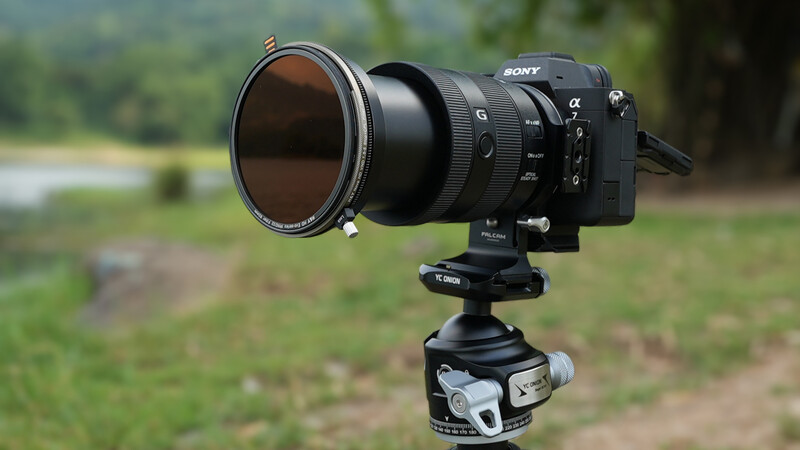
This new filter comes in a form that is distinct compared to other circular filters in the market. Behind the filter is a fixed-size screw-in thread that has to be matched with the lens’ diameter or adapted with a step-up ring. It is connected to a metal frame that houses the glass elements of the filter. When the metal frame is rotated, it controls the entire assembly, which results in the CPL’s effect being adjusted. This layer can be locked using a pin that applies friction to the frame, which prevents adjustment of the filter when the user wants to avoid unintentionally rotating the polarizer.
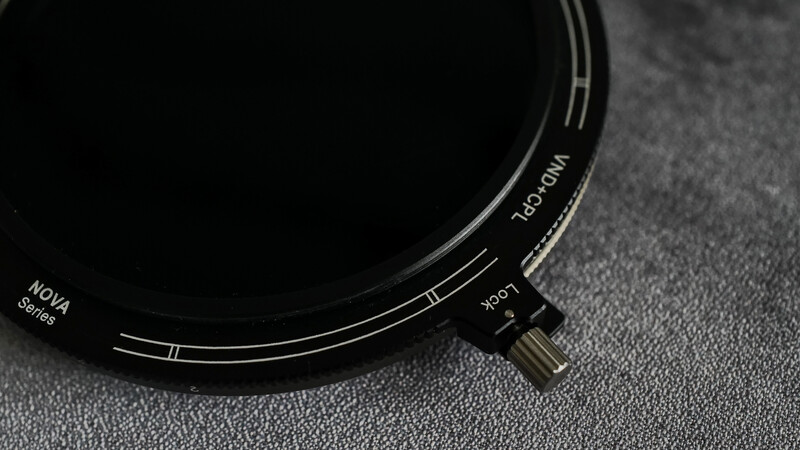
In front of this is a tab that controls the front layer of glass. Adjusting this controls the effect of the variable ND filter, which ranges from 1 to 5 stops of light reduction. The front surface of the filter is noticeably larger than the filter thread because it is intended to prevent cross polarization artifacts.
How It Solves the Problem
There are two ways, based on how the filter was made, that help it avoid going beyond the level that works. First, the variable ND is limited to 5 stops, compared to others that can go up to 10 stops. While it may seem like a limitation, it can be considered more of a safety measure to avoid mistakes. Going beyond 5 stops can be achieved by conveniently using magnetic filters on top of the VND.

The other way the X artifact is avoided is that the filter was made to be oversized compared to the lens itself. When the thread is a certain filter size, the actual filter is basically one size up. If the lens and the thread are 67 mm, the actual size of the filter is 72 mm. If the lens is 82 mm, the actual size of the filter is 86 mm. This is so that, if the banding appears, it covers more surface area of the lens and the image circle so the effect is less likely to cut across the frame in a distracting way. While this is not absolutely guaranteed, it is a practical way to reduce the chances of getting the unintended effect.

Stacking Options and Compatibility
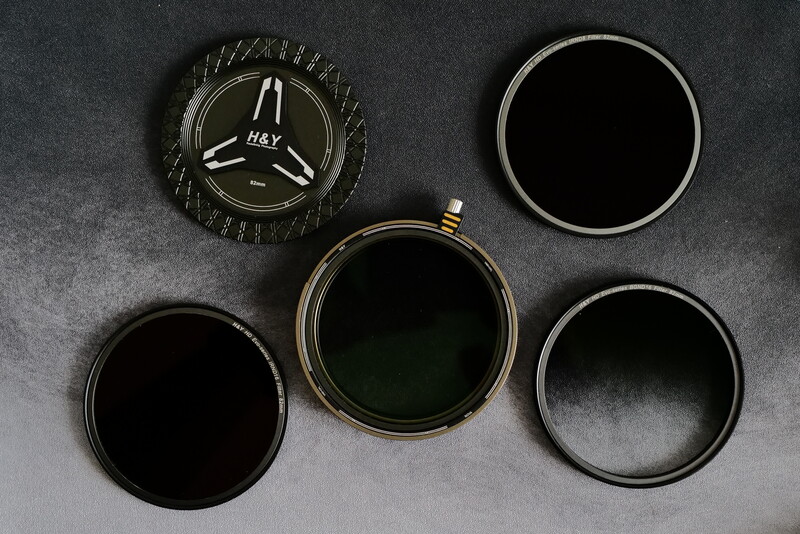
On the front layer of the filter is a magnetic rim that is compatible with various magnetic attachments. Out of the box, the filter comes with a magnetic lens cap that comes in the size of the oversized filter. Aside from that, the H&Y Nova Series VND + CPL Filter can be used with H&Y EVO-Series circular filters that are the same size as the front magnetic rim (one size up from the lens thread).

Using this magnetic rim, the user can magnetically attach additional filters for additive effects. When combined with an ND32 (a 5-stop ND filter), the setup becomes a 6.5-to-10-stop variable ND. Other options that can be used are 3 stops (ND8), 4 stops (ND16), 6 stops (ND64), or 10 stops (ND1000). Aside from heavier ND filters, the EVO-Series also comes with compatible effects filters such as white mist, black mist, streak, and cross. For landscape photography, the VND and magnetic ND filters can be used with a 4-stop circular GND that is also available.
Application
Because of the design of the filter and its magnetic compatibility with add-on filters, the usability of this variable ND filter has expanded. With a 1.5-to-5-stop variable ND and CPL, the singular Nova filter can already be very useful for shooting portraits and video in daytime situations that are not extremely bright.

With the addition of magnetic ND filters, the VND can be topped up for brighter situations or to achieve a darker combined effect. Because of this, the VND also becomes usable for landscape photography, especially since many landscape scenarios require the use of wide angle lenses. The EVO circular GND can also be used as a third layer if the focal length is not so wide that it catches the edges of the filters’ frames. On the other hand, the magnetic attachment can also be used for effects filters such as white mist, black mist, streak, or cross filters that are also available in the H&Y EVO lineup.

If you want a structured refresher on fundamentals that will make this kind of filter workflow easier to apply in the field, Photography 101 is a solid baseline. For landscape-specific use (where filtration decisions and post work intersect), Photographing the World: Landscape Photography and Post-Processing pairs well with a variable ND workflow.
This allows the user to quickly mount effects filters and remove them as necessary without having to unscrew anything when the Nova filter is the base. Overall, as long as there is enough light to be filtered, this variable ND and its magnetic add-on filters can be used to create whatever image the photographer envisions.

What I Liked
- Unique design lessens probability of cross polarization
- Magnetic add-on filters for combined effects
- Color-neutral glass
What Can Be Improved
- Mounting options could be improved by using stronger magnetic adapter rings instead of fixed rear threads, so one filter can be used across multiple lens sizes






Join the Fstoppers community for free
-
Post comments and join in the discussions
-
Browse the site ad-free
-
Share your work and get featured in the community
-
Compete in the photo contests for fun and prizes
No comments yet