Medium format on a budget is tempting, but the real question is whether it changes how you work or just slows you down. This video puts you on a cold shoreline where the light refuses to cooperate, and you get to see what happens when you commit to a slower setup anyway.
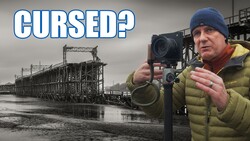
Coming to you from Jason Friend Photography, this grounded video starts at Roa Pier in Sunderland with a sunrise plan that immediately looks shaky. Friend arrives expecting color and ends up thinking in monochrome before the camera is even fully settled. You see the practical side of choosing a location that is interesting but not peaceful, with noise, movement, and no guarantee the sky will play along. The gear choice is deliberate: a big tripod, a heavy body, and older lenses that remove the safety net of modern automation. If you tend to chase perfect conditions, the setup here pushes you to make decisions with whatever shows up.
Friend brings back a camera he previously owned and swore off, the Fujifilm GFX 50S, and he is blunt about why it makes sense now: used prices have shifted and the body can be found around $1,500. He contrasts that with what he uses when walking farther, the Fujifilm GFX100RF, and you can feel the tradeoff between speed and ritual. The core experiment is adapting film-era medium format glass onto the digital body, which forces manual focus and removes electronic hand-holding. He mounts a Mamiya 105-210mm zoom lens from a Mamiya 645 Super and talks through a simple fear most people avoid admitting: the frame might not fill the way you imagined, so you may need a panoramic approach instead of pretending it is fine.
The shooting details are where the video gets quietly useful without turning into a lecture. Friend relies on focus peaking and checks exposure as the light shifts, and you watch him correct a first attempt that runs long and gets away from him. He adds a 6-stop ND filter to smooth the water, then has to rethink timing because the scene brightens faster than expected. He keeps calling the camera slow and clunky, but he treats that as a feature when the goal is careful framing, not speed. The adapter cost comes up too, which is the part people leave out when they say “cheap lens,” and it changes the math if you are building a small kit from scratch. Later, he swaps to a Mamiya 50mm shift lens and deals with rogue waves while trying to keep lines straight, which turns “nice idea” into “move now” in seconds.
The last section changes the feel again, and it is worth watching because it is not just more of the same. Friend breaks his black-and-white rhythm and aims for color with a lighter look, then second-guesses it after seeing the result. There is also a small moment that says a lot about field discipline: he notices something in the frame and physically removes it instead of assuming it will be fixed later in editing software. He closes with an honest note about sharpness and why “not clinically sharp” can still be the right choice when the image has a specific feel. Check out the video above for the full rundown from Friend.



Join the Fstoppers community for free
-
Post comments and join in the discussions
-
Browse the site ad-free
-
Share your work and get featured in the community
-
Compete in the photo contests for fun and prizes
5 Comments
I would LOVE to use medium format gear, if only there were super telephoto lenses that would fit natively on the MF cameras. I mean if there was a MF lens that gave exactly the same angle of view that my Sigma 60-600mm gives, I would love shooting with such a setup.
I think MF is a really great choice for so many kinds of photography, but for wildlife at 500mm, 600mm, and 800mm it just isn't there yet. And due to cost and weight and other practicalities, it sadly may never be a viable option for really long telephoto work.
Oh god, I hated using that camera.
Rented it a few times to see if MF was a good fit, and frankly it's not for most people. GFX 50s is the only camera I've ever used that would crash when shooting to card, tether would drop constantly, aperture control would be lost in C1 when changing lenses without a reboot of the camera. Also, only camera system I've ever used where the exposure at f/8 across lenses didn't result in the same exposure... Some lenses are darker than others, and lenses like the 32-64mm would have an 800k color shift from wide to telephoto..
It just sucked to use.
Yeah, it's 50MP, but a D850/Z7/Z8/Z9 that can shoot at ISO 64, negates any sensor benefit of a 50MP GFX at ISO 100.
I used to own a GFX 100s mk1. The problem with that camera was like you said the occasional firmware stability which I can deal with but the real big issue is that it would over heat while taking photos and just shut down mid shoot. Granted it was a summer day but none of my other cameras have ever done that while just shooting photos and i can't be standing around with a camera that won't work mid shoot. Luckily I always carry a full frame back up but I bought a MF camera for a reason and if I can't use it then what's the point of having it. It Makes sense if it overheats while shooting video but during photos is just crazy.
I ended up selling it and buying a Nikon Zf which I like very much. That said the image quality out of the 100s is bonkers. Those 16 bit raw file almost can't be broken. If only it didn't over heat I'd still be using it. I also kept seeing a lot of user reports of people having a litany of issues with it. I decided to cut my losses while I still could. I've had several Fuji cameras and as much i liked them all of them had firmware issue that would cause them to freeze up during shooting. You'd have to remove the battery to get the camera to turn off and reboot.
20 years ago there were tangible benefits to real medium format 645 and 6x7 film over 35mm film and any digital cameras available at the time. Today, I can't find any reason to use digital MF. 50 and 60mp 24x36mm sensors offer all the resolution necessary and surpass scans of most old 645 film. Fuji GFX isn't really even "medium" format. It's a cropped sensor that's only half the frame area of true 645. You might eek out a bit more dynamic range and bit depth with MF sensors, but it isn't visible in print.
I had a 100s. There are still reason to own MF. Namely resolution for those that need the MOST resolution but a big one that is usually glossed over is the insane level of editing latitude you can get out of 16bit medium format files. The 16bit raws are super forgiving. You almost can't break them. I've shot in some crazy situations that would have my full frame cameras struggling and the 100's files would just come out super clean. Over exposed/under exposed images were never an issue. Pushing shadows in images never produced ridiculous amounts of color noise rendering the image unusable either. i had to put effort into getting unusable images. Now If you don't do much editing then I would very much agree with your statement. Out side of editing there really isn't much reason to go medium format.