
Street photography is about decisions, not perfection. That’s the difference between a picture and a moment that stays alive.
The street doesn’t give you time to adjust your settings, fix your framing, or wait for better light. It gives you a fraction of a second and asks one simple question: are you ready to choose?
Every strong street photograph starts with a decision. To stop. To move. To react. To trust your instinct.
Miss that moment and it’s gone forever.
The Photograph
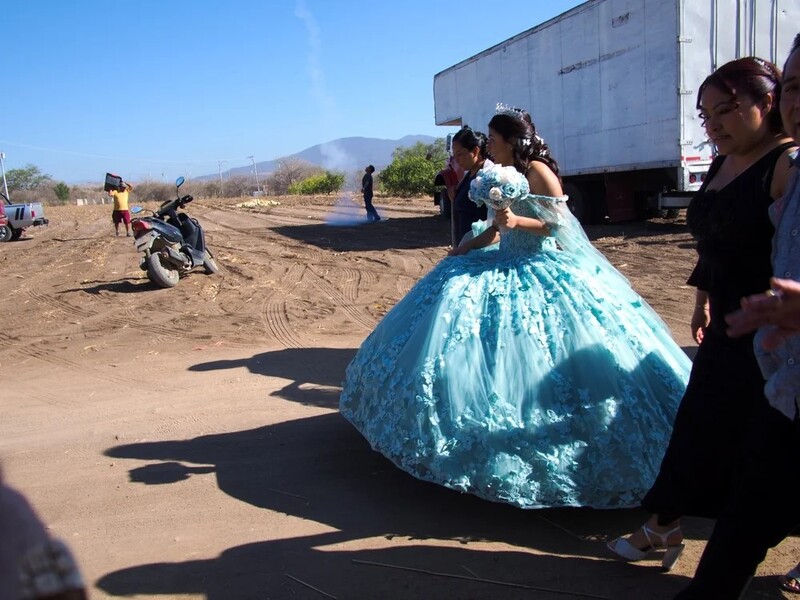
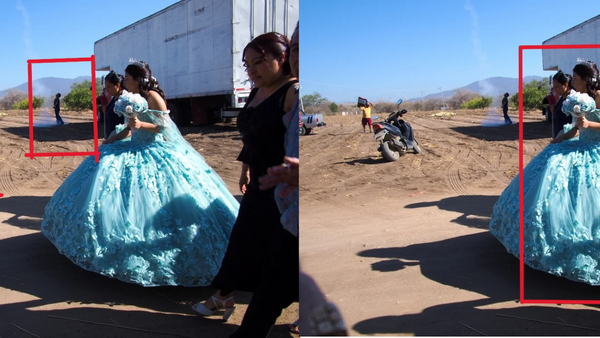
San Martín Tilcajete is a small village outside the city of Oaxaca. I was in a taxi when I took this photograph, and the taxi moved fast on that dusty, bumpy road. But I immediately recognized the potential of the scene. I knew I had to take a chance, even though it was difficult—difficult to control everything, and difficult to frame it like that, shooting from the window of a moving taxi. I had to use all my previsualization skills and shoot at exactly the right moment. Click. Boom. The awareness of having the photo.
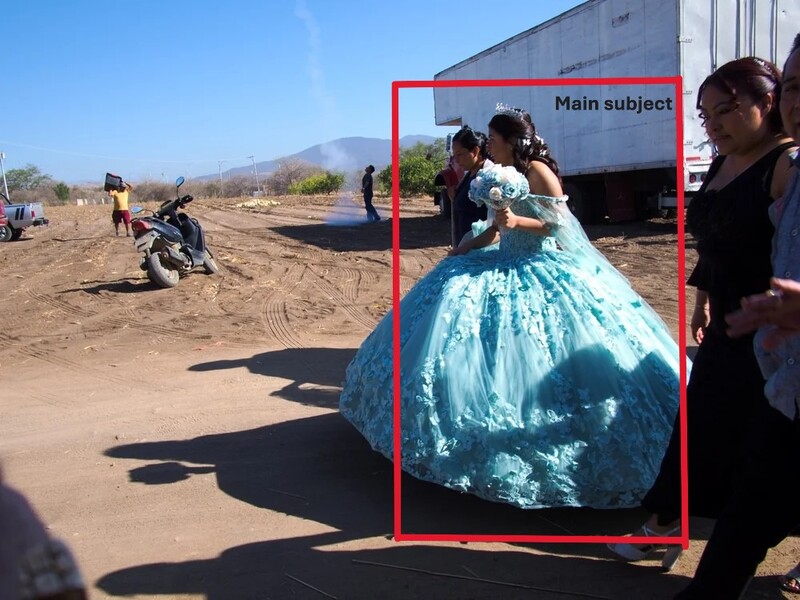
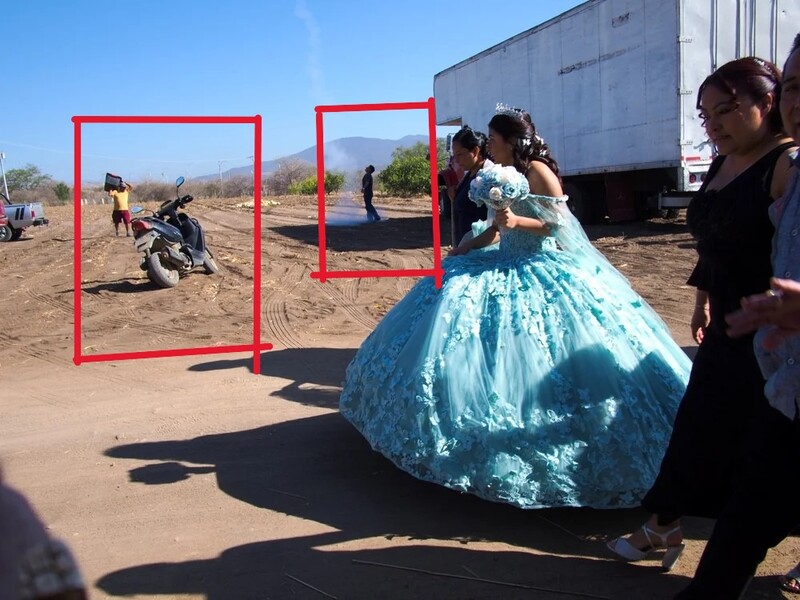
The girl in the party dress crossing the countryside. The surreal contrast. The shadows entering the frame, emphasizing three-dimensionality. The sense of depth of the truck. The scenes behind it are other photographic moments—interesting ones that could be isolated and appreciated individually.
Garry Winogrand said, “Every photograph is a battle of form versus content. The good ones are on the border of failure.” I totally agree with this idea, and I’m not limiting it to street photography, but photography in general—at least the kind of photography I am interested in proposing. If we accept that form is composition, framing, and the technical aspects of a photograph, and content is what is actually happening inside the frame, we can understand how having a good street photograph is very hard.
Stop Thinking About Perfection
This photograph is pretty far from perfect. Let’s look at the entire photograph. There are some formal problems. The most obvious is probably in the lower left corner, although it’s quite easily camouflaged by the blur: that’s my hand, or rather, my wrist, complete with a watch. Henri Cartier-Bresson said, “Cropping is like cutting your brain,” and he also said, “The photograph is composed at the moment of exposure, not afterwards.” I married his philosophy in this sense, because for me, street photography is about recognizing a moment and leaving it as close to the way I saw it as possible. This has to do with the fundamental reason why I do street photography. I do it to become a better photographer, therefore as training to always be ready, even when busy with client work. My idea of street photography has to do with a reactive choice, not perfection constructed at a table.
That’s why you’re seeing the shot as it is, as I did when I saw it: the moving car, the unclear frame, the elements coming and going, which provide that tension so precious in the economy of a true street photograph—the chaos.
Because this photograph is constructed with layers. Many believe that photographing with the layering technique (to put it simply, foreground, middle ground, and background) involves choosing to wait in one place and await the decisive moment. But in my experience, I can say that layers can be found even in a shot taken instinctively and without having to wait.
Here we have a photograph far from the idea of perfection.
Yet the image works. Because it tells a story. Because it’s true. Because it’s alive.
This photograph also works for me because of the presence of elements of ambiguity. Joel Meyerowitz once said that “one of the great ‘superpowers’ of the street photographer is to connect elements that, in reality, are not at all connected.” Being able to give a form through composition, and therefore find a harmony, creates a rhythm; I would dare say a musicality that reaches the observer.
The Reactive Choice
Reactive choice in photography isn’t shooting at random. It’s not raising the camera and hoping something will work. I know that many photographers tend to think this way, but that is not the correct way, in my opinion, to be good photographers.
To be reactive means reading a scene in half a second. This speaks to the skill of previsualization. It is also about sensing a tension in space, and recognizing that there, right there, in that moment, something is happening that deserves to be captured. The street doesn’t warn you. It doesn’t prepare you. It doesn’t wait for you. It puts a fragment of reality in front of you and asks you to decide. When I am making my photography, most of the time I see before I think. I must have a brain that is predisposed, through experience, to react instinctively, but also to think very quickly. But be careful: it’s not even about being the fastest. Street photography is more about recognizing a story at the exact moment it’s there, in front of you.
To Be a Street Photographer
How did I actually take this photograph? I was present even when I wasn’t taking the photograph. But the camera was with me, ready. And, of course, my mind was on fire. My gaze was trained. My eye was constantly focused—always present and always focused. That means being a street photographer. Because being a street photographer is different from being just a photographer. A street photographer doesn’t have the camera in the bag. I wasn’t “in session,” but I was ready. I’m always ready. This is being a street photographer.
Conclusions
I would invite you to reflect on the idea of the perfect photograph, because it’s more important to find the real moment. It is also an invitation to trust your instinct, but with the awareness that we need to train this. Over all these years, I can say that the street doesn’t give you time to be perfect: it gives you one second to decide.




Join the Fstoppers community for free
-
Post comments and join in the discussions
-
Browse the site ad-free
-
Share your work and get featured in the community
-
Compete in the photo contests for fun and prizes
2 Comments
You hit on a vital truth: the street doesn't wait for perfection. But there’s a deeper layer to 'instinct' that often goes unaddressed.
In my experience filing for organizations like Reuters and the Seattle P-I, I found that 'reactive choice' isn't actually a reflex—it’s the speed at which you apply structural discipline. When you say you 'see before you think,' what’s actually happening is that your brain has already decoded the architecture of the frame. The 'chaos' you mention only becomes a story when it’s anchored by geometry. If you haven't authored the stage first, your instinct is just a gamble.
To the practitioners reading this: don't just wait to be 'struck' by a moment. Train your eye to recognize the underlying foundations of the street—the leading lines, the tonal weights, the negative space. When you master this your 'instinct' becomes an act of authorship rather than a lucky reaction. Speed is the mechanical requirement, but structural intentionality is the professional one.
Stop hunting for luck and start building the frame.
There’s a lot of truth in what you’re saying, especially about structure.
Instinct is not magic. It’s trained. It’s memory, repetition, visual culture, all compressed into something that feels immediate. And yes, when it works, it’s often because the brain has already organized the scene before you’re even aware of it.
But I’d be careful about making it too architectural.
If everything becomes structure first, you risk turning the street into a stage that’s already decided. Clean, controlled… and sometimes dead. The danger is that you start looking for confirmation of a frame instead of being open to disruption.
For me, it’s more of a tension.
You carry structure inside you, of course. Geometry, balance, weight, all of that is there. But you don’t always impose it first. Sometimes you let the chaos hit you, and only then you recognize the order within it, almost at the same time you press the shutter.
It’s less “build the frame” and more “be ready to receive it… and shape it in a fraction of a second.”
Luck? No. But also not total control. Of course, I am talking about street photography here. Other speech would be with my portraiture work.