Most advice about natural light boils down to two instructions: shoot at golden hour and avoid midday. Both hold some truth, yet most of your shooting happens in the hours between, and knowing what the sun is doing at each stage decides whether a frame has depth or falls flat.
Max Kent builds his walkthrough around three properties of natural light: strength, direction, and quality. He starts at blue hour, a little after 7 a.m. in a British winter, when the sun is still below the hills and nothing in the scene is lit directly. At that stage, the light is soft and low in contrast. The gap between highlights and shadows shrinks, and the light wraps around whatever you point the camera at. Kent compares it to the way film sets use softboxes, diffusion, and bounced light to get the same look on purpose, which gives you a practical test in the field: if a scene already looks like a lighting crew softened it, you're working with the most forgiving light of the day.
Once the sun clears the horizon, direction takes over. At a low angle, sunlight passes through far more atmosphere, so it stays fairly soft, but now shadows stretch clearly across the scene. Kent turns side-on to the sun to show how light on one side, shadow on the other, and more light in the background stack into layers that read as three-dimensional. Until roughly 10 a.m., you get soft light and sideways direction at the same time, which is why so many people plan their shoots around those first hours. He also points out that strong images come out of "technically bad" light all the time, and weak ones come out of perfect golden hours. Light sets up the conditions, and you still have to make the picture.
Softness comes down to the apparent size of the light source relative to the subject. The sun is enormous, but from the ground it covers only about half a degree of sky, so direct sunlight throws crisp, hard-edged shadows. Before sunrise, after sunset, or under cloud, the sky itself becomes the source. It stretches across a huge portion of your view, and shadow edges blur out. Portrait shooters have relied on this for generations with open shade, where a subject is lit by a bright patch of sky or a sunlit wall while the sun itself is blocked. Studio lighting follows the same physics, so a 5-foot octabox placed close to a model gives softer light than the same box pushed across the room. Golden hour warmth has a separate cause. At low angles, the atmosphere scatters away more of the blue end of the spectrum before the light reaches you, leaving the orange and red tones people associate with sunrise and sunset.
Midday is where Kent spends the most time, and he argues against packing the camera away when the sun gets high. Hard overhead light brings heavy contrast and messy shadows, so his first approach is to accept the flatness and simplify. He points to a frame he made in Sorrento under full midday sun. It holds up because the composition is uncluttered and the foreground, midground, and background separate cleanly. With fewer elements competing for attention, the harsh shadows have less to tangle with. His second approach uses the shadows that still exist at noon, cast by buildings, archways, and interiors. It also depends on where you and your subject stand relative to the sun, which can turn the same scene from flat to layered without waiting an hour for better light.
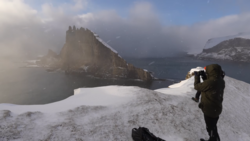
Overcast days get their own section. Kent splits them into bright, white-cloud days and dark, gray ones, and each calls for a different exposure decision. The right call also depends on whether you shoot digital or film. Digital files recover underexposed shadows far better than clipped highlights, while film handles overexposure well and underexposure poorly. He also has a specific aperture suggestion for overcast street work, when the usual layers of light aren't there to separate a subject. Mist and fog come up near the end, and he counts them among the best conditions you can get, with a couple of cautions about exposure and focus.
Kent's demonstration of how turning his back to the noon sun changes his own portrait is in the video above.


Join the Fstoppers community for free
-
Post comments and join in the discussions
-
Browse the site ad-free
-
Share your work and get featured in the community
-
Compete in the photo contests for fun and prizes