August might be the worst month of the year to point a camera at the landscape, and if you shoot nature the way most people do, the woods in late summer can feel like a dead end. The trick that separates a productive session from a frustrating one has less to do with what you shoot and more to do with what you refuse to shoot.
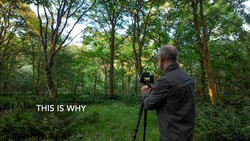
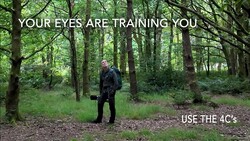
Working through a damp English wood in the middle of a drought, Simon Booth frames the whole outing around a single question: to shoot or not to shoot. He points out a jelly fungus growing across a fallen tree, notes how it would form a strong diagonal through the frame, and then walks away from it. Compositionally it works. It just never makes you do a double take. That gap between "technically fine" and "worth the effort" is the thread running through everything Booth does here, and it's the kind of judgment that takes years in the field to build. He keeps naming subjects that beginners gravitate toward, like bracket fungus on a dead silver birch, and explains why they rarely become compelling images even though they catch the eye.
The keeper shots show the payoff. Booth finds a muddy cycle track where birch leaves have gathered in the ruts, and he moves around until the spacing between the dark soil and the pale leaves feels even and easy on the eye. Then he underexposes hard, pushing the histogram right to the edge of clipping the blacks so the soil drops away and the leaves float like stars in a night sky. He shoots it on his 35-100mm lens at f/16 and ISO 100, exposing for the brightest leaves rather than the whole scene. A second image, a single birch leaf nestled into the intersection of two flattened fern ribs, becomes a lesson in focus stacking, tripod placement over hidden bramble, and using a polarizer to kill the sheen on wet foliage.
What makes this approach worth borrowing is how it inverts the usual advice. Most tutorials teach you to find more, to squeeze a frame out of every interesting thing you pass. Booth is teaching subtraction. A holly leaf on a fern gets rejected because there's a gap in the surrounding green. A bracken frond on a mossy boulder gets rejected because one section is missing and the moss is too close in tone to the leaf. Each rejection comes with a specific, nameable reason, and that's the part you can take into your own shooting. When you can articulate exactly why a scene fails, distracting edges, uneven distribution, a tonal clash, a missing piece, you stop wasting frames on subjects that were never going to hold up. This mindset connects to a broader shift in how serious nature shooters work now. Cheap storage and fast burst modes have trained a lot of people to shoot first and decide later, but the photographers producing distinctive work tend to do the opposite, making the hard call before the shutter ever fires.
Booth's exposure philosophy is worth sitting with too. He consistently edges darker than the histogram suggests he should, arguing that a "correct" middle exposure strips out the mystery and atmosphere he's after. He shoots raw, so white balance and brightness stay flexible in post, yet he still dials in cloudy white balance on location for the warmth it brings to golden holly litter. The final image of the session, a lone sycamore leaf surrounded by fallen holly, leans entirely on contrast of texture and shape rather than color, with the pale leaf ribs positioned to lead the eye into the frame. He'd walked past it three times before he saw it.
The value here isn't a gear list or a settings recipe. It's the running commentary on decision-making, the thinking made visible while it's happening rather than cleaned up afterward. Watch the full session above to see which subjects Booth rejects, how he builds those final abstract frames, and the reasoning behind every yes and no.
Join the Fstoppers community for free
-
Post comments and join in the discussions
-
Browse the site ad-free
-
Share your work and get featured in the community
-
Compete in the photo contests for fun and prizes
4 Comments
In the film days with a 36-frame roll of film it was prudent to be particular, and not waste a frame, but with modern digital cameras ability to shoot a myriad number of frames on a memory card such cautions are irrelevant, as the non-keepers can just be deleted, and sometimes a shot that you don't anticipate to be a non-keeper can favor-Ly surprises you.
This is just another a-typical presentation of offering supposed extraordinary wisdom, that in reality amounts to nothing at all.
Well said! I couldn't agree more.
What a perfect introduction... an older gentlemen walking along slightly out of breath, announcing to viewers that he hasn't come up with anything meaningful for a video. Just what I want to spend 30 minutes following. Actually I had to quit at about the three minute mark. Fortunately the text summary from Alex comes to the rescue. And here, apparently, lies the theme of the video:
"Simon Booth frames the whole outing around a single question: to shoot or not to shoot."
My answer (not his): Shoot. When undecided.... make the best composition you can think of, maybe a couple more too. Never walk away. Always shoot. It's part of the "seeing" process that can only be learned by clicking the shutter and evaluating the results. You don't just learn photography by watching videos. You learn by shooting, shooting more and more until experience affects the number of so-called keepers. For the majority of photographers, evaluating what works and what doesn't work is best discovered at home while reviewing images on the computer. No matter how trained your eye, images look different on the computer than in the field.
Digital photography has been such an enormous gift, that it blows my mind that anyone would say not to take advantage of it.