














Deconstructed Vanitas
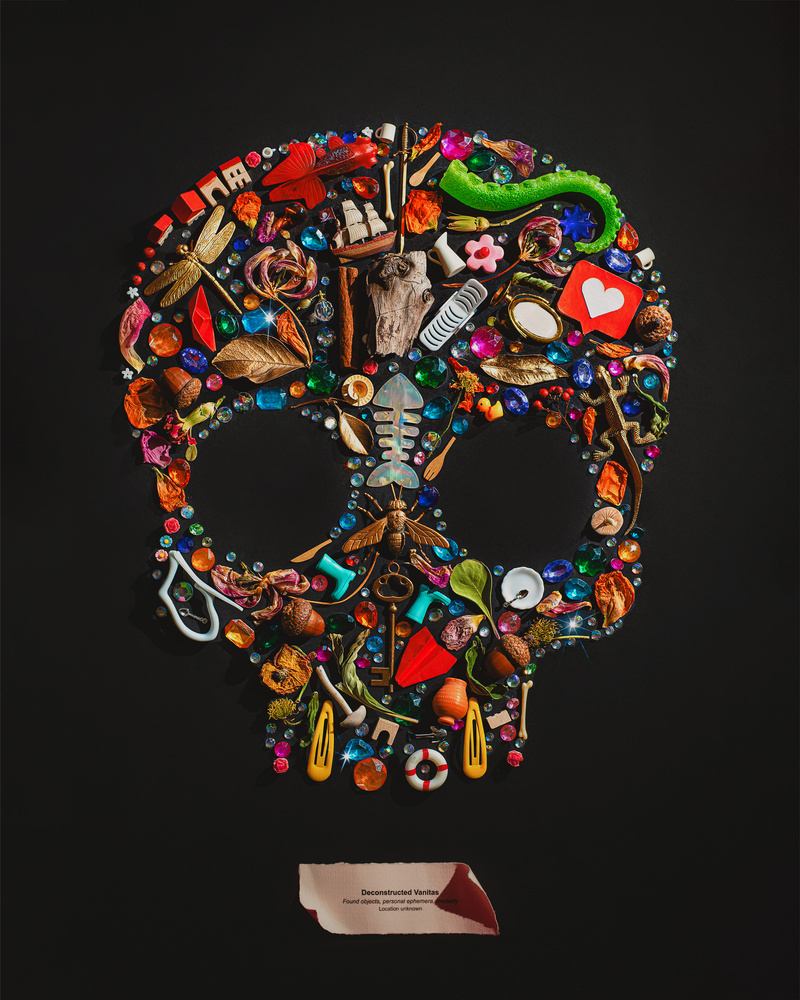
I’ve been working with still life my entire creative life. It’s a genre I know intimately — not just technically, but historically and symbolically. Of all its forms, vanitas holds particular weight: a genre of allegorical still lifes rooted in 16th- and 17th-century Europe, vanitas uses transitory objects — extinguished candles, fading flowers, rotting fruit — to remind us of mortality, the futility of pleasure, and the vanity of worldly pursuits.
I wanted to look at this tradition through a contemporary lens and also think about how we remember, collect, and aestheticize impermanence. I kept the genre’s most recognizable motif — the skull — but instead of recreating a classical arrangement I rebuilt it as a counterform: my skull is filled with tiny objects. These objects echo the genre’s symbolic vocabulary — dead insects, tableware, gems, dried petals, seashells. But they are playful, brightly lit, materially eclectic.
I like to think of it as a kind of two‑step fractal: a vanitas inside a vanitas. It doesn’t spiral into infinity — just folds in once, like the genre giving itself a wink. There’s solemnity in the symbolism, but also humor — a knowing, slightly absurd approach to the aesthetics of death and decay.
Click on the thumbnails below to comment and rate each image.
Click here to learn about the Fstoppers rating system and what each star value means.
No comments yet