

Every year, someone declares Micro Four Thirds dead. And every year, the system answers with glass that simply does not exist anywhere else. OM System just dropped the M.Zuiko 50-200mm f/2.8 IS PRO, the world's only constant f/2.8 zoom covering 100-400mm equivalent, and it is the kind of lens that makes full frame shooters do math they do not enjoy. But that flagship is not the whole story. Micro Four Thirds offers a lens catalog that rewards curiosity and punishes assumptions.
Here are 12 lenses that do not just make MFT competitive; they make it the obvious choice for specific kinds of shooting.
Super-Telephoto Lenses
OM System M.Zuiko Digital ED 50-200mm f/2.8 IS PRO
B&H Price: $3,699.99
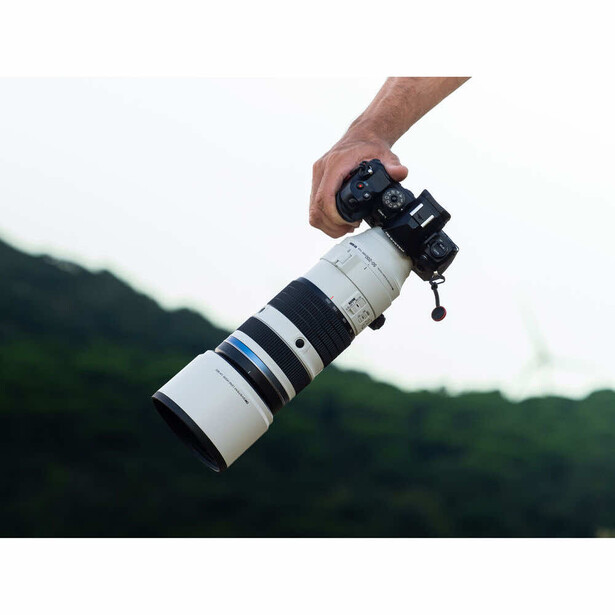
This is the lens that prompted this article. The OM System 50-200mm f/2.8 IS PRO is the world's first and only fully weather-sealed super-telephoto zoom offering a 100-400mm equivalent focal range with a constant f/2.8 aperture. Announced in September 2025, it immediately redefined what is possible in a handheld wildlife and sports package. The lens pairs OM System's 5-axis Sync IS with its own optical stabilization for up to seven stops of compensation, and it supports the company's MC-14 and MC-20 teleconverters to push reach to a staggering 800mm equivalent. It weighs 2.37 lbs. The Canon RF 100-300mm f/2.8 that covers a shorter range weighs 5.8 lbs and costs more than double.
Key Specs
- Equivalent Focal Length: 100-400mm (200-800mm with 2x TC)
- Maximum Aperture: f/2.8 constant
- Weight: 1,075 g / 2.37 lbs (without tripod collar)
- Filter Thread: 77mm
- Minimum Focus Distance: 0.78 m (30.7") throughout zoom range
- Max Magnification: 0.25x (0.5x equivalent)
- Stabilization: 7-stop Sync IS with compatible bodies
- Weather Sealing: IP53 rated, freezeproof to -10°C
- Special Feature: White thermal coating reduces internal heat buildup
Why You Should Choose It
If you shoot wildlife or sports and have ever stared at the size and weight of a 400mm f/2.8 prime for full frame, this lens is the argument for MFT distilled into a single product. It offers reach that would require a 100-400mm f/2.8 zoom in full frame terms (a lens that does not exist at any price) in a package you can genuinely handheld all day. The 7-stop Sync IS means you can shoot at shutter speeds that would be reckless on any other system. With the 2x teleconverter, you are at 800mm equivalent at f/5.6, still faster than most super-telephoto zooms. The price of the 50-200mm f/2.8 IS PRO is significant, but try pricing the equivalent capability in any other mount. You cannot, because it does not exist.
OM System M.Zuiko Digital ED 150-400mm f/4.5 TC1.25X IS PRO
B&H Price: $8,799.99
The 150-400mm f/4.5 TC1.25X IS PRO is the apex predator of the MFT lens lineup: a birding and wildlife lens with a built-in 1.25x teleconverter that extends its native 300-800mm equivalent range to 375-1,000mm equivalent with the flick of a lever. Stack the external MC-20 teleconverter on top of the built-in TC and you reach a staggering 2,000mm equivalent. This is lens-as-telescope territory, and it remains fully weather-sealed, stabilized, and autofocusing throughout. Originally launched in 2021 and still essentially without peer, it represents the most extreme expression of MFT's telephoto reach advantage.
Key Specs
- Equivalent Focal Length: 300-800mm (375-1,000mm at f/5.6 with built-in TC; 750-2,000mm at ~f/11 with built-in TC + MC-20)
- Maximum Aperture: f/4.5 (f/5.6 with built-in TC)
- Weight: 1,875 g / 4.1 lbs
- Filter Thread: 95mm
- Max Magnification: 0.57x (1.14x equivalent)
- Stabilization: 8-stop Sync IS with compatible bodies
- Weather Sealing: IP53 rated, freezeproof to -10°C
- Special Feature: Built-in 1.25x teleconverter with dedicated lever
Why You Should Choose It
This lens exists for one kind of photographer: the person who needs extreme reach with professional autofocus in a package that does not require a monopod and a chiropractor. The built-in teleconverter means you can switch between 800mm and 1,000mm equivalent without touching a bag, swapping glass, or breaking your shooting rhythm. Birders who have used this lens tend to describe the experience in terms that sound religious. At $8,800, it is a serious investment, but Canon and Nikon shooters chasing similar reach are looking at $12,000-plus for a 600mm f/4 prime that still does not zoom. If extreme wildlife is your primary discipline, the 150-400mm f/4.5 TC1.25X IS PRO is the lens that makes the entire MFT system worth buying into.
If you want to sharpen your wildlife and landscape technique to match what glass like this can deliver, Fstoppers offers Photographing the World: Landscape Photography and Post-Processing with Elia Locardi, which covers field techniques and editing workflows that translate beautifully to MFT's strengths.
Panasonic Leica DG Elmarit 200mm f/2.8 POWER O.I.S.
B&H Price: $2,997.99
The Panasonic Leica DG Elmarit 200mm f/2.8 POWER O.I.S. is the quiet legend of MFT telephoto shooting: a prime lens that delivers 400mm equivalent reach at f/2.8 in a package that weighs under three pounds. Panasonic includes a 1.4x teleconverter in the box, extending reach to 560mm equivalent at f/4. Released in 2017 and never updated because it did not need to be, this lens produces images with a rendering quality that still makes experienced photographers stop scrolling. Its Leica-certified optics deliver the kind of micro-contrast and color that zoom lenses struggle to match.
Key Specs
- Equivalent Focal Length: 400mm (560mm with included 1.4x TC)
- Maximum Aperture: f/2.8
- Weight: 1,245 g / 2.74 lbs
- Filter Thread: 77mm
- Max Magnification: 0.2x (0.4x equivalent)
- Stabilization: POWER O.I.S. (Dual IS compatible with Panasonic bodies)
- Weather Sealing: Splash, dust, and freeze resistant
- Special Feature: Includes DMW-TC14 1.4x teleconverter in box
Why You Should Choose It
There is something specific a prime lens does that no zoom can replicate: it forces you to commit to a focal length and rewards that commitment with optical perfection. The Leica 200mm f/2.8 is 400mm of that commitment. Subject isolation at f/2.8 on a 400mm equivalent is extraordinary; backgrounds dissolve into painterly abstraction. The included teleconverter extends versatility without degrading quality in any meaningful way. For wildlife photographers who work at known distances (blinds, hides, feeders) or for motorsport and action shooters who can predict where subjects will be, this lens delivers images that are immediately distinguishable from zoom captures. It is not the most flexible option on this list, but the Leica 200mm f/2.8 may produce the most beautiful results.
Versatile Zoom Lenses
OM System M.Zuiko Digital ED 12-100mm f/4 IS PRO
B&H Price: $1,399.99
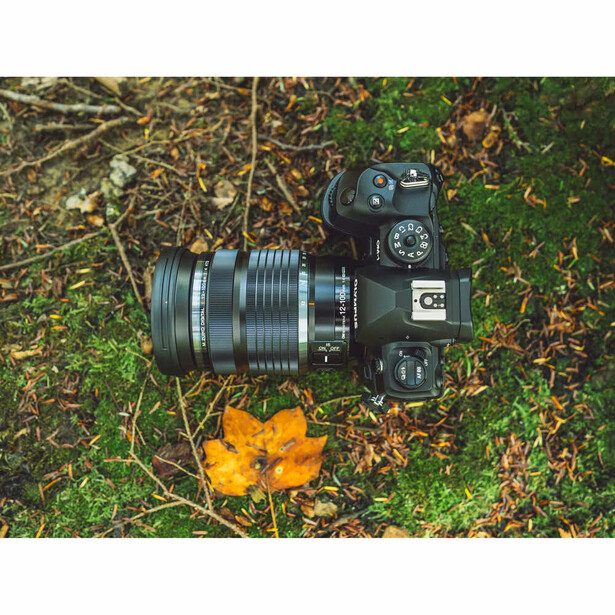
The 12-100mm f/4 IS PRO is the lens that travel photographers describe with phrases like "the only lens I brought" and "I left three primes in the hotel." Covering 24-200mm equivalent at a constant f/4, it eliminates the standard-zoom-plus-telephoto-zoom two-lens carry that defines most travel kits. Its Sync IS system pairs with compatible OM System bodies for up to 8.5 stops of stabilization, enabling handheld shots at shutter speeds that would produce unusable mush on other systems. Originally launched in 2016 under the Olympus brand, it remains arguably the greatest travel zoom ever made for any system.
Key Specs
- Equivalent Focal Length: 24-200mm
- Maximum Aperture: f/4 constant
- Weight: 561 g / 1.24 lbs
- Filter Thread: 72mm
- Minimum Focus Distance: 0.15 m wide, 0.45 m tele
- Max Magnification: 0.3x (0.6x equivalent)
- Stabilization: Sync IS, up to 8.5 stops with compatible bodies
- Weather Sealing: IP53 rated, freezeproof to -10°C
- Special Feature: Close-focus macro capability at wide end
Why You Should Choose It
This lens answers a question that haunts every photographer packing for a trip: "What if I only bring one lens?" With the 12-100mm, that question has a definitive answer. You get everything from moderately wide landscapes to tight portrait compression, all at a constant f/4 with world-class stabilization. The image quality holds up across the zoom range in a way that defies the usual superzoom compromises; there is a reason this lens has a 4.8-star rating across hundreds of reviews. The close-focusing capability at the wide end adds casual macro shooting to the list of things you did not expect to do with one lens. If you travel and do not want to think about lenses, buy this. If you are a working event photographer who needs versatility over absolute speed, buy this. It is the closest any lens has come to doing everything, and the 12-100mm f/4 IS PRO deserves a permanent spot in any MFT kit.
Panasonic Leica DG Vario-Summilux 10-25mm f/1.7 ASPH.
B&H Price: $1,897.99
The Panasonic Leica DG Vario-Summilux 10-25mm f/1.7 ASPH. is a lens that should not exist. A constant f/1.7 zoom covering 20-50mm equivalent; that is an entire bag of primes collapsed into a single barrel with no aperture compromises. No other manufacturer in any format has ever shipped anything like it. Originally designed with cinema and high-end video production in mind, the lens features a de-clicked aperture ring for smooth, silent iris pulls, minimal focus breathing, and the kind of optical consistency across the zoom range that makes colorists and directors of photography very happy. It is also exceptional for stills shooters who want wide-to-normal coverage without giving up low-light capability.
Key Specs
- Equivalent Focal Length: 20-50mm
- Maximum Aperture: f/1.7 constant
- Weight: 690 g / 1.52 lbs
- Filter Thread: 77mm
- Max Magnification: 0.14x (0.28x equivalent)
- Weather Sealing: Splash, dust, and freeze resistant
- Special Feature: De-clicked aperture ring for cinema use
Why You Should Choose It
This lens is the reason "nothing like it exists" appears so often in MFT discussions. If you shoot video professionally (interviews, documentary, narrative), the 10-25mm f/1.7 replaces a 20mm, 25mm, 35mm, and 50mm prime set while maintaining constant exposure across the zoom range. For stills shooters, it means covering the most commonly used focal lengths at an aperture that produces genuine subject isolation on a smaller sensor. The de-clicked aperture ring is not just a convenience; it is what separates this from a photo lens with video capability. This is a cinema lens that also takes remarkable stills. Paired with its sibling, the 25-50mm f/1.7, you can cover 20-100mm equivalent at a constant f/1.7 with just two lenses. That is not an incremental advantage over other systems; it is a capability that money literally cannot buy anywhere else. The 10-25mm f/1.7 is simply in a class of its own.
For filmmakers looking to build on these lenses' cinematic strengths, Fstoppers' Introduction to Video: A Photographer's Guide to Filmmaking is a solid starting point for photographers transitioning into motion work.
OM System M.Zuiko Digital ED 12-45mm f/4 PRO
B&H Price: $649.99
The 12-45mm f/4 PRO is what happens when OM System asks "How small can we make a professional standard zoom?" The answer is 254 g, shaving a full third off the weight of the 12-40mm f/2.8 PRO II, while retaining full IPX1 weather sealing, PRO-level optics, and coverage from 24-90mm equivalent. That extra 10mm on the long end compared to the 12-40mm means you get into legitimate portrait territory without swapping lenses. For hikers, travel photographers, and anyone who weighs their kit in grams rather than pounds, this is the standard zoom that disappears on the camera.
Key Specs
- Equivalent Focal Length: 24-90mm
- Maximum Aperture: f/4 constant
- Weight: 254 g / 0.56 lbs
- Filter Thread: 58mm
- Minimum Focus Distance: 0.12 m at wide end
- Max Magnification: 0.25x (0.5x equivalent)
- Weather Sealing: IPX1-rated splash protection (OM System describes the lens as dust, splash, and freeze resistant in use)
- Special Feature: Close-focus macro at 12mm with 0.5x equivalent magnification
Why You Should Choose It
If you chose MFT because you value portability, the 12-45mm f/4 PRO is the standard zoom that honors that choice. It gives up one stop versus the f/2.8 zoom and gains extraordinary compactness in return. On an OM-5 or the PEN series, the combined kit feels more like a premium compact camera than an interchangeable lens system. The optical quality punches well above what the size suggests; it is a PRO-designated lens for a reason. The close-focusing ability at the wide end is genuinely useful for casual macro work. For photographers who carry their kit on their back all day, or who need a compact, weather-resistant PRO zoom that does not announce itself, the 12-45mm f/4 PRO is the answer.
Specialty and Macro Lenses
OM System M.Zuiko Digital ED 90mm f/3.5 Macro IS PRO
B&H Price: $1,499.99
The 90mm f/3.5 Macro IS PRO is not just the best macro lens in Micro Four Thirds; it is arguably the most capable handheld macro lens ever made for any system. Its 2:1 native magnification (4:1 equivalent in full frame terms) means it resolves details that standard 1:1 macro lenses cannot reach, and it does this while integrating OM System's Sync IS for stabilized handheld shooting at magnifications where even breathing introduces visible motion. Add in-camera focus stacking on compatible bodies and you have a macro system that produces images with depth of field and detail that previously required a dedicated focus rail and tripod setup.
Key Specs
- Equivalent Focal Length: 180mm
- Maximum Aperture: f/3.5
- Weight: 453 g / 1 lb
- Filter Thread: 62mm
- Minimum Focus Distance: 0.224 m (8.8")
- Max Magnification: 2.0x native (4.0x equivalent)
- Stabilization: Sync IS compatible
- Weather Sealing: IP53 rated, freezeproof to -10°C
- Special Feature: Supports in-camera focus stacking for extreme depth of field
Why You Should Choose It
Macro photography has traditionally required a tripod, a focus rail, and patience measured in minutes per frame. The 90mm f/3.5 Macro IS PRO changes the discipline. With Sync IS and 2:1 magnification, you can shoot handheld at magnifications that reveal the compound eyes of insects, the texture of pollen grains, and structures invisible to the naked eye. The 180mm equivalent working distance means you are not pushing your lens into a spider's personal space to get the shot. In-camera focus stacking on the OM-1 series produces images with front-to-back sharpness that would take 20 or more individual frames to composite manually. For nature photographers, scientific documentation, or anyone fascinated by the world at small scales, no other system offers anything close to what the 90mm f/3.5 Macro IS PRO delivers handheld.
If macro is a discipline you want to explore seriously, Fstoppers' Mastering Macro Photography with Andres Moline covers complete shooting and editing workflows that pair perfectly with a lens like this.
Laowa 6mm f/2 Zero-D MFT
B&H Price: $499.00
The Laowa 6mm f/2 Zero-D MFT is the widest rectilinear prime available for Micro Four Thirds, delivering a 12mm equivalent field of view (121.9 degrees) with very low distortion. That last part is the engineering achievement: ultra wide lenses typically barrel-distort aggressively, requiring heavy software correction that degrades corner quality. The Laowa is optically corrected for distortion at the glass level, meaning straight lines stay straight without computational intervention. It features electronic contacts for aperture control from the camera body, bridging the gap between third-party manual-focus lenses and native system integration.
Key Specs
- Equivalent Focal Length: 12mm
- Maximum Aperture: f/2
- Weight: 188 g / 0.41 lbs
- Filter Thread: 58mm
- Max Magnification: 0.18x (0.36x equivalent)
- Focus: Manual focus only
- Special Feature: Electronic contacts for in-camera aperture control
Why You Should Choose It
Ultra-wide rectilinear lenses are architectural and astrophotography essentials, and the Laowa 6mm f/2 delivers the widest such perspective available for MFT at a fast f/2 aperture. That speed matters enormously for astrophotography, where every fraction of a stop translates to more stars captured in less time. The low-distortion optical design means you can photograph buildings, interiors, and real estate without the warped geometry that plagues many ultra wides. At 188 g and $499, it is also remarkably accessible. Manual focus is the only compromise, and for the disciplines where the Laowa 6mm f/2 Zero-D excels (astro, architecture, landscapes), that is barely a compromise at all, since most of these subjects are focused at or near infinity.
For astrophotography enthusiasts, Fstoppers' Photographing the World 2: Cityscape, Astrophotography, and Advanced Post-Processing with Elia Locardi is a natural companion to a lens like this.
Prime Portrait and Ultra-Wide Lenses
Olympus M.Zuiko Digital ED 17mm f/1.2 PRO
B&H Price: $1,399.99
The Olympus M.Zuiko Digital ED 17mm f/1.2 PRO is the wide angle member of Olympus's legendary f/1.2 PRO prime trinity: three lenses designed not just for speed but for a specific bokeh aesthetic that Olympus calls "feathered." At 34mm equivalent, it sits at the intersection of wide angle and normal, the focal length that photojournalists and street photographers have gravitated toward for decades. The f/1.2 aperture on MFT produces depth of field roughly equivalent to f/2.4 on full frame, which is genuinely useful shallow DOF rather than the razor-thin plane that makes f/1.2 on larger formats unpredictable. The lens is fully weather-sealed and shares filter threads, physical dimensions, and control layout with its 25mm and 45mm siblings.
Key Specs
- Equivalent Focal Length: 34mm
- Maximum Aperture: f/1.2
- Weight: 390 g / 0.86 lbs
- Filter Thread: 62mm
- Minimum Focus Distance: 0.2 m (7.9")
- Max Magnification: 0.15x (0.3x equivalent)
- Construction: 15 elements in 11 groups, including ED-DSA element
- Weather Sealing: Dustproof, splashproof, freezeproof to -10°C
- Special Feature: MF Clutch mechanism and depth-of-field scale
Why You Should Choose It
The 34mm equivalent focal length is arguably the most versatile single focal length in photography: wide enough for environmental context, tight enough to isolate a subject against their surroundings. The f/1.2 aperture means this lens handles low light with authority, and the feathered bokeh rendering gives out-of-focus areas a dimensional, three-dimensional quality that is distinct from the optical signatures of competing brands. The weather sealing means it works in conditions that would sideline non-PRO glass. For documentary photographers, street shooters, or anyone who wants a single prime that handles the broadest range of situations, the 17mm f/1.2 PRO is the lens that stays on the camera.
OM System M.Zuiko Digital ED 45mm f/1.2 PRO
B&H Price: $1,599.99
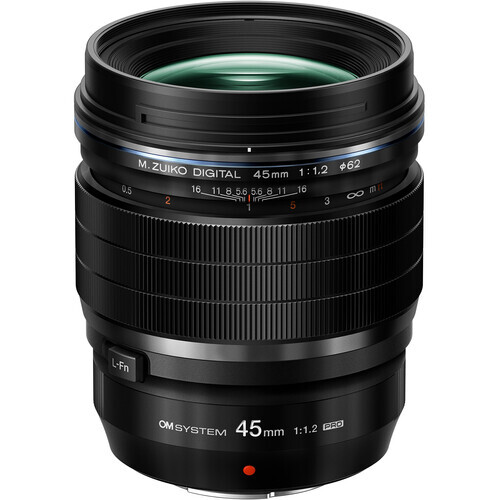
The OM System M.Zuiko Digital ED 45mm f/1.2 PRO is the gold standard for portrait photography on Micro Four Thirds. At 90mm equivalent with an f/1.2 maximum aperture, it produces the classic portrait perspective with subject isolation that rivals what full frame shooters achieve with an 85mm f/1.8. But it does this in a body that weighs 410 g and measures roughly the size of a coffee mug. The optical design prioritizes what Olympus calls "feathered bokeh": a smooth, gradual transition from sharp to unsharp that gives portraits a three-dimensional quality distinct from the more clinical rendering of modern full frame portrait lenses.
Key Specs
- Equivalent Focal Length: 90mm
- Maximum Aperture: f/1.2
- Weight: 410 g / 0.9 lbs
- Filter Thread: 62mm
- Minimum Focus Distance: 0.5 m (19.7")
- Max Magnification: 0.1x (0.2x equivalent)
- Construction: 14 elements in 10 groups
- Weather Sealing: Dustproof, splashproof, freezeproof to -10°C
- Special Feature: Feathered bokeh design philosophy
Why You Should Choose It
Portrait lenses live and die by their rendering: not just how sharp the subject is, but how everything behind and around the subject dissolves. The 45mm f/1.2 PRO does not just dissolve backgrounds; it paints them. The feathered bokeh creates images with a depth and dimensionality that clients notice even if they cannot articulate why the photos look different. At 90mm equivalent, you get flattering facial compression without the excessive working distance that longer portrait lenses demand. The weather-sealing means outdoor portrait sessions in mixed conditions do not require protective measures. If portraits are a significant part of your work or passion, the 45mm f/1.2 PRO is the lens that makes MFT competitive with any system at any price point.
Sigma 56mm f/1.4 DC DN Contemporary
B&H Price: $579.00
The Sigma 56mm f/1.4 DC DN Contemporary is the lens that makes experienced photographers question their expensive prime collections. At 112mm equivalent on Micro Four Thirds, it provides a tight portrait perspective with an f/1.4 aperture that delivers genuine subject isolation, and it does this for under $600. Sigma's Contemporary line emphasizes the balance between optical performance and real-world portability, and the 56mm embodies that philosophy at 280 g. The lens has been available since 2018, accumulating a reputation across multiple mount systems as one of the best value propositions in modern optics. On MFT specifically, its tight field of view and bright aperture create a combination that is unique in the system.
Key Specs
- Equivalent Focal Length: 112mm
- Maximum Aperture: f/1.4
- Weight: 280 g / 9.9 oz
- Filter Thread: 55mm
- Minimum Focus Distance: 0.5 m (19.7")
- Max Magnification: 0.14x (0.28x equivalent)
- Construction: 10 elements in 6 groups
- Weather Sealing: Rubber mount seal for dust/splash resistance
- Special Feature: Stepping AF motor for near-silent photo and video AF
Why You Should Choose It
The math on this lens is almost unfair. The OM System 45mm f/1.2 PRO costs three times as much, and while it is optically superior in specific rendering qualities, the Sigma matches or exceeds it in raw resolving power. Comparative tests have shown the 56mm f/1.4 holding its own against both the $1,600 Panasonic Leica Nocticron 42.5mm f/1.2 and the $700 Olympus 75mm f/1.8. At 112mm equivalent, it provides tighter framing than either of those lenses, making it exceptional for headshots and compressed street photography. The 9-blade aperture produces smooth, round bokeh highlights. If you want a portrait prime for MFT and you are not sure how deep you want to invest in the system, the Sigma 56mm f/1.4 is the answer that costs less than dinner for two at a nice restaurant.
Panasonic Leica DG Summilux 9mm f/1.7 ASPH.
B&H Price: $547.99
The Panasonic Leica DG Summilux 9mm f/1.7 ASPH. is the smallest, lightest ultra wide autofocus prime in Micro Four Thirds, and one of the only fast ultra wide AF primes in any mirrorless system at this price point. At 18mm equivalent, it delivers the kind of wide angle perspective that landscape and architecture photographers crave, with enough speed to work handheld in dim interiors and at dusk. But its party trick is a half-macro minimum focus distance of just 3.7 inches (9.5 cm), enabling ultra wide close-up compositions that combine sharp foreground detail with expansive background context. At 130 g, it adds almost nothing to your kit.
Key Specs
- Equivalent Focal Length: 18mm
- Maximum Aperture: f/1.7
- Weight: 130 g / 4.6 oz
- Filter Thread: 55mm
- Minimum Focus Distance: 0.095 m (3.7")
- Max Magnification: 0.25x (0.5x equivalent)
- Construction: 12 elements in 9 groups
- Weather Sealing: Splash, dust, and freeze resistant to -10°C
- Special Feature: Half-macro design with 0.5x equivalent magnification
Why You Should Choose It
Ultra-wide primes tend to be either expensive, slow, manual focus, or all three. The Panasonic 9mm f/1.7 is none of those things. It autofocuses, it is weather sealed, it has Leica-certified optics, and it costs $500. The f/1.7 aperture means you can actually achieve noticeable background blur at ultra wide angles, an effect that usually requires f/1.4 or wider on full frame at equivalent fields of view. The close-focusing capability transforms the lens into a creative tool for forced-perspective compositions, food photography, and environmental portraits with dramatic wide angle distortion. For vloggers, the 18mm equivalent field of view at arm's length captures speaker plus environment without a fisheye look. This is the lens that makes you want to shoot wide, and at 130 g, there is zero reason not to throw the Panasonic 9mm f/1.7 in the bag every time.
The Bottom Line
Micro Four Thirds in 2026 is not competing on sensor size, and it never was. It competes on what the system makes possible: a constant f/2.8 zoom from 100-400mm equivalent that you can handheld all day; a constant f/1.7 zoom that replaces a bag of primes; a macro lens that resolves structures invisible to the naked eye without a tripod; a 24-200mm travel zoom with stabilization so good it changes what "handheld" means. These are not incremental improvements over what other systems offer. They are capabilities that do not exist elsewhere at any price.
The system's real argument is not about price; it is about physics. A smaller sensor means smaller, lighter lenses with longer equivalent reach and deeper equivalent depth of field at any given aperture. Those physics produce lenses that full frame systems cannot replicate without tripling the size and weight. Whether you are a wildlife shooter who needs 800mm equivalent in a carry-on, a videographer who needs constant f/1.7 from wide to normal, or a travel photographer who wants one lens that genuinely does everything, MFT has glass that was designed specifically for you. The system is not dead. It is the only one building lenses no one else can.




Join the Fstoppers community for free
-
Post comments and join in the discussions
-
Browse the site ad-free
-
Share your work and get featured in the community
-
Compete in the photo contests for fun and prizes
10 Comments
I don't see "a $150 prime that embarrasses lenses four times its price", or ANY $150 prime, for that matter.
Right you are, thank you! Forgot to take out that sentence when I updated my draft.
Great choice of lenses! I have 6 of them, and 2 more which I have sold, and am still saving up for the 50-200mm F2.8. One could argue that this lens makes the Pana-Leica 200mm F2.8 redundant, being both lighter and having the flexibility of a 4x zoom.
One lens that could be included in the list is the Olympus 8mm F1.8 PRO fisheye. This might be a niche lens (great for astro-photography, and generally fun to use) but it's a unique offering, an auto-focus fisheye lens with such a wide aperture. An in-camera option even converts the image to rectilinear, if the fisheye effect is too much for one's liking (though it's not as sharp in the corners as the Laowa 6mm).
Panasonic's 12-32 deserves mention. It's uniquely small, quite sharp, and used ones are available cheap.
Hmm, my kit includes the Leica 100-400, Lumix 8-18 the the OM 12-200. Now that's a kit to travel with.
There are so many incredible Micro Four Thirds that didnt make this list but are still absolutely delightful and worth checking out:
-- OM 7-14mm f/2.8 PRO
- OM 8mm f/1.8 Fisheye PRO
- OM 8-25mm f/4 PRO
- OM 12-40mm f/2.8 PRO
- OM 20mm f/1.4 PRO
- OM 40-150mm f/2.8 PRO
- OM 40-150mm f/4 PRO
- OM 45mm f/1.8
- OM 60mm f/2.8 Macro
- OM 75mm f/1.8
- OM 75-300mm
- OM 17/25mm f/1.8 II
- Panasonic 14mm f/2.5 Pancake
- Panasonic 15mm f/1.7 Leica
- Panasonic 20mm f/1.7
- Panasonic 42.5 f/1.2 Leica
- Panasonic 12-35mm f/2.8
- Panasonic 25-50mm f/1.7
- Panasonic 35-100mm f/2.8
A point of clarification for those not familiar with the range, "- OM 17/25mm f/1.8 II" are two separate lenses, a 17mm and a 25mm. The 17mm f1.8 II + OM-3 (both weather sealed) with leather half case and wrist strap is my walk about fun rig.
This is an interesting article. Unfortunately you do not define what exaclty you mean by equivalent lenses for the different systems and my understanding is different here.
Let's assume a MFT shooter takes his camera, a certain focal length and aperture and creates an image with it. Then he prints it out and hangs it on the wall. So for me the question would be: What lens does the FF shooter need to take to get the exact same result. With this I mean: the print has the same size, shows the same subject, there is the same amount of depth of field / Bokeh, same brightness of the image and the same visual noice. So both images are basically undistinguishable. In this case I would say that we have found the equivalent setup / lens.
In your article you comepare the MFT 50-200mm F2.8 to a hypothetical FF 100-400mm F2.8 lens, and the MFT 200mm F2.8 lens to a FF 400mm F2.8 lens.
If we look at the focal length then everybody will hopefully agree that indeed we need to compare 200mm MFT to 400m FF in order to get the same subject size. So this is equivalent. So the subject size in the two images on the wall are the same.
However, when we look at the aperture then a 200mm F2.8 MFT lens will have a different depth of field than a FF 400mm F2.8 lens. The FF lens will have a shallower depth of field. The two images on the wall will look different. So we need to change something - and that is the aperture. We need to stop it down by two stops and will end up at F5.6. Do we agree that the depth of field of a MFT 200mm F2.8 and FF 400mm F5.6 is the same?
Now comes the more difficult part: You might think that by reducing the aperture on the FF lens to F5.6 might show the same depth of field but increases the visual noice of the image - but this will not be the case. What it true: If you have an MFT F2.8 lens and compare it to a FF F2.8 lens, both will "produce" the same amount of luminance (amount of light per area). So on the FF camera with F5.6 you will need to increase the ISO by two stops to compensate for that difference. But because the area of the FF sensor is also 2x larger the final visual noice of the image is the same. Another way to view it is to think about the photons. All images are based on the photons that hit the sensor - no photons, no image. The photons are the information that is captured. Collect more photons and you collect more information. So the smaller MFT sensor with an F2.8 lens will collect the same number of photons than a FF sensor at F5.6. The 2x aperture difference will cancel the 2x image sensor size difference. But when both setups collect the same number of photons, hence the same information, the outcome regarding visual noice will be the same.
That means, when comparing equivalent lenses in the way I have defined above (delivering undistinguishable results), then not only the focal length needs to be adjusted but also the F-stop (let's assume T-stop = F-stop). So the point is: e.g. the MFT 50-200mm F2.8 zoom lens needs to be compared to a FF 100-400mm F5.6 lens. And those lenses do exist. The MFT 200mm F2.8 is equivalent to a FF 400mm F5.6. The MFT 12-100 F4 is equ. to a 24-200 F8. The MFT 10-25 F1.7 and 25-50F1.7 are equivalent to FF 20-50 F3.4 and 50-100F3.4. The other way round: A FF 24-70 F2.8 would be equivalent to a MFT 12-35 F1.4 lens.
So my conclusion is that if you are using equivalent lenses of MFT and FF (by adjusting both focal lenght and aperture) you will get the same results with no advante for either side. BTW also the size and weigt difference is not as great as you would expect when comparing this lenses. Don't get me wrong, the lenses you mention here seem to be great lenses and probably also good reason the use a MFT system. They may be lighter and cheaper than their FF counterparts. But they do not offer capabilities that are not available in other systems.
In my opninion Olympus/OM systems make great lenses and for telephoto it’s hard to find equivalent FF lenses. On the other side, the wide one, where are you going to find an m43 equivalent to the Laowa 8-15mm f/2.8 FF Zoom Fisheye Canon RF-mount (4-8mm f 1.4).
For portraits to get an equivalent look to a 85mm f/1.2 on full frame, you would need a 42mm f/0.6
The extreme cost of those high-end MFT lenses really doesn't help sway the myriad arguments in favor of larger sensors. $3,000 for the PanaLeica 200mm is crazy. I owned one. Image quality was no better than a $600 300mm f/4 on APS-C or cropped full frame at a lower price.