Shooting with a 100 MP medium format camera sounds like it should be complicated, slow, and demanding. The Hasselblad X2D II 100C makes a strong case that it doesn't have to be any of those things, and it's doing something with HDR imaging that no other camera has managed to execute.
Coming to you from Gordon Laing, this detailed video covers the X2D II 100C from sensor specs to real-world handling, and Laing doesn't hold back on either the strengths or the limitations. At around $7,400, this is serious money, though Laing points out that Sony's a7R VI and Canon's EOS R1 are priced only slightly lower, so the gap between full frame flagships and medium format has narrowed considerably. The 100 MP BSI sensor measures 43.8 x 32.9 mm, giving it 1.7 times the surface area of a full frame sensor, and when paired with the XCD 35-100mm f/2.8 zoom Laing tested, the resolution is genuinely beyond what most other systems can resolve at equivalent focal lengths. He also puts the IBIS through a practical handheld test and gets results that would surprise most people familiar with other stabilization systems.
One of the more interesting findings in the video is how the autofocus compares to the previous model. Continuous AF is now supported, though only with the latest XCD lenses, and Laing demonstrates subject detection and face and eye tracking working confidently in real conditions. There's no video mode here at all, which is either a dealbreaker or completely irrelevant depending on what you shoot. The burst speed tops out at three frames per second, with raw files dropping to 14-bit during bursts, so this isn't the camera for fast action. What it is built for comes through clearly in Laing's sample images, all out-of-camera files shot in HDR mode, where the color rendering and tonal handling reflect Hasselblad's decision to offer zero in-camera color profiles and trust their Natural Color Solution processing entirely.
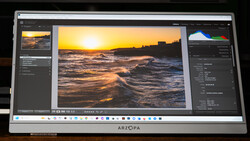
The HDR implementation is where the camera separates itself most clearly from everything else on the market. The rear screen is a 3.6-inch OLED with 2.36 million dots and 1,400 nit peak brightness, which is what makes the on-camera HDR playback actually work rather than being a theoretical feature you can only appreciate later on a phone or laptop. Laing filmed and edited the entire video in HDR so viewers on compatible displays can see the effect directly. The camera also writes Ultra HDR JPEGs natively, which display with standard brightness on older screens but take advantage of higher brightness on modern ones. Hasselblad's Focus Mobile app for iOS extends this further, letting you toggle the HDR effect, remote control the camera, and export raw files as HDR-compatible JPEGs for sharing.
Check out the video above for the full rundown from Laing, including his complete ISO and dynamic range tests, a closer look at the menu system and build quality, and a side-by-side HDR toggle demonstration that's worth seeing on a compatible display.


Join the Fstoppers community for free
-
Post comments and join in the discussions
-
Browse the site ad-free
-
Share your work and get featured in the community
-
Compete in the photo contests for fun and prizes
4 Comments
What’s interesting here is that smartphone users have been living in an HDR-native photographic ecosystem for years. My iPhone 15 Pro Max has displayed computationally rendered HDR images on a 6.7" HDR screen since day one.
As much as I would indeed love to have this camera, it's biggest limiting factor is the cost, not just from the body (which may be justified), but the very high cost and availability and choice of lenses, especially telephoto. Medium format also has an inherent crop factor of 0.79, making the 35-100mm in terms of full frame 28-79mm.
I can think of essentially no one who needs this.
It has nothing to do with need. If everyone just had only what someone thinks they need, the world (at least as we know it) would be much different. Also,
Who needs anything more than 24 mp?
Who needs autofocus?
Who needs any lens bigger than 200 mm?
Who needs a mirrorless camera?
Also -Who needs a boat for a hobby?
If you live in the city, who needs a pickup truck? (or even a car in some cases)
Who needs a private airplane?
Who needs a swimming pool?
Who needs more than 1 television (or a super large TV)
Who needs anything more than a laptop pc?
Who needs social media?
on
and
on..........