
Most photographers think of base ISO as a single number: the setting that produces the cleanest possible image with the widest dynamic range. In reality, even "base ISO" is more complicated than it sounds.
Some cameras shift their base ISO depending on the recording mode or gamma curve you've selected (log versus standard, for instance), and a growing number of cameras expose two or more base ISO points by design. The transition between those gain modes fundamentally changes how your sensor handles light, noise, and shadow detail. This technology goes by several names (dual gain, dual conversion gain, dual native ISO, and dual base ISO), and the terminology is used loosely enough that even experienced photographers conflate concepts that are technically distinct.
Here's the thing: understanding how your sensor's gain structure works doesn't require an electrical engineering degree, and it can meaningfully change how you expose in the field. Once you know what's happening under the hood, you'll stop treating ISO as a simple "brightness knob" and start using it as the creative and technical tool it actually is.
How ISO Actually Works (the Short Version)
Before we can talk about dual gain, we need to clear up a persistent misconception. ISO does not change your sensor's sensitivity to light. Your sensor captures the same number of photons regardless of whether you've set ISO 100 or ISO 6,400. What ISO actually controls is what happens to that signal after the photons have been collected.
Here's the simplified signal chain: light hits the sensor's photosites, which convert photons into an electrical charge. That charge is stored briefly, then read out as a voltage. This voltage passes through an amplifier (the "gain" stage), and the amplified signal is fed into an analog-to-digital converter (ADC) that translates it into digital values your camera records as a raw file.
When you increase ISO, the camera applies more gain to the signal. In many implementations, this happens as analog amplification before the signal reaches the ADC. But not always: some cameras implement certain ISO steps as digital scaling after the ADC, or use a mix of analog and digital gain depending on the ISO value. The details vary by manufacturer and model. Regardless of where the gain is applied, the general principle holds: amplification boosts everything, including the electronic noise generated by the sensor and readout circuitry. That's why higher ISOs tend to produce noisier images. You're not capturing worse light; you're amplifying the noise floor alongside the signal.
At base ISO (typically ISO 100 or 200), your camera applies minimal amplification. This preserves the maximum dynamic range because the full signal, from the faintest shadows to the brightest highlights, fits within the ADC's recording window. As ISO increases, you generally lose highlight headroom and gain cleaner shadows, but the specifics depend on how each ISO step is implemented. An ISO step applied as analog gain before the ADC will push the brightest information beyond what the ADC can record, directly clipping highlights. But a step applied digitally after the ADC may not change the sensor's analog headroom at all. The net effect is a trade-off between highlight retention and shadow noise, but the slope and character of that trade-off varies by camera and ISO value.
What Dual Gain Changes
Here's where it gets interesting. In a traditional single-gain sensor, there's one amplification pathway and one set of trade-offs that degrade as ISO increases. Dynamic range generally trends downward with rising ISO, though the exact rate of loss is sensor- and implementation-dependent rather than a fixed rule.
A dual-gain sensor introduces a second readout mode with a different amplification configuration. The sensor's pixels have a switchable capacitor in the readout path. At low ISOs, the capacitor is engaged, providing extra electron-storage capacity for high dynamic range. At a certain ISO threshold (the "switch point"), the capacitor disengages, which boosts the conversion gain: the signal gets a stronger initial push before reaching the amplifier and ADC.
Why does this matter? Because the higher conversion gain reduces the relative impact of downstream read noise. The result is that at the switch point and above, the sensor delivers noticeably cleaner shadow performance than a single-gain design would at the same ISO. In practical terms, the dynamic range curve doesn't just degrade steadily from base ISO upward. Instead, it dips as expected, then partially resets at the switch point, giving you better performance at higher ISOs than the single-gain trajectory would predict.
The switch point varies by camera and sensor. Common switch points include:
- ISO 400: Many Sony-designed sensors used in various Nikon and Fujifilm bodies
- ISO 640 to 800: Several Fujifilm X-Trans sensors and some Nikon Z-series bodies
- ISO 100/640, 640/4,000, 200/1,250, or 400/2,500: Panasonic S-series cameras (S1H, S5, S5 II, and others) where the dual native ISO values shift depending on the selected color profile: 100/640 in standard profiles, 640/4,000 in V-Log, 200/1,250 in Cinelike, and 400/2,500 in HLG
- ISO 800 and 2,000: Panasonic GH6 with Dynamic Range Boost enabled (base ISO 800, or base ISO 2,000 in V-Log and HLG)
- ISO 1,250 and above: Blackmagic Pocket Cinema Camera 4K (dual native ISO at 400 and 3,200, with the camera automatically switching to the high-gain circuit at ISO 1,250)
The exact numbers depend on the sensor, the camera's processing pipeline, and the manufacturer's engineering decisions. These are not always published in spec sheets, which is part of why this technology remains poorly understood by most photographers.
Dual Gain vs. Dual Native ISO vs. Dual Gain Output: Clearing Up the Terminology
The photography and video worlds use several terms that sound interchangeable but describe meaningfully different implementations. This is worth sorting out.
Dual conversion gain (DCG) is the broadest and most technically accurate term. It refers to any sensor that can switch between two pixel readout modes with different capacitance configurations. This is the technology originally developed by Aptina (later acquired by ON Semiconductor) and licensed by Sony Semiconductor. It appears in many Sony-designed sensors, and since Sony Semiconductor supplies sensors to multiple manufacturers, DCG can be found in many (though not all) cameras from Sony, Nikon, Fujifilm, and others that use Sony-fab sensors. However, those brands also ship models with sensors from other suppliers, so DCG presence can't be assumed across an entire brand's lineup without checking the specific model. In most stills cameras that have it, the switch happens automatically and invisibly at a manufacturer-chosen ISO value.
Dual native ISO is a marketing term popularized by Panasonic and Blackmagic Design, primarily for their video-oriented cameras. It describes the same underlying concept (two gain modes with different noise and dynamic range characteristics) but with greater transparency about the two operating modes. The implementation details differ by manufacturer. On Panasonic bodies like the S1H, users can manually lock the camera into a "Low" or "High" base ISO circuit, or set it to "Auto" where the camera switches between circuits as the ISO dial is adjusted. On Blackmagic cameras like the Blackmagic Pocket Cinema Camera 4K, the gain switches automatically as the user adjusts ISO: the camera operates in the low-gain circuit from ISO 100 to 1,000 and switches to the high-gain circuit from ISO 1,250 upward. There's no separate toggle to force a circuit, but the user effectively selects which gain bank to use by choosing an ISO value within that range. In both cases, the key difference from invisible DCG in stills cameras is that the manufacturer openly communicates the dual-gain structure, which helps video shooters plan exposure around it.
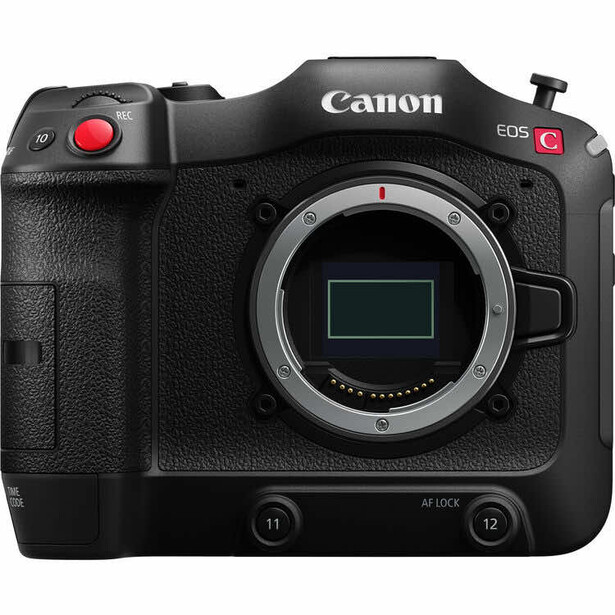
Dual Gain Output (DGO) is Canon's proprietary implementation, used in cinema cameras like the Canon EOS C300 Mark III and Canon EOS C70. This is a fundamentally different and more ambitious approach. Instead of choosing one gain mode or the other, DGO reads each pixel simultaneously at two different amplification levels (high gain for clean shadows, low gain for preserved highlights) and combines them into a single image. This produces over 16 stops of dynamic range. It's also significantly more complex and expensive to implement, which is why it remains confined to Canon's Cinema EOS line and hasn't appeared in their stills cameras. ARRI uses a similar simultaneous dual-readout approach in its ALEXA cameras.
The key distinction: most DCG and dual native ISO implementations read the sensor in one gain mode at a time, switching between them at a specific ISO threshold. DGO and ARRI's approach explicitly describe two separate readout paths from each pixel with different amplification levels, combined into a single high-dynamic-range image. The Panasonic GH6's Dynamic Range Boost mode also combines a high-gain and low-gain output from each frame into a single result, and Panasonic describes it as reading two types of image data simultaneously. Whether this constitutes the same per-pixel dual-readout architecture that Canon and ARRI describe, or a related but distinct implementation, isn't entirely clear from Panasonic's published documentation. What is clear is that the end result is expanded dynamic range beyond what either gain mode delivers alone, which places it closer in function to DGO-type systems than to simple single-mode DCG switching.
What This Means for Photographers in Practice
If you're a stills photographer shooting a recent mirrorless body, there's a good chance your camera has some form of dual conversion gain, and you've been benefiting from it without knowing. But understanding the switch point lets you make smarter exposure decisions.
The "ISO invariance" myth, clarified. You may have heard that modern sensors are "ISO invariant," meaning it doesn't matter whether you raise ISO in-camera or push exposure in post. This is partially true, and dual gain is the reason. Below the switch point, many cameras are very close to ISO invariant: shooting at ISO 100 and pushing four stops in Lightroom produces similar noise to shooting at ISO 1,600 in-camera. But at the switch point, the in-camera ISO wins decisively, because the hardware gain change reduces read noise in a way that software cannot replicate. Above the switch point, ISO invariance returns within that higher gain mode.
The practical takeaway: if your camera's switch point is at ISO 800, and you're debating between shooting at ISO 400 and pushing one stop in post versus shooting at ISO 800 natively, the ISO 800 shot will likely be cleaner in the shadows. You're getting a hardware-level noise reduction that post-processing cannot match.
Exposing for dual gain. In low-light situations where you're already above your camera's switch point, there's little reason to be shy about ISO. The sensor is in its high-gain mode and delivering optimized shadow performance. Conversely, if you're shooting in bright conditions and have headroom, staying at or near base ISO gives you maximum dynamic range because the low-gain mode preserves the most highlight information.
Checking your camera's switch point. The easiest way to find your specific camera's gain switch point is to visit Bill Claff's Photons to Photos website (photonstophotos.net), which publishes measured read noise data for hundreds of cameras. Look for the point in the read noise curve where there's a noticeable drop. That's your switch point. Alternatively, DPReview's dynamic range measurements will show a bump or plateau in the DR curve at the switch ISO.
Which Cameras Have It
The short answer: it's widespread, especially among recent mirrorless bodies with Sony-designed sensors. But the implementations vary, and not every camera has it.
Sony-designed sensors (used in many Sony, Nikon, Fujifilm, OM System, and Leica cameras) have used dual conversion gain for years. The Sony a7 V, Nikon Z6 III, Fujifilm X-T5, and Nikon Zf all show measurable dual-gain behavior in their read noise curves. The switch is automatic and invisible to the user.
Panasonic makes the feature explicit on video-oriented bodies like the Panasonic Lumix GH6 and Panasonic Lumix S5 IIX, where it's marketed as "Dual Native ISO." Some models allow the user to manually lock a specific gain circuit, while others (including the GH6's Dynamic Range Boost mode) combine a high-gain and low-gain output from each frame for expanded dynamic range. Base ISO values vary by recording mode: on the GH6, Dynamic Range Boost sets the base ISO to 800, or to 2,000 in V-Log and HLG. On S-series cameras like the S1H and S5 II, the dual native ISO values shift with the selected color profile (100/640 in standard, 640/4,000 in V-Log, 200/1,250 in Cinelike, and 400/2,500 in HLG).
Canon uses dual conversion gain in some of its stills sensors (the Canon EOS R5 Mark II, for example) and the more advanced DGO technology in its Cinema EOS line.
Blackmagic Design popularized the concept for independent filmmakers with cameras like the Blackmagic Pocket Cinema Camera 6K G2, which offers dual native ISO at 400 and 3,200.
Dual conversion gain is widespread in modern mirrorless cameras, but it's not universal. The question isn't whether every recent camera has it; it's whether yours does, and if so, where the switch point falls. Check your specific model's read noise measurements on Photons to Photos to find out.
The Bottom Line
Dual gain ISO isn't a feature you activate or a setting you toggle in most cameras. On Panasonic bodies with Dual Native ISO, you may have explicit control over which gain circuit to use (or you can let the camera choose automatically). On Blackmagic cameras, the switch happens automatically as you adjust ISO past a threshold. On most stills cameras, it's invisible entirely. But in all cases, it's a fundamental property of how your sensor processes light, and knowing it exists gives you a real advantage in the field.
The next time you're in a low-light situation agonizing over whether to push ISO higher, remember: there may be a point on the dial where your sensor actually gets meaningfully better at handling noise, not just incrementally worse. Find that point. Use it deliberately. And stop thinking of ISO as a one-dimensional slider from "clean" to "noisy." It's more nuanced than that, and your images will be better for understanding why.
If you want to go deeper on how exposure decisions affect your final images across different shooting scenarios, Fstoppers' Photography 101 course covers the technical foundations, and The Well-Rounded Photographer extends those principles across eight different genres where understanding your camera's behavior in varied lighting conditions becomes essential.




Join the Fstoppers community for free
-
Post comments and join in the discussions
-
Browse the site ad-free
-
Share your work and get featured in the community
-
Compete in the photo contests for fun and prizes
4 Comments
Good article. One additional point is that shooting above the second gain stage should still be a deliberate choice, especially in high-contrast night scenes.
When I photograph strong aurora in northern Norway, I often have extremely bright structures in the sky and a very dark foreground, especially around new moon. In those situations, I prefer to stay at the upper gain stage of my camera rather than pushing ISO much higher. That gives me enough dynamic range to lift the shadows later while still protecting the brightest parts of the aurora from clipping.
So while the second gain stage can improve shadow noise, going far beyond it is not always the best option if highlight retention is critical.
Why dual? Do you know there are digital cameras with eleven (11) NATIVE ISOs?
www.achtel.com/9x7
I confess, I got curious, but no pricing on that site. Probably, if you need to know that, you cannot afford it. Given that a Hasselblad is about $50K, I'll guess at 10X that, but maybe millions.
Excellent! In a couple of years the best-of-both algorithm should be widely available. I'd already guessed out that I could fix up ISO 800 images better than stretching out ISO 400 and now I know why! Thank you.