
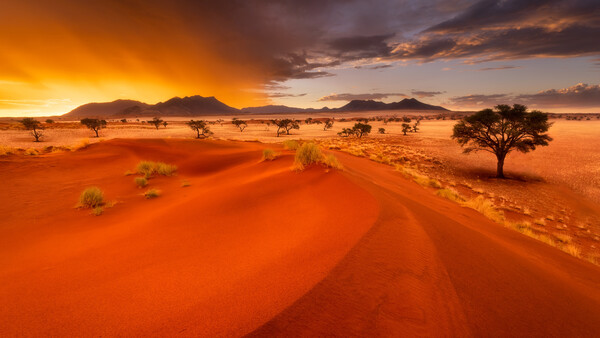
You may be reaching for the wrong glass to capture those stunning landscapes, trading intentional composition for uninspired vastness. Let's discuss why swapping out your go-to wide angle lens for a telephoto or mid-range lens could be the secret to creating truly compelling, focused photography.
The idea that a wide angle lens is the ultimate tool for landscape photography is widespread, but over-relying on it can limit creativity and produce dull, uninspired compositions. Composition involves not only including natural elements but also, crucially, excluding them. Using a wide angle lens carelessly often forces unnecessary features into the frame.
The Problem With Wide Angle Default
Many photographers, like me, are wide angle lens lovers, enjoying the sense of vastness the lens offers. However, you shouldn’t fall into the trap of using a wide angle lens at all times.
A wide angle lens:
- Makes distant subjects look smaller and farther away than they appear to the naked eye.
- Introduces lens distortion, which can be undesirable in certain scenes.
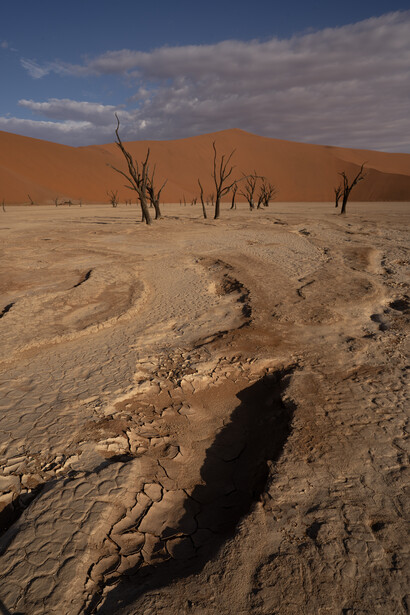
- Often forces the inclusion of foreground elements that may distract from the main subject, as can be seen in the photo of dead trees in Namibia.
- Creates a chaotic scene without a clear subject, resulting in a composition that lacks appeal and a specific point of focus.
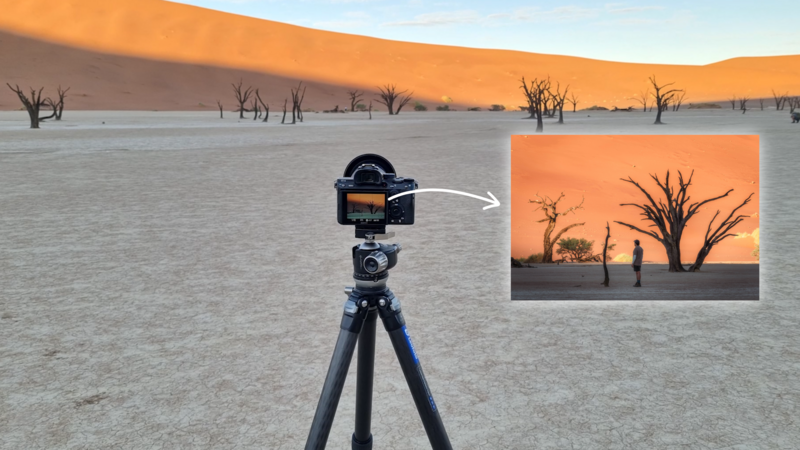
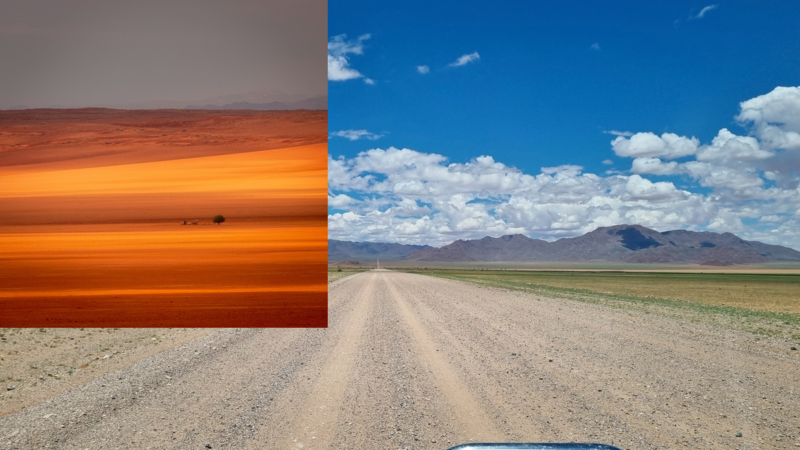
Here’s a wide angle shot of the same location. It seems like I am making a desperate attempt to create a foreground with the dried mud cracks using a wide angle lens. The trees appear smaller than they really are, and believe me, those sand dunes are massive. They take about an hour to climb, yet they look quite small in this photo.
The Power of Telephoto and Mid-Range Lenses
The strategic use of mid-range and telephoto lenses enhances creative options, especially in landscape photography. When I was in Namibia, I surprisingly found myself using a 70-300mm telephoto lens frequently because the wide angle lens couldn't capture the scene's beauty effectively.
A telephoto lens offers several compositional advantages:
- Breaks down a scene into multiple, manageable compositions.
- Compresses the scene, bringing distant elements closer and making them more prominent in the frame.
- Helps focus the viewer's eye on the primary subject and the specific beauty of its shape and arrangement.
- Captures distant details that embody the essence and entirety of the subject, whereas moving physically closer with a wide lens could lead to losing the desired aesthetic impact.
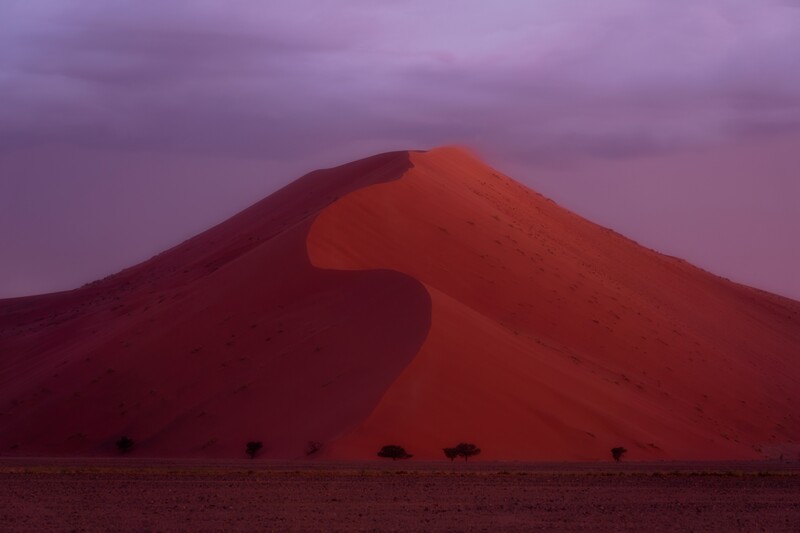
Here’s another shot of the Namibian desert, taken at 194mm from quite far away. In comparison, a casual wide angle view is pretty but lacks meaning.
Evaluate, Train, and Judge
My advice for aspiring landscape photographers is to develop intuition and constantly evaluate the scene before settling on a lens choice. As a photographer and a lover of vast vistas, you must try to avoid preconceived ideas about a location, especially when it’s new to you. Don’t default to the wide angle just because it’s a landscape; instead:
- Look at the scene first.
- Train your eye to see the potential compositions.
- Use your judgment to select the right tool (wide, mid-range, or telephoto) that best isolates the subject and eliminates distractions.
By thoughtfully evaluating the scene and choosing the lens that best serves the composition, photographers can ensure their equipment facilitates, rather than hinders, their creativity.
Join the Fstoppers community for free
-
Post comments and join in the discussions
-
Browse the site ad-free
-
Share your work and get featured in the community
-
Compete in the photo contests for fun and prizes
32 Comments
Perhaps the next step in landscape photography is to stop using the camera altogether. The genre has become a showroom for editing skills rather than a study of nature. Maybe trusting taste and imagination over glass and gear would be both more honest, and more profitable for those who sell beauty instead of presence.
I don’t quite understand what you’re saying. Are you saying to not photograph. I’m already having trouble with the article when I just received my first wide angle lens that I intend to use. I just bought a Hasselblad XCD 25mm 2.5 lens. I have always agreed with the premise of the article, but for the idea of becoming more of a part of the scene, I felt like it was time to go wide for a change. I can tell it’s going to be a challenge. I do agree with you in regards to over editing. That and “taste” are precisely why I am using the X2D2 from Hasselblad. I don’t want to edit anymore. Now I don’t have to.
Hi Jerome, I am a wide-angle photography enthusiast and use wide-angle lenses extensively. This article I wrote aims to raise awareness that wide-angle lenses can sometimes be a trap. You must use them, as capturing vast vistas or wide scenes is storytelling and helps pull the viewer into what you saw and felt. My next article on wide-angle lenses will actually focus on how to use them, or what I do and what I avoid. My personal portfolio is full of wide-angle shots. In retrospect, I should have made it clear in the article that I don't mean we must discard them, but instead use them with caution. Also, I should have made the title a bit less intense :-)
If the result is what matters, then the camera may soon no longer be needed. It already isn’t, for example, in commercial production, where generating a visual of a generic forest scene is simpler and faster.
But if you enjoy the process, nothing changes. Cameras like Hasselblad make the entire process an incomparable pleasure.
I fear the day when cameras are no longer needed. Aside from opinions on lens choices, photography is such a beautiful art; the joy lies in creating it yourself. My partner is an artist, and she faces similar issues where it's her hard work vs. someone generating something similar much faster.
It’s certainly very challenging. But on the other hand, it gives us a chance to focus on what truly matters and to develop a personal approach that AI will never be able to reproduce.
I agree on all sceptic and fear for AI and so, but landscape and travel are the fields in which I don't fear any development, because I do this for exploring and (telling the story of) the experience.
First do not get to worked up with this article showing a wide angle in wide far away captures for we all want to show more of a area that your peripheral vision would see but not clearly. The point is to make one aware of what scene not to use it on but to think with your eyes.
Landscape photography has ALWAYS been dependent on editing. Nothing new about that. Read Adams books if you need evidence.
Any photograph has always needed editing since the very beginning, but that’s not the point.
What changed is where the work happens. Landscape photography once depended on being there — on waiting, watching, missing, trying again. Like Adams did.
Now most of it happens after the fact. The scene is adjusted, perfected, rebuilt. The light no longer arrives; it’s applied. The process moved from the field to the screen, and with it, the meaning of presence slowly faded.
21 years ago in my youth, I spent a year in New Zealand on a work visa and shot the entire year on my trusty Olympus OM-2n and 50mm prime (both of which I still have today), and never once felt like I needed anything wider.
My default used to be 16-35 or a 17-28mm. I am more inclined towards a 24-70mm these days. 50mm is a great choice. I use it extensively for my shoots with people.
Muji, brilliant article, straightforward, concise, direct, and stays on point, (you must be a student of Hemingway!), possibly the best I've read to date here at FS. Although I may be bias since these are the practices I've abided by for the last 35+ years.
Thank you for reading and for your feedback, Paul :-) It seems I have ruffled some feathers with this one. I’ve received quite a few comments from close friends (teasing me), as they saw this article and took the mickey because they know I use wide-angle lenses extensively.
The author here has shown where he misused his ultra wide lens with the with the dried mud cracks in the foreground. The main thing to always remember about the super ultra wides is there is a story near and another far away where both are combined. Many captures of a wide scene is manly called a tourist photo where one tries to capture everything.
A wide 35mm or ultra 16mm or super wides 10mm all have their place EVEN telephotos of many different ranges for those times to walk or stand still. The reason is it is your eye that sees the story you want to capture. Primes are pretty much left at home for todays telephotos are now great meaning fewer lenses in a bag.
I am one who began with wides like a 16mm of the 16-35mm f/4 but in the beginning I found the Sony E 10-18mm (15-27mm in 35mm) f/4 OSS a very small lens smaller than primes even today that could be used in full frame mode at 12-18mm (18mm if the rear light shield is removed as Trey Ratcliff showed in a review in 2014.
At the time no maker of cameras and lenses had a 12mm except fisheye lenses not till Sony in 2017 with the FE 12-24mm f/4. There is a film Canon FD 14mm f/2.8. But this E 10-18mm is what I trained my eye with for the super wides. I still carry it in my everyday walkabout bag with my FE 24-240mm that in APS-C is 36-360mm (in camera cropping) a big range to have at your finger tips, just saying more in not always needed.
The key to the Wide's is the multi story in the image, the foreground and the background. Sunsets/rises are good for the art in the sky will never be the same ever again or astro Milky Way's where again the sky is the art behind a foreground subject that you can get super close to also.
Info you will never get the size of the moon as you see it with a wide angle lens!
Remember to also see with your photo eye the other story!
1. using the FE 12-24mm at 12mm in 2017 to get more in an image than anyone else with the A7RM2 using bracketed 3 at +/- 2EV when all others were doing long exposures.
2. using the Voigtlander 10mm f/5.6 to also get more using the A7SM1 hand held when tripods were not allowed.
3. The Voigtlander HELIAR-HYPER WIDE 10mm F5.6 with two stories
4. The E 10-18mm at 12mm two stories of sky and ground 2015
Thank you for sharing your thoughts and some great images.
Some of my favourite landscape shots were taken with a 105mm macro lens. But wide angle has it's place if used well with foreground too, the tourist shot description is really accurate for most though.
Stunning rock formations. They remind me of the Cederberg region here in South Africa.
I shoot about 50% wide angle and 50% with my telephone photos. Zoom and I can guarantee you that I sell more wide-angle photos for printing and for framed print as well. It's just a look that customers prefer so in my game I go with what my customers want so if you're just shooting for amateur hour knock yourself out pull out your big zoom and shoot to your hearts content but if you want to se then you will find you will sell more of the wide angle look that simply because they look more epic on a wall especially when printed at A1 or AO size. And if you look what's on my wall in my house, it's telephoto photos but I know that my customers they will prefer the wide-angle shot. And at the end of the day, it's also how you use that lens as well. I don't think there should be a hard and fast rule with it at all. I have been using my GFX 20 to 35 which is equivalent to 17 to 28 and that lens has been an absolute moneymaking machine so I would be stupid not to use it. I would be derelict in my duty not to use that lens.
What a beautiful image! You’re absolutely right: there shouldn't be strict rules when it comes to photography. It really depends on personal preference and the specific needs of the scene.
You're correct it is really down to what the scene requires. I also know from a selling perspective as I sell a lot of framed prints and I mean a lot and I guarantee you that about 80% of them are shot with a wide angle lens. That's just a look that customers prefer so why would I move away from a formula that's been really successful for me that would just be plain stupid......
It’s preference … and I’m not even gonna waste time to read the article with such a click bait title
In general, I feel that the closer the subject to a wide angle lens, the better.
Couldn't agree less with this post.
Wide angle lenses are great for landscape photography.
No doubt if you write a continuing article about the benefits of a wide-angle lens, Muji, you'll speak to how it emphasizes foreground elements for good reasons. In your article, you say "[A wide angle lens] often forces the inclusion of foreground elements that may distract from the main subject." Therein lies the heart of the issue. If the foreground is the main attraction, and the background is relatively less important, a wide-angle lens is a perfect choice. If the foreground is truly a distraction, go with a longer lens and take it out of the picture.
Possibly the greatest benefit of a wide-angle lens is that shorter focal lengths have much greater depth-of-field. Wide-angle lenses are nice to have in your bag, but seeing an appropriate picture is completely different than with longer lenses. It's not just a matter of including more real estate into the picture. Instead, you'll be looking at your feet for interesting subjects, and then trying to determine how the background complements that subject.
My next article, ironically, is about how to use a wide-angle lens (Do's and Don'ts). In hindsight, I should have made the title a bit less intense. Most of my landscape work has been shot with wide angles. Thank you, as always, for sharing your insights and some stunning images.
As a writer, you probably understand the correlation between titles and response rates. Your audience here at Fstoppers appears to be natural contrarians. Nobody seems to be interested in responding to a non-controversial subject, but give someone a reason to jump all over you, and the quantity of comments skyrockets. So while some folks are critical of click-bait, a delicate balance between misleading titles and stimulating a response from its wording is worth finding.
Sorry Mujahid, I appreciate the effort of the article, some arguments are valid, but I strongly disagree on your statement to stop using wide angle (which I heard many times before btw). People who opt against wide angle always seem to leave out the style element. It's more important HOW you use that wide angle (to avoid flat compositions with much elements and a small background). Wide angle ofc makes a certain dynamic possible which can be exciting or playful. On the other hand a long tele lens can often create a more serene scene.
How would I make the photo standing on a cliff, with only a tele in my bag? Personally I'm a 16-35 fan. I use it for the majority of my travel photo's (also because of the more neutral 35 option or even a mild crop towards 50 or so). It's the perfect tool for both reportage, environmental portraits, cityscapes (how to photograph New York with tele only) and landscapes. And yes, at the same time I keep alert for those nice crops isolating a certain subject. That's when I grab my 24-105 or in a low percentage of photos my tele, which I carry all day but mainly use for things I simply can't reach.
It's an interesting question though whether to use one or two focal points only for a coherent series, or to use diverse focal points (2 zooms) for variety. In most cases I prefer the later and consciously play with totals and details. Though I know this can be achieved with 1 lens as well (more efficient and a fun challenge as well), I sometimes like to explore options with both if I have the time at that spot.
Hi Leo, thank you for taking the time to read and respond, I really appreciate it. As I mentioned to Ed in the previous comment, my next article will ironically focus on how to effectively use a wide-angle lens, covering the do's and don'ts. Looking back, I realise I should have chosen a less intense title. Most of my landscape photography has been shot with wide-angle lenses. While I am open to using them, I always evaluate whether the situation truly calls for it, so I don't automatically default to wide angles. I agree with the points you've highlighted.
There are no rules just people trying to get views online. Just get out there and hope for great light, any camera, any lens, anytime.
I have found this Article, and the comments it has stimulated, one of the best I have considered in fstoppers for a long time. Traditionally I have shot wide my landscapes o (24-50 or 28 prime with appropriate cropping). Photographing landscapes in the South Island of New Zealand in Autumn this year, our guide suggested I shoot at 600mm into the snow covered ranges which I did with my OM System gear and an OM System 2X Teleconverter. I was amazed at the range of interesting compositions it uncovered that I had never ever considered before. I'll be using both in future. Thanks Mujahid and respondents - you've all broadened my perspective.
You are welcome :-)