
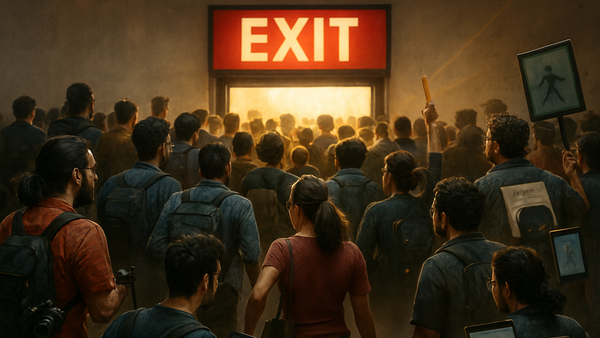
A growing number of photographers and creatives, once loyal to Adobe, are walking away. Is this the slow decline of Adobe's monopoly on the creative world?
For the last twenty years, Adobe has had a creative monopoly in the creative world. Little competition, but really, no competition that could come close to offering what Adobe could offer its creative users. In recent years, Adobe's dominance has started waning, and the pushback has begun due to rising costs, ethical concerns, and better competition. Adobe has become too comfortable as the leader in tools for creatives. Will this come back to bite them in the butt?
The Breaking Point
What is driving the departure? One word: subscriptions. Subscriptions have their pros and cons, like everything, but many are starting to feel subscription burnout. Think about it—how many subscriptions, as a photographer, are you paying for each month? For me, it's six. Add in the subscriptions you are using at home, and the number can be much higher. Gone are the days of purchasing software and then uploading it for use. Don’t get me wrong, the subscription route in the long run is a much more affordable option if you regularly update your software. Many are starting to feel that you are essentially “renting” the software, which is just wasted money. Many alternatives offer flexible plans or one-time purchases, creating long-term savings in return. An Adobe Photography Plan costs $240 a year, compared to Affinity Photo costing a one-time purchase of $70.
Ethical and Privacy Concerns
The hot-button topic these days is AI, and Adobe is no stranger to the issue. Back in 2024, Adobe updated its terms of service, allowing AI training on users' content—a move that raised significant concerns and crossed a line for many. Rightfully so! This created backlash from the creative community, especially long-time users of their products, leaving them feeling betrayed. With this, many users started questioning Adobe’s transparency and ethics around their use of users’ data. The result: trust issues. Adobe was seen as the cheating spouse after years of marriage. How could they be trusted?
Performance
Users started complaining about sluggish performance and frequent crashes, especially with Photoshop and Lightroom. Users began exploring other options and found that Capture One and Affinity Photo were suitable replacements, providing better responsiveness. Often, Adobe prefers machines with higher specs, which can be unfriendly to budget-conscious or mobile creatives.
Hostage Situation
Adobe has created a locked-down system that could be described as a hostage situation. There was difficulty in migrating catalogs and raw files to other options you are migrating to. Many of Adobe’s files and workflows are solely tied to their processes. When a developer locks down their software, they are creating fear in the user, whether they know that or not. Why? They are then too afraid to leave. They feel they are starting over, and when you have thousands of photos, migrating them to a new platform seems daunting. Even transferring files from one computer to a new one can be daunting.
Gaining Momentum
While Adobe appears to be losing ground, other developers are releasing options that are giving Adobe a run for its money. Releases like Affinity Photo and long-standing ones such as Capture One have become more powerful with new releases and tools at the disposal of creatives. Options will become more prevalent than they already are in the future as Adobe continues to let down its existing customer base. I expect Adobe to start losing its monopoly over the years as creatives shift their business elsewhere, unless Adobe wakes up and realizes what a mess they have created.
The Transition Isn’t Without Tradeoffs
In a world where creatives have long been loyal to Adobe, despite their reservations, the transition has not been smooth for the creative user. New interfaces, shortcut changes, and unfamiliar workflows ultimately bring a learning curve. Taking time to learn new software and workflows will take a once-speedy process, due to familiarity, and ultimately draw out one's time. Once the learning curve is in the rearview mirror, many users have stated they are seeing better usability and faster results.
What This All Means to the Creative Industry
The creative industry is rooted in history with Adobe, and its market share largely remains, but competition is finally credible. The backlash against Adobe signals that creatives are valuing control, ownership, privacy, and ethics more than ever before. Taking a stand and letting Adobe know that we are fed up and taking charge. No longer are creatives wanting to be held hostage by brands and their privacy agreements. What happens when enough creatives voice their opinions and start to leave Adobe products? Adobe will begin to see this shift, and it could force their hand to rethink their strategy on pricing, performance, and trust.
 Should You Make the Shift?
First and foremost, only you can make the final decision. Yet, there are key considerations to take into account when you are thinking of ditching Adobe and making a switch.
-
Budget constraints
-
Level of reliance on Adobe
-
Type of creative work (video, photography, retouching, and design)
-
For hobbyists and freelancers: alternatives can fully replace Adobe
-
For high-end commercial teams: partial switch or hybrid workflows might be a better starting point
In Conclusion
The age of choice has returned to creative users. For the first time in years, photographers and other creators finally have more than a few choices for viable, reliable, powerful creative software. Adobe remains the largest provider of software to innovative users, despite its downfalls over the last few years. Adobe will remain the number one choice of users for years to come, but they will lose a large portion of their user base in the future, especially if they continue to play their same old game. Unfortunately for Adobe, they did this to themselves in a short matter of time. For us creatives, our future has never been brighter, with more options than ever to choose from. One final question that I pose to readers is: What do you value more—familiarity or freedom?


Join the Fstoppers community for free
-
Post comments and join in the discussions
-
Browse the site ad-free
-
Share your work and get featured in the community
-
Compete in the photo contests for fun and prizes
74 Comments
This is a mixed bag of both the good and the bad of the Adobe software suite. The good is that we are seeing frequent upgrades/updates. There is more in PS than I will ever use, but on occasion the tools there can turn an image into something worth having. I was recently editing some photos that members sent to me for inclusion in a catalog. I was able to make them look fantastic with the Adobe tools.
The bad is that you are basically renting the software. If you don't keep up the subscription, you are locked out. No grace period. The other bad is using someone else's software to edit; you have to relearn how to use it, and it isn't always as intuitive as Adobe.
I like the Adobe Suite, as I use Bridge, PS, Dreamweaver and the beta programs they offer. With the neural filters and content fill, you can do a lot in what used to take a long time.
At my age I have been using this software for since ver. 1.5, I can't see migrating somewhere else unless it is to the local cemetery.
When doing the math about on-off purchase vs subscription, don't forget inflation:
Assuming you upgrade every 2 years:
Photoshop purchase: $700, upgrade $200 (+/- the prices in 2012):
$700 + $1200 (6 upgrades) = $1900 or 95 months or 8 years of subscription ($20/month).
This is without taking inflation into account: a one time purchase of Photoshop today would cost $986.
yup people have forgotten or they didn't do photography pre 2013
my Creative Cloud subscription costs me AUD$1055 per annum...I used to buy the creative suite outright, started with CS4 but had used, at work, Photoshop back to versions before the CS suffix was used. Over the period of the last 15 years or so I started doing video as well as stills so the full suite suited my needs with Photoshop, Premiere Pro, After Effects and Audition being used regularly and the ability to transfer assets through the pipelines of these programs suited my changed needs so I bit the bullet and just ran with the subscription model when it came in...I no longer do paid work so it is now a personal expense but one that I "need" as well as want...the thought of switching everything over and learning new software is a bit daunting to me as I have had 3 brain bleeds in that 15 year period and find new procedural learning hard so I do have a reliance on Adobe
Before Adobe moved to a subscription model consumers could choose to buy the latest update or not. I used the CS3 suite for many years as it did what I needed and there was no need to spend more money for features I didn't need.
I did upgrade finally as a lot of my work involved InDesign and for some reason😁 Adobe kept changing the file format in a way that was not backwards compatible.
However once they went to a subscription model I realised that my files would be unreadable if I ever stopped my subscription. I did not want my business held hostage having to pay whatever monthly fee Adobe chose.
I have a suggestion for a win-win scenario.
Imagine how good it would be if Adobe offered their software in both a perpetual licence version and a subscription version. Those who preferred to pay a subscription would be able to continue doing so, and those of us who don’t need frequent upgrades would be able purchase a perpetual licence version and also enjoy using the software. Everybody wins. Even Adobe wins. I haven’t paid them a single penny since they went subscription only. If they went back to offering a perpetual licence version of Lightroom, I would buy it. That would mean another customer and more money for them. Win-win.
This article is click bait at best, and misleading at worst. Where are these masses who are leaving Adobe? Based on the comments here I'd say that's a false narrative.
And the article says it's $240 a year for Photoshop but I pay $12 a month which makes it $144 (the $20/month price is for the cloud version and 1tb). Further to that, before the subscription model was implemented the price to upgrade Photoshop was closer to $500-600 and that was yearly as well. If you missed too many upgrades and 2 or 3 later you wanted all the new stuff you had to buy a new full license for around $1000.
So people complaining about the subscription are just whining because they can't get a pirated copy anymore. I can't tell you how many working professional photographers I knew who openly admitted to having a pirated copy of the software. Now that it's $12/month they're mad they have to pay at all and they can't break the law to have it for free. Think about it. That is why Adobe switched to subscriptions in the first place, to get a handle on unauthorized use of their products. And if I may say so, rightly so!
Professional photographers who did that should be embarrassed. They'd then turn around and complain when their clients copied their images without permission. Karma is a ... well you know.
So no I'm not leaving Adobe. I'm happy with what I pay and what it delivers.
This is supposed to be a photography site and you can't even use a real image?! What's the issue, you don't want to pay an actual photographer for their images?? You're part of the problem then.
You've repeated several times now the cost of a Photoshop upgrade as $500. For a single user, the Photoshop upgrade cost for CS5 (2010) and CS6 (2013) was $199. The extended license and full creative suite license would have raised the cost, but for just the regular single-user Photoshop license, it was not as costly as you claim. And it was not yearly... I generally upgraded every other version without ever paying for a full new license. Having been a Photoshop user from the beginning, I was curious what my upgrade costs were in the 1990s... alas, a Photoshop 5.0 upgrade in 1998 cost $169. A new license was typically in the $700 range.
LRC is slowing down with each update and its getting frustrating. My main complaint is when I batch edit and any type of denoise is involved, I just let it run overnight since it can take a few hours to batch edit 2000 photos. Then when I navigate from photo to photo, it can take half a second. I don't have the best of the best PC, but I'm well above the required specs.
It is not that all are leaving Adobe, it is just not everyone has the time to edit images. And a reason film is now popular.
I have a nephew that buys many different cameras and expensive to boot and he just uses the Auto Function(s) and just sends images to others via the net.
I mainly like Lrc myself and have other programs also to play with but not a pro just a hobbyist, I have time for I am retired, everyone has a toy!!!
As a long-time Adobe Photoshop user, I switched this year, because of the reasons of what the article describes.
Having tried the top 10 alternatives, I can tell you that the second spot is not even close and I'm not defending Adobe here, but one thing should be said, Photoshop is a hell of a piece of software.
Yes, I grumbled when I ‘had to’ switch to a subscription model, but the numerous and significant updates to Lightroom over the years have been worth it. However, I’ve ditched Photoshop: it was bloated, handcuffed on iPad, and solely focussed on AI-this and AI-that. Not my scene. I replaced it with Affinity Photo (a breath of fresh air on iPad) and trimmed my Adobe subscription down to both Lightrooms + 1TB, paying just over CAD150/year. I’ve spent thousands on camera gear; another $150/year for industry-standard editing is worth it. Other than Capture One, there is simply no other editing suite that competes with Lightroom when used at the depth I’m using it. Yes, I’m frustrated with the iPad version, but anything I need to do in my authentic photography, I can do in Lightroom or Lightroom Classic on my laptop.
Click-bait headline aside, the big problem with leaving Adobe is that there's no good alternative, just bargain-bin wannabes. I tried one of the other big names for a couple of years, mainly out of self-righteous resistance to Adobe's subscription change. Big mistake. Now I'm back with Adobe and happy with it.
Everybody's financial situation is different, and I can't judge, but I wonder about it when I see people with many thousands of dollars worth of pro-spec bodies and lenses in their gear lists complaining about $20/month for a critical workflow tool.
Are there any companies now that dont want to try to get a monthly credit card charge?
I switched to capture one, affinity photo, and davinci resolve to get away from adobe. I couldn't be more pleased. I own my software and none of it comes with bloatware that hogs the hardware performance of my computers. Once adobe announced it was going to subscription I called that it would get worse performance and continually rise in price with shady contracts. I was not wrong. there is a reason adobe is getting sued by the U.S. government right now.
On the performance of adobe software, I can't get more than 5 images in before light room slows to a crawl requiring me to restart my computer. Photoshop does the same thing. It's because both programs will not dump the ram they use when moving to a new project /image. Also, after YEARS, the polygonal lasso tool is STILL busted in Photoshop. I do a lot of selections and I constantly had to restart selections because specific functions of that tool would just not work. Pressing backspace to undo selection points just randomly stops working and so does the ability to pan around the workspace. it is incredibly frustrating and makes what normally would be a pretty quick job into something that can take hours to complete.
CC software installs like 5 different OTHER programs that hog resources. You can't just install Photoshop and Light-Room. Nope you have to have a whole suite of resource hungry nonsense that doesn't help you get work done. It does NOTHING for you but a lot for Adobe. After using capture one, affinity photo, and resolve I have learned that they all do the jobs I need done far better than adobe software can. Especially affinity photo. Good lord it makes retouching portraits a breeze.
I paid $120 for a one-year subscription that includes Creative Suite, Lightroom, and Adobe Portfolio, which I use to host my website. I haven’t seen a better deal than this. If another company wants to tempt me, they’d need to offer a $5 subscription that includes a website or portfolio platform—then we’d be talking.
Everyone is promoting these new softwares but they are nothing great. Yes they are nice but nothing new that Adobe cannot do. I have tried some of the new ones. They do great job but at the same time they are limited. Adobe allows you to set up actions and adaptive presets. Once you set these up its even better than the other softwares and you do everything at one place. You don't have to switch software for 1 or other thing.
I realised this a sponsored article but absolutely gobsmacked noone in the comments has mentioned the completely free open source option of GIMP and Darktable.
Sure, if you like pain. Darktable's UX is so illogical that my head hurts. And GIMP is not even in the same class as Adobe or the top 10 other alternative to Ligthroom/Photoshop.
Pretty much every article about every photo editing software always claims it to be a new Photoshop or a big Adobe rival, so I'd take it with a grain of salt. That being said, with prices going up, some users getting tired of the subscription based model (I see a lot of in on Reddit, for example) and free or one time purchase alternatives like Gimp or Photoworks being right there I can see how a part of Adobe's clientele switches to that instead. However, how big is that part actually? Guess we wouldn't know.
Adobe's subscription model is predatory, but it has competitive pricing. My reason for switching away from Adobe is not pricing but a multitude of reasons:
1. At every step, they want to chug AI down your throat, which I don't like.
2. They almost force you to upload everything to their cloud storage; the only way to prevent that in Lightroom is to pause syncing, and there's no option to turn it off entirely. If the photo is loaded from disk, for some reason, it works worse; all the culling and other controls are slow.
3. They modified their T&C so that you automatically agree that all your photos will be used for AI training, which is a hard pass for me.
4. Their cancellation fees are outrageous and plain and simple illegal in the EU at least.
5. There's no easy way to completely get rid of all their apps, like that creative cloud BS app, also Adobe has the gall to state that it's "not recommended to uninstall their app", this is still stated on their website: https://helpx.adobe.com/creative-cloud/help/uninstall-creative-cloud-de… I had to go over like 5 steps to uninstall all that crap and I'm not even sure it's fully uninstalled everything.
... and the list could go on and on...
I regularly see this “end of Adobe” theme pop up from fstoppers in my feed. At this point, it is beginning to feel like Clickbait.
I remember when it was something like $700 to buy a perpetual license from Adobe and you got just about everything. It was some kind of master deal.
The subscription model is probably on par but I get every single app that they offer plus Adobe stock and generative AI. I think non-discounted is around 59 a month and you can install it on three machines.
I definitely like reading articles on replacements because it’s expensive, in fact when I discovered Davinci Resolve I don’t think I’ve opened up Premier Pro since.
I doubt, however, that these subscription models or alternatives spell the “end of Adobe”.
It can be click bait, but there are times when there's valid news since everyone is trying to topple Adobe. I remember the days where Adobe didn't care (unofficially) if individuals pirated their software, because when companies were looking for talent all they could find were people who knew Photoshop, Illustrator, etc. This strengthened their hold on the market for the last 25+ years and no one has really been able to compete, outside of Capture One, but that doesn't have Photoshop's capabilities. They're so entrenched in the culture that any photo editing is called "Photoshopping."
I think the subscription model, while not ideal for a lot of people, works with the constant updates. Tech is expensive, innovation is expensive, and the ridiculous amounts of money companies are throwing at top AI talent is ridiculous and they have to pay for it somehow. I'm fortunate enough to be able to afford $60 a month for the full suite, though I definitely don't use it as much as I should.
All that being said, I think your last statement rings true. Subscription models aren't gone and Adobe definitely isn't on the way out.
Yep. A lot of these titles are click baity but they do generate a lot of discussion which is good but I agree with what you said. even though I personally don't use Adobe any more they aren't going away anytime soon. It also must be noticed that even though Adobe is here to stay there is a not insignificant number of users that are indeed leaving Adobe for other software. Kind of like how There is a not insignificant number of people leaving Windows for Linux for similar reasons. Windows still has something like 5 billion active licenses across the globe but their market share has waned in the last couple of years. Especially with their push of privacy invasive software's like windows recall and and hardware failures likely being cause by Microsoft's increased reliance on A.I coding and just plain poor decision making (I've already been a victim of this). It also doesn't help Windows that younger generations use their phones as their primary computing devices so they have no need for Windows. I think the common factor in these discussions is that users are increasingly desiring more agency and control over the things they are spending their money on and using in their everyday lives.