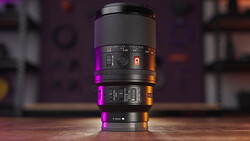
Macro lenses rarely change the way you shoot, but this one pushes past life-size and keeps autofocus. If you want cleaner close-ups, steadier handheld results, and more control over depth, take a look at this option.
Coming to you from Gordon Laing, this practical video walks through the new Sony FE 100mm f/2.8 Macro GM lens and shows what 1.4:1 looks like in the real world. Working distance stays comfortable at roughly 9 cm from the front at maximum magnification, so you avoid casting shadows or startling a living subject. Autofocus remains dependable at the minimum focus, and DMF gives you a quick nudge to place the critical plane. The focus limiter offers full, infinity–0.5 m, and 0.26–0.7 m ranges to cut hunting at close range.
Laing shows how the lens behaves in the field, not just on a bench. Corner sharpness improves when you stop down slightly at macro distances, while center detail is already crisp wide open. You also see the effective aperture change up close, where f/2.8 behaves closer to f/5.6 for exposure, which affects your ISO picks. Handheld clips benefit from optical stabilization in the lens plus in-body stabilization, which steadies small movements that would otherwise wobble a composition. Continuous AF holds on as you move from portrait distance toward minimum focus, provided you keep a small AF area on the specific feature that matters, like an insect’s eye.
Key Specs
-
Focal Length: 100mm
-
Aperture: Maximum f/2.8, Minimum f/22
-
Lens Mount: Sony E
-
Lens Format Coverage: Full frame
-
Minimum Focus Distance: 10.2 in / 26 cm (from sensor)
-
Magnification: 1.4:1 macro reproduction, 1.4x magnification
-
Optical Design: 17 elements in 13 groups
-
Aperture Blades: 11, rounded
-
Focus Type: Autofocus
-
Image Stabilization: Yes
-
Filter Size: 67mm (front)
-
Dimensions: ø 3.2 x L 5.8 in / ø 81.4 x L 147.9 mm
-
Weight: 1.4 lbs / 646 g
Build and controls land where you expect from a G Master lens. You get an aperture ring with click/de-click, an AF/MF switch, two focus-hold buttons, and a DMF toggle for full-time manual override. Weather-sealing is improved, including a mount gasket you can trust in humid spaces. The focusing ring uses a clutch to flip between modes, and the long throw in manual helps nail plane placement without hunting.
The video also covers behavior outside macro distance. At portrait range, you get clean separation at f/2.8 with smooth backgrounds, though not the melt of a faster short tele. Bokeh balls show slight cat’s-eye shaping toward the edges at f/2.8 and become more uniform by around f/4, while the 11-blade diaphragm shows geometric shapes as you stop down further. Focus breathing is visible as you rack from infinity to close focus, which is typical for macro designs and something you account for when composing tight frames. Shutter choice matters with living subjects and moving plants, where 1/400 second is a pragmatic floor under mixed light and the practical aperture loss at close focus pushes ISO higher, up to ISO 8,000 in one dim example.
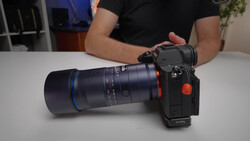
You also see practical combinations with native accessories. The lens maintains autofocus with the Sony FE 1.4x Teleconverter and FE 2.0x Teleconverter, which extend magnification while keeping handling familiar. The camera body used in the demo is the a7R V, and its AF system helps when you switch from subject-detect to a tight single-point area at very close range. Check out the video above for the full rundown from Laing.


Join the Fstoppers community for free
-
Post comments and join in the discussions
-
Browse the site ad-free
-
Share your work and get featured in the community
-
Compete in the photo contests for fun and prizes
3 Comments
"Macro lenses rarely change the way you shoot..." Standing on its own, that comment makes no sense to me. Having started my adventures with a camera in the field of landscape photography, a macro lens for me changed everything....
The first and most obvious thing is that I can get much closer to the subject than most longer focal length lenses. The focus distance (subject to sensor) of my Sigma 2.8 105 macro lens is about 12" and the working distance (subject to front of lens) is about five inches. Coming from a predominantly landscape photography background when I acquired the macro lans, I'm changing the way I look from grand view landscapes to the tiniest details. I'm looking at my feet instead of far out into the distance. And then I'm zooming in closer and closer... to the picture within the picture, and within that picture to another picture. It's a completely different way of seeing.
The next major change in the way of seeing a macro photo is a result of the lens's limited depth-of-field. At extreme closeness to the subject, DOF is razor thin. Some photographers attempt to override this limitation by combining numerous images in a focus-stacking application. I've used that technique twice or maybe three times since buying a macro lens about eight years ago. Honestly, focus stacking a hundred images seems like a dizzying amount of work.
Instead of trying to get every pixel in focus as I would in a landscape photo, I've embraced shallow depth of field as an art form. Something with a more painterly effect. But it's not that simple. The first decision is where to focus the image. Since the area in focus is a small part of the image, placing the camera in position relative to the subject which captures the most elements on the same focal plane is a big decision. I still want a super sharp line or edge on a a small portion of the main subject, but how much or how little is a totally new way of seeing. And while the background is thrown out of focus, shapes and colors still matter as a critical ingredient in the composition. In other words, it's not like I can simply throw the background out of focus and forget about it. Bright spots in the sky can still be distracting, as are colors that don't work well with your subject.
Thank You for the extra info! You never know enough!
Thank You so much! Your video with so much info takes one back to close ups of all kinds, Thank You also for the focus stacking results for a macro capture is just part of the object and with focus stacking you get a whole object. I also have the A7RM5 that I love, and have wanted to do a focus stacking. This video would be great for a beginner or even a seasoned macro capturer.
One question, if the lens is a 1:1.4 then adding a 1.4X teleconverter equals ? Or even if you go to APS-C mode that is equal to 1.5X.
Have one on the way just getting my thoughts together again.
Just to say how much fun the FE 90mm F2.8 Macro G OSS is also.
#1 and 2 . #1 FE 90mm F2.8 Macro G OSS + A7RM2 Hand Held on a walkabout F/2.8 1/25s ISO 200