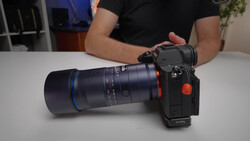
The Sony FE 100mm f/2.8 Macro GM lens gives you something few lenses do: true macro precision with portrait-level rendering. It’s not just a tool for bugs and textures but a versatile upgrade that replaces one of Sony’s most beloved lenses, the 90mm Macro. If you’ve relied on that classic lens and started feeling its age, this new version brings back the excitement.
Coming to you from Gerald Undone, this thorough video breaks down the Sony FE 100mm f/2.8 Macro GM lens and what makes it a real step forward. The lens is slightly longer and heavier than the 90mm but keeps familiar comforts like optical stabilization and the focus clutch. Gerald notes that Sony added a de-clickable aperture ring, a second function button, and a full-time DMF switch, all small changes that make daily use smoother. The front filter thread now matches other modern Sony lenses at 67mm, reducing adapter clutter. Most notably, this lens supports Sony’s 1.4x and 2x teleconverters, pushing magnification to an impressive 2.8:1 macro ratio.
The build changes matter, but the real leap is under the hood. The older 90mm relied on an aging Direct Drive SSM motor. The new 100mm replaces that with four XD linear motors that are nearly twice as fast, quieter, and more precise. Autofocus at close range is stable and confident, even when the subject is millimeters away. Gerald points out that focus breathing remains noticeable at extreme magnification, but for portraits or mid-distance work, Sony’s focus breathing compensation feature handles it cleanly.
Key Specs
-
Focal Length: 100mm
-
Maximum Aperture: f/2.8
-
Minimum Aperture: f/22
-
Lens Mount: Sony E
-
Format: Full Frame
-
Minimum Focus Distance: 10.2 in / 26 cm
-
Magnification: 1.4:1
-
Optical Design: 17 Elements in 13 Groups
-
Aperture Blades: 11, Rounded
-
Image Stabilization: Yes
-
Filter Size: 67 mm
-
Weight: 1.4 lbs / 646 g
Gerald compares the new lens directly to the 90mm, revealing sharper detail in the center and corners. Chromatic aberration is nearly invisible, even wide open, and flare control is better too. The 11-bladed iris softens the bokeh slightly, producing smoother transitions and less busy backgrounds. For portraits, that refinement shows immediately, as the subject stands out while the background falls away in a clean blur. Gerald highlights the improved color rendition as well, calling it more natural and balanced than its predecessor.
There’s also a practical side. Macro shooters who do focus stacking might still need rails because the frame shifts slightly during focus, but the image quality is worth the extra effort. Whether shooting portraits or crawling up to a spider’s web, the new 100mm holds sharpness edge to edge and delivers richer color and texture.
Gerald doesn’t call it perfect, but he makes it clear this is the best macro lens Sony has built so far and a major upgrade from the 90mm. Check out the video above for the full rundown.




Join the Fstoppers community for free
-
Post comments and join in the discussions
-
Browse the site ad-free
-
Share your work and get featured in the community
-
Compete in the photo contests for fun and prizes
2 Comments
One thing missed in reviews is the add when selecting APS-C which is a 1.5X add to all from the base 1.4X and a add of 1.4X or the 2X teleconverters closer is closer. As in the years past most used film telephotos and on a rail sliding some a little to focus stack and then putting together in PS all a long process even adjusting lighting at each step and mostly from some distance away also, just to say difference from just a few years ago to this now Sony lenses AND to do hand held out of doors where live subjects can be captured on their home turf getting more real vs a staged image!
The 90mm is awesome in its own right and only a slight increase in price a no brainier to just go to the 100mm or even sell your 90mm and use that $ to the purchase.
#1 a 90mm hand held on a walk about.
What about Ring Flash's for front of lens?
Another thought while my brain is turning circles first is the lens is a 1.4X so is it a 100mm or a 140mm but it is a macro 140mm base lens right! No one reviews what MM is if in APS-C mod of an added 1.5X making a total 210mm BEFORE adding a teleconverter. My A7RM5 does a Pixel Shift getting a 240.8MP image able to do it hand held also. The A7RM5 60MP camera is used most for cropping by many photographers but in APS-C mode you get a in camera crop meaning one a closer image of 90MP.
So will the A7RM5 be able to do focus stacking while in a macro mode hand held and if you add pixel shifting to the mix of the capture can all be done at one time then if you also are in APS-C mode for that closer image. or even adding the 1.4X or 2X teleconverters and even also in APS-C Mode, Yes you would have to be some distance away because of MM distance but a miracle if all can be done hand held I would recommend a tripod anyway, but what a test and with video to show all. My math may be way off but it is just a thought no one has presented in a review yet. Also the many thoughts before its arrival in November sometime a Thanksgiving month to give Thanks for great lens also. Using APS-C mod you use the center of the sensor allowing for even faster AF points and other things too. Like when birding and using the 200-600mm with a 2X teleconverter and in APS-C mode you a very close like standing there. But you are like using 1800mm lens so how far away will you have to be to capture the macro image?
#1 using the 200-600mm with 2X teleconverter in APS-C mode from the bank of a lake to a tree in the center of the lake like 50 or 100 yds and also you get bokeh in front and back with DOF center of focus.