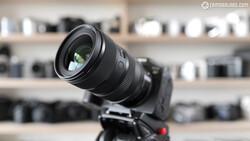
Sigma recently released the new 16-300mm f/3.5-6.7 DC OS Contemporary lens, designed to tackle everything from wide angle landscapes to distant sports action with one lens. It could simplify your kit, but is the convenience worth the potential compromise in image quality?
Coming to you from Curtis Padley, this practical video takes you trackside at the Donington Historic Festival, where Padley tested the Sigma 16-300mm f/3.5-6.7 DC OS Contemporary lens on his Sony a6700. This lens boasts an expansive zoom range from 16mm to 300mm, equivalent to 24-450mm on full frame, covering nearly every scenario imaginable. Padley appreciates its versatility, highlighting convenience for travel and sports photographers, and tests its autofocus speed, stabilization, and handling. Impressively, Sigma included optical stabilization, a first for their APS-C lenses, providing up to six stops at the wide end and 4.5 stops at telephoto lengths. That's especially useful paired with cameras like the a6700, which adds five stops of its own.
Padley also addresses concerns about image sharpness, common in lenses with such extreme zoom ranges. Surprisingly, he notes solid performance at the center across most focal lengths, though corners soften, especially at the 300mm extreme. There's expected barrel distortion at the wide end and some pincushion distortion zoomed in, though both can be minimized with in-camera corrections. Chromatic aberration, typically problematic with lenses of this range, shows up mildly but remains manageable in most shooting scenarios. Padley demonstrates its strengths and weaknesses clearly, showing examples from the race.
Key Specs
-
Focal Length: 16 to 300mm (24 to 450mm equivalent)
-
Aperture: f/3.5-6.7 maximum; f/22-45 minimum
-
Lens Mount: Sony E, Canon RF, Leica L, Fujifilm X
-
Lens Format: APS-C
-
Angle of View: 83.2° to 5.4°
-
Minimum Focus Distance: 6.7 inches (wide), 41.3 inches (tele)
-
Magnification: 1:2 Macro (0.5x)
-
Optical Design: 20 elements in 14 groups
-
Stabilization: Optical (6 stops wide, 4.5 stops telephoto)
-
Filter Size: 67 mm
-
Weight: 21.7 oz (615 g)
With these specs, it's clear Sigma is positioning this lens for those who prioritize flexibility, particularly travelers, sports, wildlife enthusiasts, or casual shooters who prefer carrying just one lens. Padley points out that its close-focus capabilities nearly let you touch subjects at the widest setting, ideal for basic macro-style photography. Despite some compromises in maximum aperture, limiting background blur for portraits, its autofocus is notably fast, quiet, and reliable when paired with Sony’s AI-enabled autofocus system.
Padley emphasizes build quality, noting it feels premium despite its compact size and lightweight construction. It includes dust- and splash-resistance, a weather-sealed gasket, and a water-repellent front coating—ideal features for outdoor and challenging conditions. Handling is enhanced by a thoughtfully designed zoom ring, which requires minimal wrist movement to go from wide-angle to full telephoto.
Padley ultimately finds the lens's strengths outweigh its limitations, particularly given the price of $769. For photographers who value convenience and versatility without sacrificing too much quality, this lens could become a mainstay in their bag. Check out the video above for the full rundown from Padley.

Join the Fstoppers community for free
-
Post comments and join in the discussions
-
Browse the site ad-free
-
Share your work and get featured in the community
-
Compete in the photo contests for fun and prizes
3 Comments
I guess if you can.... At least it's not terribly heavy.
Why would you buy this?
Nearly $800 for a 18-300mm to get a large lens (on top of your $1400 camera) when you could go all the way and spend $1000 just 200 more than the lens price on a second camera with a huge lens 24-3000 like a nikon p1000. The times you want to play with super zooms probably mean you may as well have a 2nd camera on hand.
Just a thought.
This lens will give same top magnification as a 450mm does at full frame (compared to 3000mm equivalent if the coolpix). That’s 6 times the magnification, but the average crop camera will have a 14x larger sensor. You would get better quality photos using this sigma lens and zooming digitally.