

We have all been there. It is pre-dawn at a landscape you’ve been waiting for weeks to shoot, or you’re packing up after a wedding reception has ended. You need to find that memory card you just dropped, but your phone flashlight just isn’t cutting it. While a phone flashlight is certainly convenient, it is rarely the right tool for the job.
Recently, I decided to add a couple of dedicated flashlights to my photography kit, after getting into high-performance flashlights for hiking and outdoor adventuring. A dedicated light isn’t tied to my phone’s battery, and it’s brighter, more durable, and offers far more versatility. After trying a few different options, I have settled on two small, affordable, and incredibly useful models from Wuben: the G5 and the PL01. I’ve got a few that now live permanently in my camera bags and have proven their worth repeatedly.
Versatile EDC
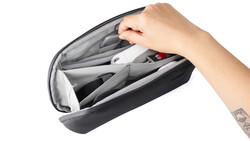
The Wuben G5 has become a permanent fixture in my hard-shell cases. It is about the size of a Zippo lighter or FZ100 battery and weighs just 52 grams, making it small enough to slip into any pocket of a camera bag, a case, or even just keep clipped to a camera strap. Despite its small size, it is packed with features that come in handy in the field.
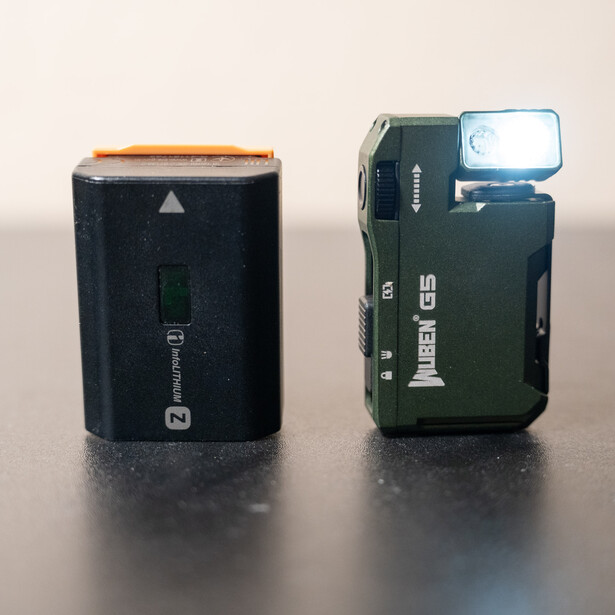
The main white light is controlled by a very easy-to-understand user interface (a welcome change from some complicated UI setups on other enthusiast flashlights). A single click turns it on, and a rotary dial provides stepless dimming from a very gentle 2-lumen "moonlight" mode all the way up to a surprisingly bright 400 lumens.
This analog control is my favorite way to adjust brightness, as it gives precise control over the output without having to cycle through preset modes. If you need a quick blast of maximum power, a double-click instantly activates the 400-lumen turbo mode.
What sets the G5 apart from other compact lights is its physical design. The head of the flashlight rotates a full 180 degrees. It also has a rotating clip and a strong magnet in the base. This combo of features makes it perfect for hands-free lighting. I have clipped it to my backpack strap to light the path in front of me, hooked it into a belt loop, and magnetically adhered it to the top lid of a Nanuk case and angled the head to light up the compartments.
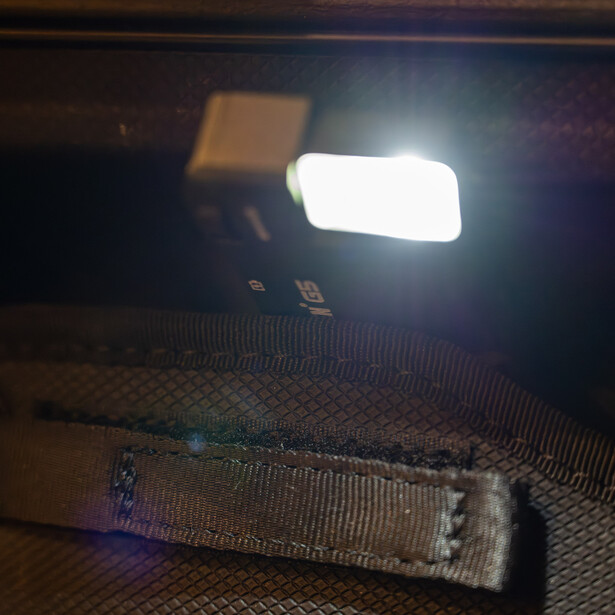
It even has a secondary RGB light mode, which can be useful for preserving night vision via the red light or for getting some creative long-exposure effects on foreground subjects (although this is quite a bit lower output).
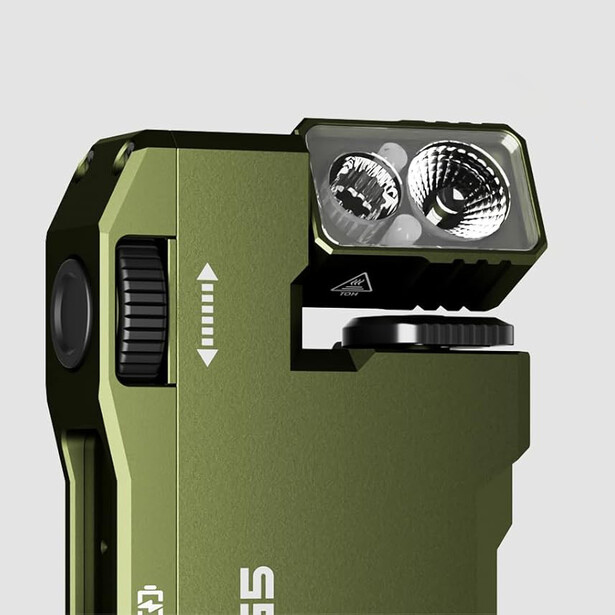
It has a tough metal shell, IP68 waterproofing, and charges via the USB-C port. The port is hidden behind a sliding lockout switch. This prevents the light from accidentally turning on in your bag but can also make it easier to accidentally toggle the light off if you knock the switch. It also supports passthrough charging, so you can run it directly from a power bank if the internal battery is out.
Inspection Meets EDC
While the G5 is a fantastic all-rounder, the Wuben PL01 penlight serves a more specialized role. Its long and thin form factor is perfect for sliding in a pocket, while the focused beam excels at inspection tasks—think checking a lens for dust and scratches or examining the threads on a filter.
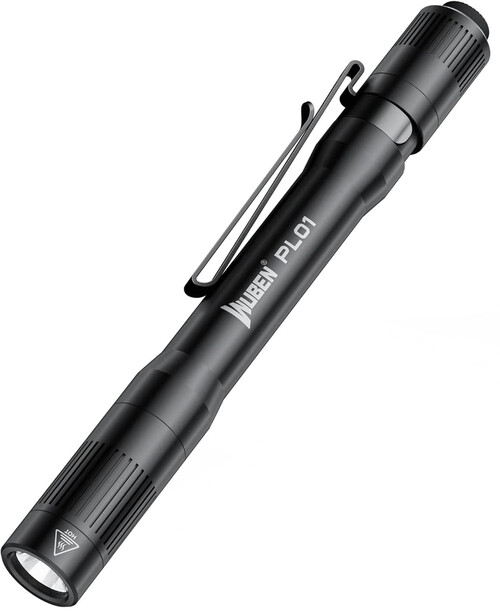
The key feature of the PL01 is its high-quality light source. It uses an emitter with a relatively high CRI of 90+. This means the light shows colors more accurately than many typical flashlight LEDs. This can make a surprising difference in scenarios where color discernment matters. The beam is a neutral 5000K, which is pleasant enough to work with and avoids the harsh blues of cheaper lights.
The PL01 has a boosted 650-lumen turbo mode for when you need a lot of light quickly, although this only lasts for about a minute. Its standard high setting of 150 lumens is more than enough for most work you’d be doing with the light.
As a travel light, I particularly appreciate its dual-fuel capability. It ships with a rechargeable 10880 battery that has a built-in USB-C port, but the light can also run on two standard AAA batteries. This is a huge advantage for fieldwork, as AAA batteries are available almost anywhere in the world and serve as a nice backup to the somewhat niche 10880 rechargeable cell.
Its aluminum body is IP68 waterproof and drop-resistant, and Wuben even points out you can clean the light with rubbing alcohol, a particularly nice option if the TSA makes you put the light in a grimy metal detector tray. The included two-way clip is useful, although the G5 offers significantly more mounting options.
Minor Flaws
No product is perfect, and there are a couple of trade-offs to keep in mind with these lights. The Wuben G5's battery is integrated and not user-replaceable. This is understandable given its compact size and waterproofing, but it’s still something to be aware of, especially if you leave your bag in very hot or very cold conditions.
The PL01 has a similar sticking point: while the 10880 battery is removable and replaceable, finding a replacement in the U.S. from common vendors is very difficult. While the AAA fallback is a fantastic feature, you’ll end up locked out of the 650-lumen turbo mode.
If you don’t need something as tightly integrated, there’s a wealth of 18650 lights that’ll offer easy battery interchangeability, and I’m particularly a fan of right-angle form factor lights, which can serve as a headlamp, camera strap light, or task lighting. These might not have the same flexibility of the G5 and certainly aren’t as compact.
Adding a dedicated flashlight to your camera bag is one of the simplest, cheapest, and most effective upgrades you can make to your field kit. The convenience of having a bright, versatile, and reliable light source that doesn’t rely on your phone or its battery cannot be overstated. The Wuben G5 and PL01 are two examples that serve slightly different but complementary purposes. The G5 is a great pocketable or packable utility light, while the PL01 is a superb inspection light with an EDC-capable setup and even makes for a great inclusion in your camera cleaning kit. For their price, it is easy to justify putting a light in every bag.
The Wuben G5 and Wuben PL01 are both available from Amazon.

Join the Fstoppers community for free
-
Post comments and join in the discussions
-
Browse the site ad-free
-
Share your work and get featured in the community
-
Compete in the photo contests for fun and prizes
12 Comments
More than any other, I use my $10 generic-brand head-mounted light because 1) it has a COB lamp for wide coverage close-up and a spot for greater distances, and 2) it leaves my hands free. It even has a magnet for mounting on pipes or under the open hood of my car.
Personal opinion? Get a Godox LITEMONS Led6R. Same price, little bit larger... Now you have a tiny video light that doubles as a flashlight. Magnetic too.
Good idea for something you just want to have in your photo bag all the time. I like my LED6Bi ($20) for dim ambient shots when I get tired of using flash, enough so that I recently added the much brighter - but still operable with one hand - C30Bi ($60). FWIW, neither of these has a magnet, but the LED6Bi has a hotshoe foot. Might put it on-camera for fill with the C30Bi as key in my left hand.
My phone is always with me and battery life is never an issue.
From the title, I thought you were going to say to buy a large roll of double sided Velcro.
Equally useful! One of these days I'd like to put together a whole guide to the accessories under $50 that are worth picking up.
I keep strips of varying length stuck inside my camera bag and a few larger lengths rolled up in my accessories pocket. The small strips are great for cable ties and other things. The larger ones can be used for lashing straps.
Also, get rolls of the adhesive type of velcro. I stick power supplies to my tripod that way.
For LED light reviews, please provide time limit details, especially for smaller lights that clain higher outputs.
Oftem many of those lights are very expensive for what they offer, since they will often claim a high out out, while not being forthcoming that they often have a time limit of 30-60 seconds.
It is like the flash lights in some big box stores where they claim 2000 lumens, but on the back if the box, it only does it for 15 second, then drops to 300 lumens. Or some pricy head lamps that claim 1000 lumens, but after about 2 minutes, the output gradually drops to 250 lumens.
The best ones are ones that can sustain their max output until the battery is drained.
“The PL01 has a boosted 650-lumen turbo mode for when you need a lot of light quickly, although this only lasts for about a minute. Its standard high setting of 150 lumens is more than enough for most work.”
Useful info but it is lacking for the G5. It was the one that was most interesting but the 400 lumen "turbo mode" was glossed over.
Sustained brightness is most important, as that determines how useful it is for certain work.
For example, I have had trouble getting a good head lamp as most would end up dropping their brightness, and often they are based on many companies blindly using the same IC and using the reference design from the data sheet, thus you will see even 100 lumen generic units that drop to 1/3rd of their output even though they are not getting hot. PS this happened in some bigger brands, e.g., the Duracell branded head lamps. Sometimes if lucky and they didn't scrape away the IC model, you could effectively adjust the duration of a brighter mode.
The best lights are ones that use a thermistor and regulate output to avoid overheating.
Wuben doesn't provide stepdown values on the G5, and visually, there's a moderate drop in brightness after a minute or two. That's not really relevant to these categories of light however. A light the size of a Zippo won't be able to maintain 400 lumens, and even a regular 18650 light will need to regulate heat.
If you need high sustained output, you'll either need to look to a sodacan light with more thermal mass or one of the actively cooled lights, but those are completely different categories of light than small EDC lights.
I would suggest that tagging this for astrophotography is a hard “nah”. I can’t think of something that’s more taboo amongst astrophotographers than an ultra-bright white LED light. If you’re out somewhere truly by yourself and are ok with being temporarily night blind after you turn it off then that’s your choice. But if other photographers are around you’re not going to be making any new friends.
Red headlamp is king in the dark, and for good reason!