Fujifilm's X mount is now the most interesting place in photography to buy a lens, and also the most confusing. Fujifilm sells more than 40 XF and XC lenses, Sigma and Tamron have brought their best APS-C designs over, and Viltrox has flooded the mount with autofocus primes that undercut Fujinon glass by hundreds of dollars while occasionally out-resolving it. The result is a catalog with real depth and real traps, including several beloved lenses designed for 16 MP sensors that now sit under 40 MP ones showing every weakness they have.
Three things decide this purchase. The first is which sensor you are feeding, because the 40 MP X-T5, X-H2, and X100VI sensors punish older optics in a way the 26 MP bodies never did, and a handful of Fujinon lenses have been quietly redesigned because of it. The second is whether you need real weather-sealing, since that is the line where third-party value usually stops and Fujinon's price premium starts to make sense. The third is size, because a small system is the entire reason most people chose X mount, and it is very easy to bolt a full frame-sized zoom onto an X-T5 and end up with the kit you were trying to avoid. Every lens below is an APS-C design, so we give the full frame equivalent focal length alongside the native number, and every entry names the weakness that might disqualify it for you.
At a Glance
- Best Overall: Fujifilm XF 33mm f/1.4 R LM WR
- Best Standard Zoom: Fujifilm XF 16-55mm f/2.8 R LM WR II
- Best Value Zoom: Sigma 18-50mm f/2.8 DC DN Contemporary
- Best for Portraits: Fujifilm XF 56mm f/1.2 R WR
- Best Budget Prime: Viltrox AF 35mm f/1.7 XF
- Best Wide Angle: Tamron 11-20mm f/2.8 Di III-A RXD
- Best for Wildlife and Sports: Fujifilm XF 150-600mm f/5.6-8 R LM OIS WR
- Best for Street Photography: Fujifilm XF 27mm f/2.8 R WR
- Best for Macro: Fujifilm XF 80mm f/2.8 R LM OIS WR Macro
Best Overall: Fujifilm XF 33mm f/1.4 R LM WR
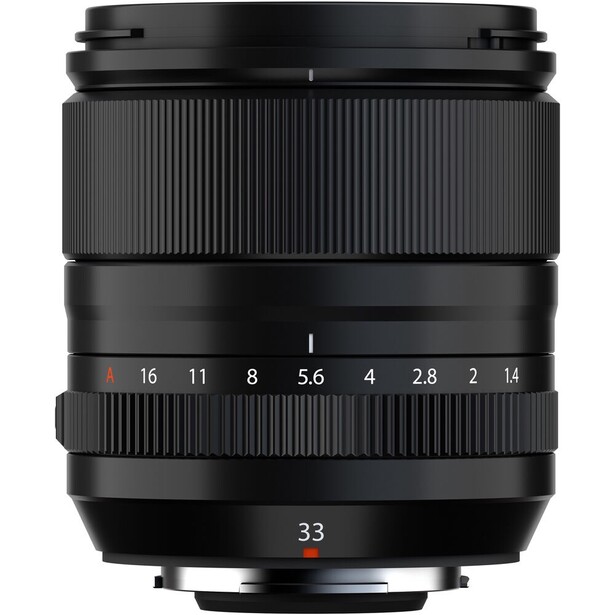
- Focal length: 33mm (50mm full frame equivalent)
- Maximum aperture: f/1.4, closing to f/16
- Stabilization: none, relies on in-body stabilization
- Minimum focus distance: 30 cm, 0.15x magnification
- Filter thread: 58mm
- Weather-sealing: yes
- Weight: 360 g
- Price: $949 (B&H)
If you buy one lens for an X-series body, buy this one. The XF 33mm f/1.4 R LM WR is the lens Fujifilm built once it realized its older primes were about to be embarrassed by a 40 MP sensor, and it is the clearest example of the company's newer optical thinking. Fifteen elements in 10 groups resolve cleanly across the frame from f/1.4 and hold up in the corners on the X-T5 and X-H2, and it does that while keeping the aperture ring and compact metal build that make Fujifilm cameras pleasant to operate in the first place.
The specification that changes how the lens feels is the linear motor. Fujifilm's older 35mm f/1.4 focuses by shoving a large glass group around with a DC motor, which is why it hunts, chatters, and misses moving subjects. The 33mm is silent and near-instant, and on a current body it holds an eye through a room full of people without drama. Add weather-sealing and it becomes a daily driver the older prime never was. The 50mm equivalent view seals it: close enough to natural vision that it disappears, wide enough for an environmental frame and tight enough for a half-length portrait, and at f/1.4 on APS-C it separates a subject from its background about the way a full frame 50mm does at f/2.
What it is not is small. At 360 grams and 73.5mm long it is noticeably bigger than the 35mm f/1.4 R it effectively replaces, and on an X-E5 or X-M5 the balance tips forward. It is also expensive for a normal prime, and the character crowd will tell you, correctly, that the older lens renders with a softness this one engineered out. If you want personality over precision, the classic Fujifilm XF 35mm f/1.4 R is still sold and costs meaningfully less. If you want the lens that will not let you down on a paid job, check the current price of the Fujifilm XF 33mm f/1.4 R LM WR at B&H.
What We Like
- Sharp across the frame at f/1.4 on 40 MP sensors
- Fast, silent linear-motor autofocus that tracks reliably
- Weather-sealed with a proper clicked aperture ring
- The most useful single focal length in the system
What Could Be Better
- Larger and heavier than the 35mm f/1.4 R it succeeds
- Priced well above the older prime it replaces
- Clinical rendering that gives up the classic lens' character
- No stabilization, so it wants an IBIS body in low light
Best Standard Zoom: Fujifilm XF 16-55mm f/2.8 R LM WR II
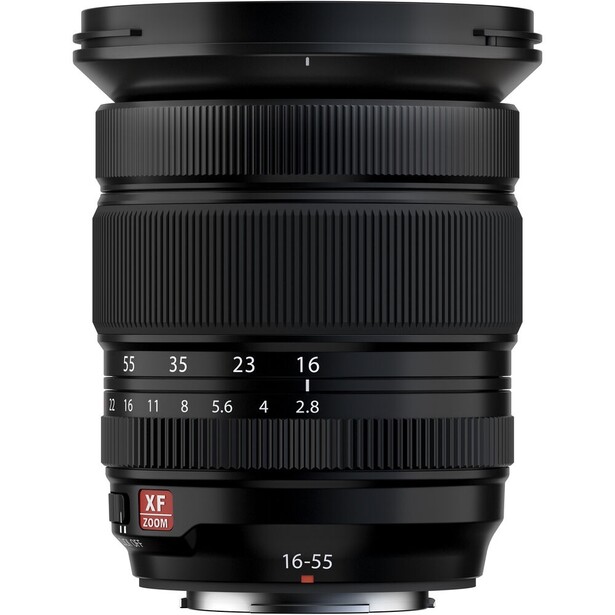
- Focal length: 16-55mm (24-84mm full frame equivalent)
- Maximum aperture: constant f/2.8, closing to f/22
- Stabilization: none, relies on in-body stabilization
- Minimum focus distance: 30 cm, 0.21x magnification
- Filter thread: 72mm
- Weather-sealing: yes
- Weight: 410 g
- Price: $1,399 (B&H)
Fujifilm's original 16-55mm f/2.8 was a fine lens with a fatal flaw for this system: it weighed 655 grams and turned a small camera into a small camera bolted to a brick. The XF 16-55mm f/2.8 R LM WR II, which reached North America at the end of 2024, cuts that to 410 grams, roughly a 37% reduction, without giving up the constant f/2.8 aperture or the weather-sealing. That is the whole argument, and it is a good one.
The 24-84mm equivalent range is the working zoom for events, editorial, and corporate jobs, anything where you cannot ask a scene to hold still while you swap primes. Sixteen elements in 11 groups, four of them aspherical, three ED and one super ED, are Fujifilm quietly confirming it built this for the 40 MP bodies, and it resolves to near-prime sharpness across most of the range. One design detail matters as much as the optics: a switch now disables the aperture ring's click stops, a first on an XF lens, so video shooters can ride exposure silently mid-take.
The catch is that this lens has no stabilization at all, which is odd for a zoom in 2026 and a genuine problem on a body without IBIS. Mount it on an X-T30 II and your handheld floor at 55mm is around 1/80 second with no help offered. It is also expensive enough that the Sigma below buys most of the range for a fraction of the money. If you shoot professionally on an X-H2 or X-T5, check the current price of the Fujifilm XF 16-55mm f/2.8 R LM WR II at B&H. Travelers should also consider the weather-sealed Fujifilm XF 16-80mm f/4 R OIS WR, which trades a stop of aperture for a 24-122mm equivalent range and 6.0 stops of CIPA-rated OIS.
What We Like
- 410 g, roughly 37% lighter than the original 16-55mm
- Constant f/2.8 across a genuinely useful 24-84mm equivalent range
- Declickable aperture ring, a first on an XF lens
- Optically rebuilt for 40 MP sensors
What Could Be Better
- No optical stabilization, a real limitation on non-IBIS bodies
- Expensive next to the third-party competition
- 72mm filters mean re-buying your filter set
- Still the largest thing most X-series owners will mount
Best Value Zoom: Sigma 18-50mm f/2.8 DC DN Contemporary
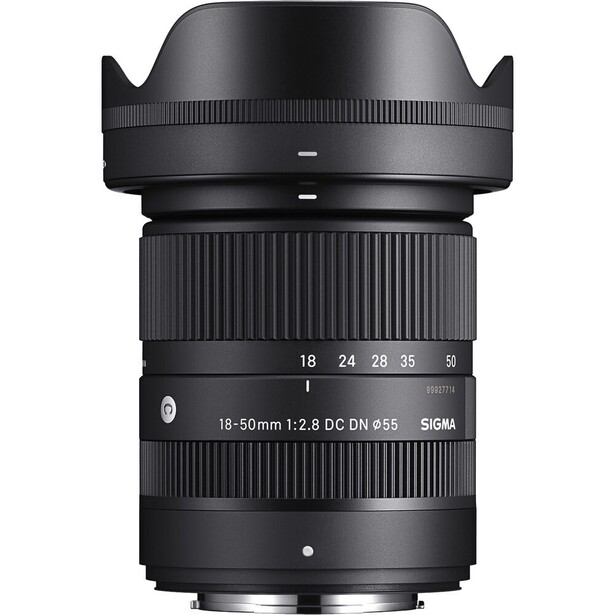
- Focal length: 18-50mm (27-75mm full frame equivalent)
- Maximum aperture: constant f/2.8, closing to f/22
- Stabilization: none, relies on in-body stabilization
- Minimum focus distance: 12.1 cm, 1:2.8 magnification
- Filter thread: 55mm
- Weather-sealing: dust- and splash-resistant mount only
- Weight: 285 g
- Price: $659 (B&H)
Ask a room of X-mount photographers which lens surprised them most and this is the one they name. The Sigma 18-50mm f/2.8 DC DN Contemporary is a constant f/2.8 standard zoom that weighs 285 grams, measures 76.8mm long, and sells for a fraction of what Fujifilm charges.
The trick Sigma pulled was to trim the range rather than the aperture. Giving up 2mm at the wide end and 5mm at the long end freed the designers to fit 13 elements in 10 groups into a barrel the size of a fast prime. You get 27-75mm equivalent coverage, close enough to the classic 24-70mm working range that most people never notice, plus a 12.1 cm minimum focus distance that turns it into a passable close-up lens for product details and food. Optically it is excellent in the center from wide open and merely good in the corners at 18mm. On a 26 MP sensor that gap is invisible; on a 40 MP X-T5 you can find it in the extreme corners, and f/4 resolves it.
The compromises are exactly what the price predicts. There is no aperture ring, which is a real loss on a camera built around one. Weather protection is a gasket at the mount and nothing more, so this is not the lens for a wedding shooter working outdoors in November, and the plastic-heavy build feels its price. None of that stops it from being the zoom we would put on a first Fujifilm camera, and if you are still choosing a body, our beginner camera guide pairs directly with this lens. Check the current price of the Sigma 18-50mm f/2.8 DC DN Contemporary at B&H.
What We Like
- Constant f/2.8 in a 285 g barrel
- Costs a fraction of the Fujinon equivalent
- 12.1 cm close focus that doubles as a light macro tool
- Sharp in the center wide open across the range
What Could Be Better
- No aperture ring, which fights the Fujifilm shooting experience
- Weather protection is a mount gasket, not full sealing
- Corners soften on 40 MP bodies at f/2.8
- Loses reach at both ends versus a 16-55mm
Best for Portraits: Fujifilm XF 56mm f/1.2 R WR
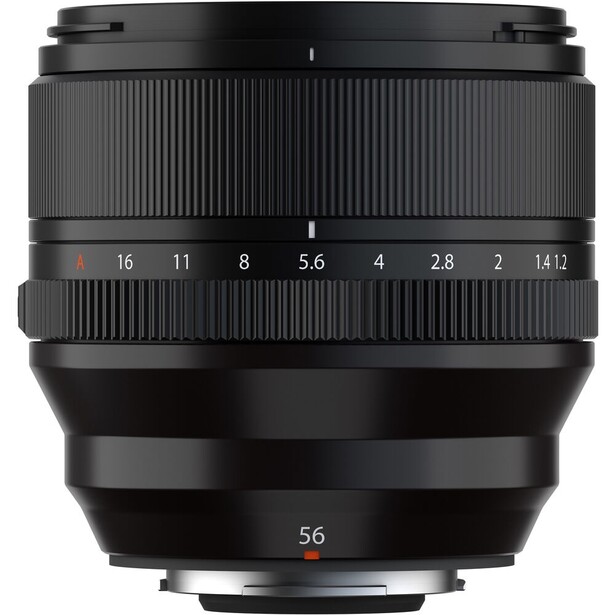
- Focal length: 56mm (85mm full frame equivalent)
- Maximum aperture: f/1.2, closing to f/16
- Stabilization: none, relies on in-body stabilization
- Minimum focus distance: 50 cm, 0.14x magnification
- Filter thread: 67mm
- Weather-sealing: yes, nine seals, rated to -10 degrees C
- Weight: 445 g
- Price: $1,199 (B&H)
Portrait photographers came to X mount for this lens. The current XF 56mm f/1.2 R WR is the 2022 redesign, not the beloved 2014 original, and the distinction matters when you shop. The new one adds weather-sealing, an 11-blade rounded diaphragm, and an optical formula that holds detail wide open on a 40 MP sensor where the old lens went soft and dreamy. Used listings still conflate the two.
An 85mm equivalent at f/1.2 is the classic portrait geometry, far enough back that faces render flatteringly and wide open enough that a background of trees or city lights melts into unbroken tone. The 11 rounded blades keep specular highlights circular deeper into the frame than the old seven-blade design managed, and in-focus rendering is crisp without being surgical, which is the balance skin needs. The weather-sealing is not a marketing footnote either: nine rubber seals and a fluorine-coated front element mean you can finish an outdoor session in drizzle, the exact situation that used to send 56mm owners back to the car.
The weakness is autofocus. This is still a DC-motor lens driving a big, heavy glass group. It is faster and quieter than the 2014 version and fine for a posed subject, but it is not what you want tracking a toddler across a lawn at f/1.2. If focus speed is the priority, the Viltrox AF 75mm f/1.2 XF Pro is a weather-sealed 115mm equivalent with a similarly extreme aperture and a lower price, though at 670 grams it is a much bigger lens. For most people shooting people, check the current price of the Fujifilm XF 56mm f/1.2 R WR at B&H. Our portrait lens guide covers the equivalents on other mounts.
What We Like
- f/1.2 at an 85mm equivalent, with genuinely beautiful bokeh
- 11 rounded blades keep highlights circular off-axis
- Fully weather-sealed and rated to -10 degrees C
- Focuses to 50 cm, closer than the original
What Could Be Better
- DC-motor autofocus, slower than modern linear-motor primes
- 445 g on the front of a small body is nose-heavy
- Easy to confuse with the discontinued 2014 version when buying used
- 67mm filters are a step up from most Fujinon primes
Best Budget Prime: Viltrox AF 35mm f/1.7 XF
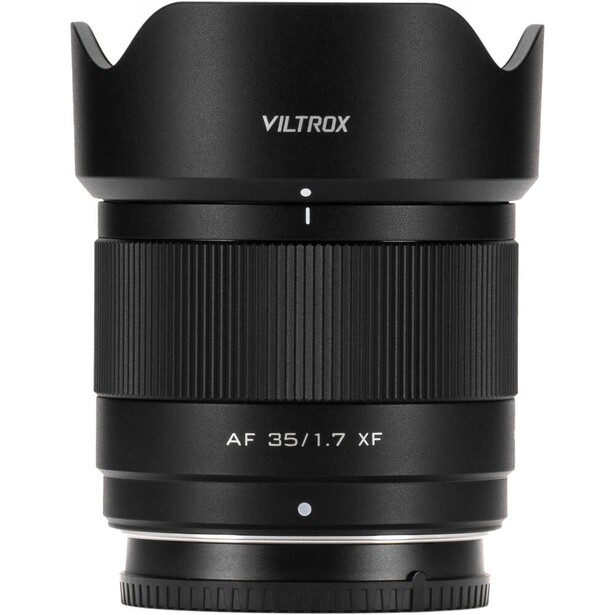
- Focal length: 35mm (53mm full frame equivalent)
- Maximum aperture: f/1.7, closing to f/16
- Stabilization: none, relies on in-body stabilization
- Minimum focus distance: 33 cm
- Filter thread: 52mm
- Weather-sealing: none
- Weight: 170 g
- Price: $179 (B&H)
Nobody expected the cheapest autofocus prime in the mount to be worth owning. The Viltrox AF 35mm f/1.7 XF weighs 170 grams, costs less than a decent tripod head, and delivers a 53mm equivalent view at f/1.7 from an 11-element, nine-group design that includes an ED element and an aspherical one. We have not put this one through a full Fstoppers review, but that 11-element formula is sharp in the center from wide open and respectable at the edges by f/2.8, which is more than the price has any business buying.
Hand it to someone who has just bought their first X-series body and owns nothing but the kit zoom. Going from f/5.6 at 35mm on that zoom to f/1.7 is a jump of about three and a half stops, and what it does indoors, at night, and to the background blur available is the single biggest visual upgrade a new photographer can buy. A Viltrox STM motor drives focus and supports face and eye detection, and the lens takes firmware updates over USB-C, which is how Viltrox has quietly fixed the compatibility annoyances that used to plague third-party X-mount glass.
What you give up is obvious in the hand. There is no aperture ring, so you set exposure from the body like a Sony shooter, the barrel is polycarbonate rather than metal, and Viltrox claims no weather-sealing at all. Autofocus is quick but audible, and it lags Fujinon's linear motors when a subject moves toward the camera. Longitudinal chromatic aberration shows as green and magenta fringing on high-contrast edges at f/1.7, which raw processing cleans up but does not erase. For the price of a good filter you still get a fast normal prime small enough to live on the camera. Check the current price of the Viltrox AF 35mm f/1.7 XF at B&H.
What We Like
- Extraordinary optics for the money, sharp in the center wide open
- Only 170 g, so it stays on the camera
- Supports face and eye detection with STM autofocus
- USB-C firmware updates keep it current
What Could Be Better
- No aperture ring
- No weather-sealing
- Visible purple and green fringing wide open
- Plastic build feels every bit as cheap as it is
Best Wide Angle: Tamron 11-20mm f/2.8 Di III-A RXD
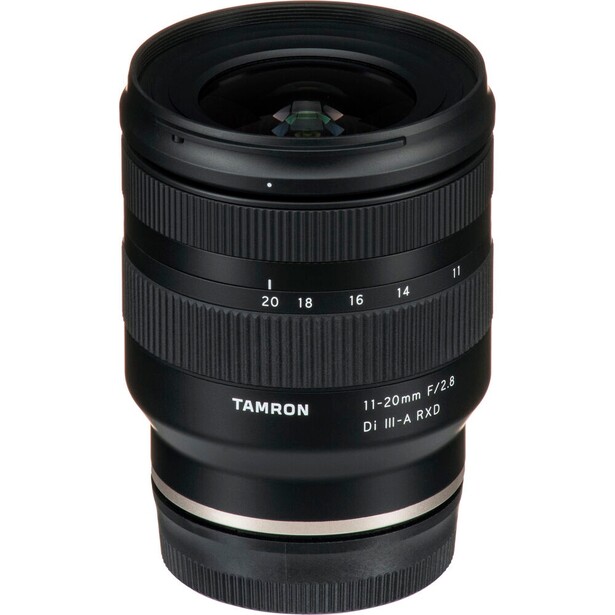
- Focal length: 11-20mm (16.5-30mm full frame equivalent)
- Maximum aperture: constant f/2.8, closing to f/16
- Stabilization: none, relies on in-body stabilization
- Minimum focus distance: 15 cm at 11mm, 0.25x magnification
- Filter thread: 67mm
- Weather-sealing: moisture-resistant construction with fluorine front coating
- Weight: 335 g
- Price: $599 (B&H)
Fujifilm's own wide zooms make you choose between speed and bulk. The XF 8-16mm f/2.8 is enormous and costs as much as a body; the XF 10-24mm f/4 is sensible and slow. The Tamron 11-20mm f/2.8 Di III-A RXD sidesteps that choice, holding a constant f/2.8 from a 16.5mm equivalent out to 30mm in a 335-gram package.
The constant f/2.8 is what makes it a landscape and astro lens rather than an architecture-only lens. At 11mm and f/2.8 you can hold stars as points for roughly 20 seconds on a static tripod, which is the whole ballgame for Milky Way work on APS-C, and the 12-element, 10-group design controls coma at the frame edges better than most zooms in its class. Its stranger talent is close focus: 15 cm at the wide end yields 0.25x magnification and a wide angle close-up look no other X-mount zoom can produce. Mountain-bike and skate photographers use it exactly this way, jammed against a front wheel with the whole environment stacked up behind it.
The complaints are consistent. Distortion at 11mm is heavy and leans on the camera's correction profile, so raw files opened in software that ignores that profile come out visibly barrel-bent. There is no OIS, and Tamron's RXD stepping motor, while quiet, sits a half-step behind Fujinon's linear motors for continuous tracking. To go wider still, the Sigma 10-18mm f/2.8 DC DN Contemporary weighs less and starts wider, at the cost of that useful 20mm end. For most landscape and interior shooters, check the current price of the Tamron 11-20mm f/2.8 Di III-A RXD at B&H.
What We Like
- Constant f/2.8 through the entire ultra wide range
- 335 g, far lighter than Fujifilm's f/2.8 wide zoom
- Focuses to 15 cm for dramatic wide angle close-ups
- Moisture-resistant build with a fluorine-coated front element
What Could Be Better
- Heavy barrel distortion at 11mm that leans on software correction
- No aperture ring and no stabilization
- RXD autofocus trails Fujinon linear motors for tracking
- 67mm filters are large for a lens this size
Best for Wildlife and Sports: Fujifilm XF 150-600mm f/5.6-8 R LM OIS WR
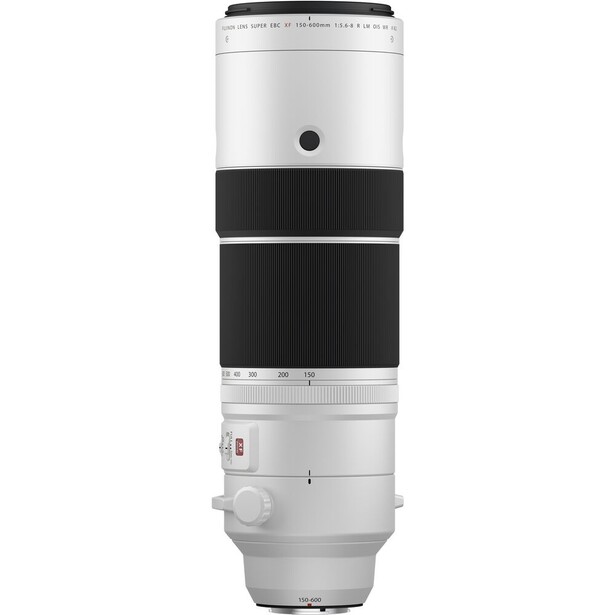
- Focal length: 150-600mm (229-914mm full frame equivalent)
- Maximum aperture: f/5.6-8, closing to f/22
- Stabilization: OIS, rated 5 stops
- Minimum focus distance: 2.4 m, 0.24x magnification
- Filter thread: 82mm
- Weather-sealing: yes
- Weight: 1,605 g
- Price: $2,399 (B&H)
Reach is the one place where APS-C stops being a compromise and becomes an advantage. The crop factor turns the XF 150-600mm f/5.6-8 R LM OIS WR into a 229-914mm equivalent, which reaches further than almost anything a full frame photographer can hand-hold, and it does it at 1,605 grams, roughly the weight of a full frame 100-400mm.
Fujifilm bought that with aperture. Accepting f/8 at the long end let the designers keep the barrel narrow and the zoom internal, so the lens never extends and never shifts its balance as you pull from 150mm to 600mm. Anyone who has tried to track a hawk with an extending zoom understands why that matters. The five-stop OIS stacks with a modern body's IBIS to make hand-holding at full extension genuinely practical, on an X-H2S the linear motor keeps pace with the body's subject detection well enough for birds in flight, and a 0.24x maximum magnification lets you fill the frame with a dragonfly from more than two meters away.
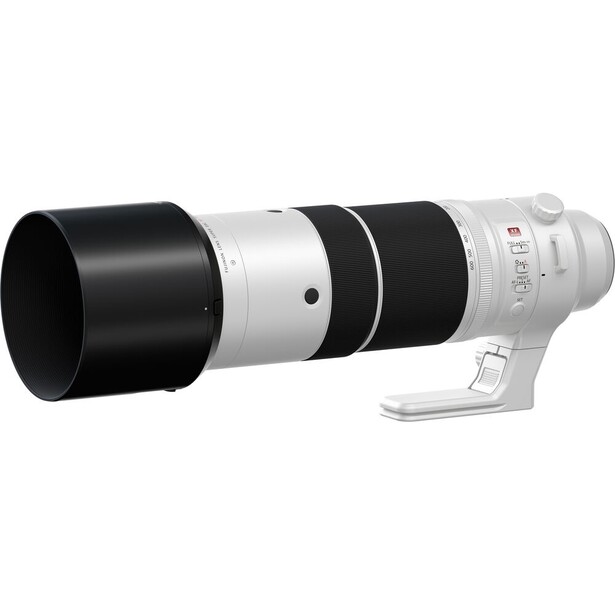
You pay for the reach in light. f/8 at 600mm means ISO 3200 in the woods on an overcast morning, and APS-C sensors do not love ISO 3200. This is a bright-light lens, and a hide-and-wait shooter will spend more time at ISO 6400 than is comfortable. At 314.5mm long it also needs its own bag. If you shoot mostly in good light, the Fujifilm XF 500mm f/5.6 R LM OIS WR is the lighter, sharper prime alternative. For one lens that covers a soccer sideline and a distant osprey, check the current price of the Fujifilm XF 150-600mm f/5.6-8 R LM OIS WR at B&H.
What We Like
- 229-914mm equivalent reach in a hand-holdable lens
- Internal zoom keeps balance constant through the range
- Five-stop OIS that stacks with body IBIS
- 0.24x magnification doubles it as a long close-up lens
What Could Be Better
- f/8 at 600mm pushes ISO hard in low light
- 1,605 g and 314.5mm long, so it needs its own bag
- 82mm filters are expensive
- Sharpness softens slightly at the extreme long end
Best for Street Photography: Fujifilm XF 27mm f/2.8 R WR
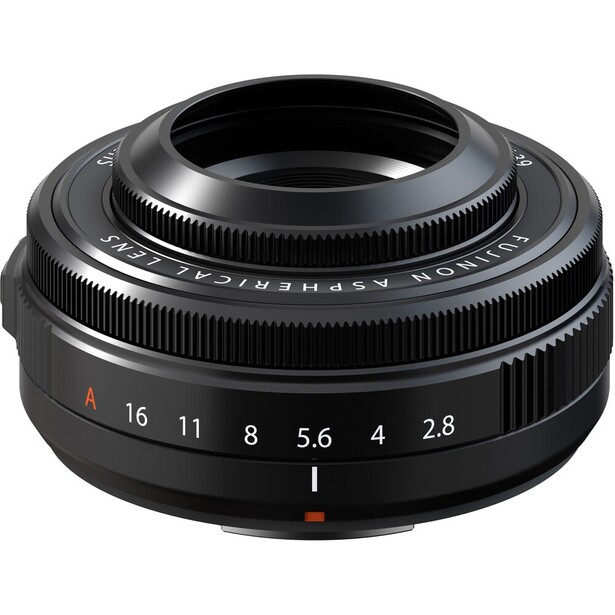
- Focal length: 27mm (41mm full frame equivalent)
- Maximum aperture: f/2.8, closing to f/16
- Stabilization: none, relies on in-body stabilization
- Minimum focus distance: 34 cm, 0.1x magnification
- Filter thread: 39mm
- Weather-sealing: yes
- Weight: 84 g
- Price: $449 (B&H)
Eighty-four grams. That single number is the case for the XF 27mm f/2.8 R WR, a pancake that adds 23mm of depth to a camera and turns an X-E5 or X-T50 into something that disappears into a coat pocket. Street photography rewards the lens you actually brought, and this is the only XF lens that never gives you a reason to leave it home.
The 41mm equivalent view sits between the storytelling width of a 35mm and the isolation of a 50mm, so a candid frame carries enough context to explain where you are without pushing people to the edges. Fujifilm added weather-sealing and an aperture ring to this second version, fixing the two complaints that dogged the original pancake, and the seven-element, five-group design is sharper than a lens this thin has any right to be, holding well into the corners by f/4. Size also changes how strangers read you: a photographer carrying an X-E5 and this lens looks like a tourist rather than a professional, and people behave accordingly.
The costs are structural. At f/2.8 there is little background separation, so this is not a portrait lens, and dim interiors put you at ISO 3200 with a slow shutter. The stepping motor is fine on a static subject and audibly buzzy in video, and the 39mm filter thread is unusual enough that finding a polarizer takes effort. If price is the sticking point, the TTArtisan AF 27mm f/2.8 is a 94-gram pancake at a fraction of the cost that keeps a clicked aperture ring, though it gives up the weather-sealing and focuses no closer than 35 cm. For the shooter who wants an X-series camera to behave like a compact, check the current price of the Fujifilm XF 27mm f/2.8 R WR at B&H.
What We Like
- 84 g and 23mm deep, the smallest XF lens made
- Weather-sealed with a real aperture ring, unlike the original
- 41mm equivalent is an ideal street focal length
- Makes an X-series body genuinely pocketable
What Could Be Better
- f/2.8 gives little subject separation
- Buzzy stepping-motor autofocus, audible in video
- Unusual 39mm filter thread
- Expensive for its optical ambition
Best for Macro: Fujifilm XF 80mm f/2.8 R LM OIS WR Macro
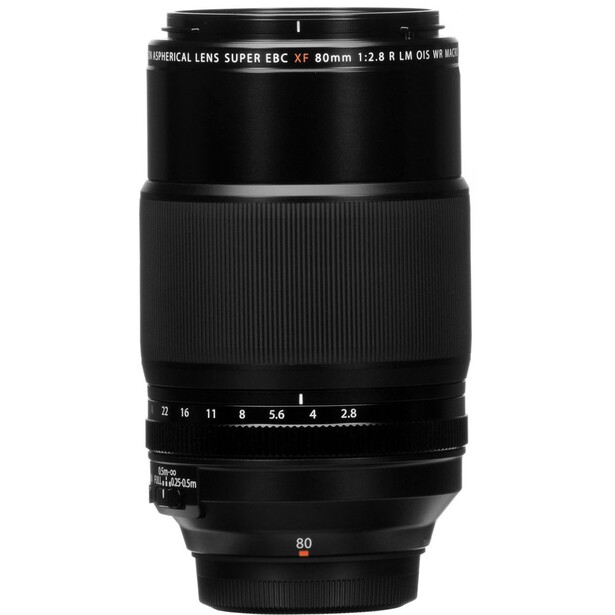
- Focal length: 80mm (122mm full frame equivalent)
- Maximum aperture: f/2.8, closing to f/22
- Stabilization: OIS, rated 5 stops
- Minimum focus distance: 25 cm, 1.0x magnification
- Filter thread: 62mm
- Weather-sealing: yes
- Weight: 750 g
- Price: $1,399 (B&H)
Fujifilm sells two lenses that reach life-size 1:1 magnification, and the XF 80mm f/2.8 R LM OIS WR Macro is the one to buy if you photograph anything that can move. The cheaper 195-gram Fujifilm XF 30mm f/2.8 R LM WR Macro also hits 1:1, but only at a 10 cm minimum focus distance, which leaves so little gap between the front element and the subject that you shade your own shot and every insect leaves before you fire.
The 122mm equivalent focal length buys that room back. Minimum focus is 25 cm from the sensor plane at 1:1, enough space to slide a light in and enough to keep a skittish dragonfly in place. Five-stop OIS, unusual on a macro lens, makes handheld shooting at moderate magnifications viable, and a focus limiter switch stops autofocus from racking through the whole range every time it loses a subject. The optics are flat-field by design and hold resolution corner to corner even at 1:1, which matters for coins, stamps, and product flat lays where one soft corner ruins the frame. Fstoppers' own Mastering Macro Photography tutorial covers the focus-stacking and lighting technique this lens rewards.
Mass is what holds it back. At 750 grams and 130mm long it outweighs the XF 16-55mm f/2.8 II zoom, and it defeats the size argument for the system entirely. Autofocus, while accurate, is slow at high magnification because the focus group has so far to travel. It is expensive enough that a casual close-up shooter should look at the 30mm macro or a set of extension tubes instead. If macro is a genre you actually shoot, check the current price of the Fujifilm XF 80mm f/2.8 R LM OIS WR Macro at B&H.
What We Like
- True 1:1 magnification with 25 cm of working distance
- Five-stop OIS, rare on a macro lens
- Flat-field optics that stay sharp corner to corner
- Weather-sealed and doubles as a 122mm equivalent portrait lens
What Could Be Better
- 750 g, heavier than most X-mount standard zooms
- Slow autofocus at high magnification
- Expensive for an occasional close-up shooter
- Long barrel makes it awkward on small bodies
How to Choose an X-Mount Lens
Start with your sensor, because it decides which half of the catalog is open to you. On a 26 MP body, an X-T30 II, X-S20, or X-E4, nearly every lens Fujifilm has ever made looks excellent, including the older and cheaper primes. On a 40 MP body, an X-T5, X-H2, X-E5, or X100VI, the picture changes. The newer designs, meaning the 18mm, 23mm, and 33mm f/1.4 primes, the 56mm f/1.2 R WR, and the 16-55mm II, were engineered for that sensor, and the older lenses show it. That does not make an XF 35mm f/1.4 R a bad lens on an X-T5. It makes it a lens with soft corners wide open on a body that can see them.
Then decide what the aperture ring is worth to you. It is the single thing that makes shooting a Fujifilm camera feel different from shooting anything else, and almost no third-party lens has one. Sigma, Tamron, and most of Viltrox's cheaper primes make you set aperture from the body, which converts your Fujifilm into a small Sony, ergonomically speaking. Plenty of people never notice. Others buy a Sigma 18-50mm, love the pictures, and sell it three months later because the camera stopped feeling like a Fujifilm.
Weather-sealing is the third axis, and it is where Fujinon's price premium is most defensible. The WR lenses are sealed properly, with multiple gaskets and fluorine front coatings, and they survive the weather that ends a shoot for everyone else. Sigma seals the mount and nothing else. Tamron's moisture-resistant construction sits in between. If your camera goes outside in bad weather for money, this is not a spec to optimize away.
One spec matters less than people think, and that is maximum aperture. On APS-C, f/1.2 delivers roughly the depth of field of f/1.8 on full frame, so the extreme fast primes do not blur backgrounds the way their numbers imply. What they buy is light, and on a body with in-body stabilization, an f/4 zoom with six stops of OIS will out-shoot an unstabilized f/2.8 lens wherever the subject holds still. Spend on the focal length you use rather than on a stop you will shoot at twice a year. One timing note: a redesigned XF 50-140mm f/2.8 is rumored to land alongside the X-T6, though Fujifilm has not announced either, so a fast telephoto zoom is the one purchase worth delaying this year.
What We're Looking For
We select lenses on optical performance at the apertures people actually use, autofocus behavior with current bodies, build and sealing appropriate to the price, and above all size, because a system that stops being small stops being X mount. Every specification here was verified against Fujifilm's, Sigma's, Tamron's, and Viltrox's current published data and live retailer listings at the time of writing, and we discarded numbers we could not confirm rather than filling the gap from memory. Most picks in our guides come from gear our writers have used and reviewed hands-on; where we have not tested a lens ourselves, we say so in the entry and write from verified specs and the lens's documented optical design.
Frequently Asked Questions
Are Third-Party X-Mount Lenses Worth Buying?
Yes, and they are now the best value in the mount. Sigma, Tamron, and Viltrox all license the X-mount protocol, so autofocus and aperture control work correctly, and their optics compete directly with Fujinon glass. What you give up is the aperture ring on most models and full weather-sealing on nearly all of them.
Do I Need the Newer Fujinon Primes for a 40 MP Camera?
Only if you shoot wide open and print large. The newer designs, including the 23mm and 33mm f/1.4 R LM WR primes and the 16-55mm II, resolve a 40 MP sensor cleanly into the corners. Older lenses like the XF 35mm f/1.4 R still make beautiful images; they simply soften at the edges at their widest apertures.
What Does the R in a Fujinon Lens Name Mean?
The R means the lens has a physical aperture ring. LM means a linear motor, which is faster and quieter than the older DC motors. OIS means optical stabilization, and WR means weather-resistant construction. A lens badged R LM OIS WR has all four.
What Is the Best First Lens to Add to a Fujifilm Kit Zoom?
A fast normal prime. The Viltrox AF 35mm f/1.7 XF is the cheapest route to a 53mm equivalent at f/1.7, and the gain in low-light ability and background blur over a kit zoom is the biggest single upgrade a new photographer can make. If the budget stretches, the XF 33mm f/1.4 R LM WR is the version you will not outgrow.
Can I Use Full Frame Lenses on a Fujifilm X Body?
Not directly, because X mount has its own flange distance and electronic protocol, and no full frame system shares them. You can adapt manual-focus lenses from Leica M, M42, and other legacy mounts with a simple adapter, and Viltrox and others sell X-mount lenses built on full frame optical designs that simply do not use the extra image circle.
Fstoppers may earn a commission from purchases made through links in this article. Our picks are made independently by our editorial team.