Micro Four Thirds survives, and thrives, on one argument: the lenses. A 100-400mm equivalent zoom that holds f/2.8 across its whole range does not exist for full frame in any form a human being can hand-hold, and a 2x macro lens with seven stops of stabilization does not exist anywhere else at all. That is the trade the system asks you to make. You give up roughly two stops of depth-of-field control and some low-light headroom against full frame, and in return you get reach, magnification, and weather-sealing in packages that weigh a third as much. Buy the wrong lenses and you have simply bought a small camera with a small sensor.
The catalog is old enough now to be a minefield. Some of the best glass here was designed a decade ago and still outperforms newer rivals, while other lenses that were fine in 2015 have been left behind by the 20 MP and 25 MP sensors in current bodies. The two brands also approach stabilization from opposite directions: OM System syncs the body's five-axis system with the lens, Panasonic builds optical stabilization into more of its glass. Mixing brands works, but you lose the best of both when you do, and we flag that in every pick where it changes the answer.
Below are ten lenses that justify the mount, from a budget normal prime to a professional telephoto that costs more than most cameras. Focal lengths are given as written on the barrel, with the full frame equivalent alongside, since the 2x crop factor is the most common source of confusion for people arriving from other systems.
At a Glance
- Best Overall: OM System M.Zuiko Digital ED 12-40mm f/2.8 PRO II
- Best Budget Prime: Panasonic Lumix G 25mm f/1.7 ASPH
- Best All-in-One Travel Zoom: OM System M.Zuiko Digital ED 12-100mm f/4 IS PRO
- Best for Portraits: Panasonic Leica DG Nocticron 42.5mm f/1.2 ASPH
- Best Wide Angle Prime: Panasonic Leica DG Summilux 9mm f/1.7 ASPH
- Best for Wildlife Reach: Panasonic Leica DG Vario-Elmar 100-400mm f/4-6.3 II
- Best Professional Telephoto Zoom: OM System M.Zuiko Digital ED 50-200mm f/2.8 IS PRO
- Best for Macro: OM System M.Zuiko Digital ED 90mm f/3.5 Macro IS PRO
- Best for Video: Panasonic Leica DG Vario-Summilux 10-25mm f/1.7 ASPH
- Best Ultra-Wide Value: Laowa 7.5mm f/2 MFT
Best Overall: OM System M.Zuiko Digital ED 12-40mm f/2.8 PRO II
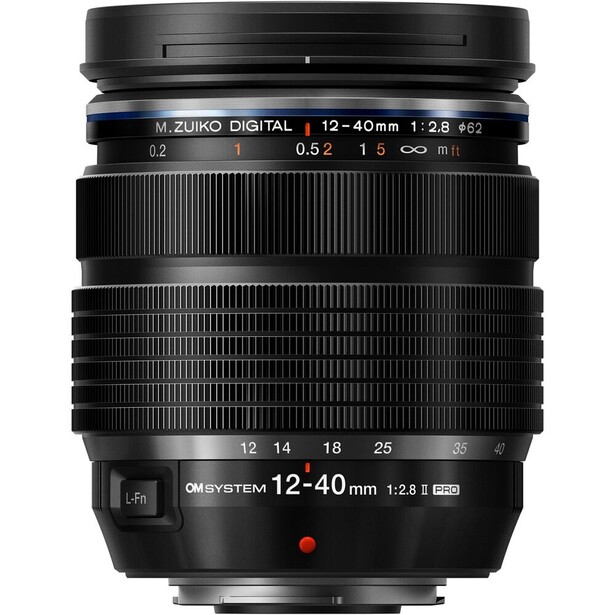
- Focal length: 12-40mm (24-80mm equivalent)
- Maximum aperture: f/2.8, constant
- Stabilization: none in lens, relies on camera in-body stabilization
- Minimum focus / magnification: 0.2 m, 0.3x (0.6x equivalent)
- Weather-sealing: IP53-rated, with fluorine front coating
- Filter size: 62mm
- Weight: 382 g
- Price: $999.99 (B&H)
If you own one Micro Four Thirds lens, this is the one. The 12-40mm f/2.8 PRO II covers 24-80mm in full frame terms, holds f/2.8 the entire way, weighs 382 g, and carries a full IP53 rating rather than the vague "weather-resistant" language most standard zooms hide behind. That combination is the reason a lot of people bought into this system in the first place, and the Mark II refresh kept every part of it intact while adding the fluorine coating that lets you wipe rain off the front element instead of smearing it.
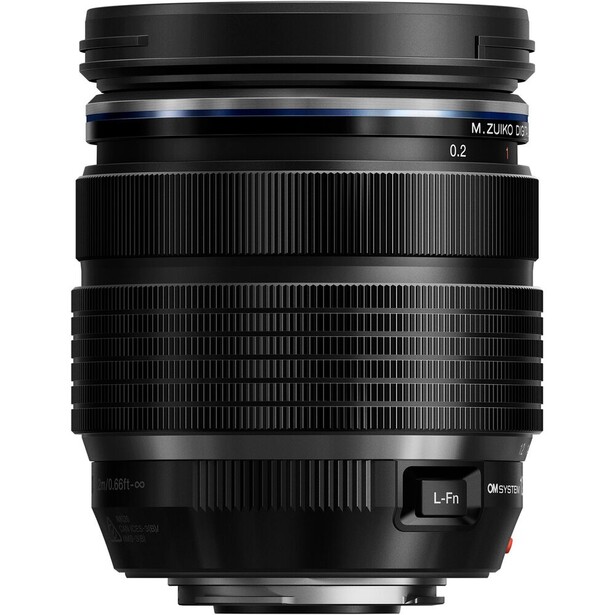
What separates it from a competent kit zoom is the close focus. At 0.2 m it delivers 0.3x magnification, 0.6x in full frame terms, close enough to fill the frame with a flower or a watch face without carrying a macro lens. The manual focus clutch is the other thing you will use constantly: pull the focus ring back and you are instantly in manual focus with a hard distance scale and hard stops, far faster than diving into a menu when you are shooting at night or through a fence.
Its honest limitation is the top end. Eighty millimeters equivalent is a short telephoto, not a portrait lens, and at f/2.8 on Four Thirds you get roughly the background separation of f/5.6 on full frame. Anyone buying this expecting creamy headshots should read the portrait section below instead. The lens also has no optical stabilization of its own, so it leans entirely on the body's in-body system, which is excellent on OM System bodies and merely good on some older Panasonic ones.
It also cannot take the MC-14 or MC-20 teleconverters. The M.Zuiko Digital ED 12-45mm f/4 PRO is the lighter, cheaper answer if you never shoot indoors. Check the current price of the OM System M.Zuiko Digital ED 12-40mm f/2.8 PRO II at B&H.
What We Like
- Constant f/2.8 across 24-80mm equivalent at 382 g
- IP53 sealing, not marketing language
- 0.3x close focus removes the need for a second lens on hikes
- Manual focus clutch with hard distance scale
What Could Be Better
- 80mm equivalent is too short for real portrait separation
- No optical stabilization in the lens itself
- Incompatible with the MC-14 and MC-20 teleconverters
Best Budget Prime: Panasonic Lumix G 25mm f/1.7 ASPH
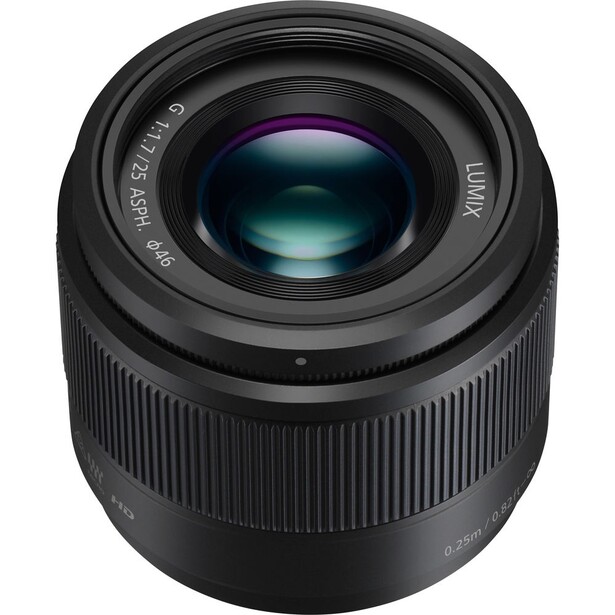
- Focal length: 25mm (50mm equivalent)
- Maximum aperture: f/1.7
- Stabilization: none
- Minimum focus / magnification: 0.25 m, 0.14x (0.28x equivalent)
- Weather-sealing: none
- Filter size: 46mm
- Weight: 125 g
- Price: $247.99 (B&H)
Nothing in this system delivers more photography per dollar than the 25mm f/1.7. It is a 50mm equivalent prime that weighs 125 g, focuses fast and silently, opens to f/1.7, and costs less than a decent tripod head. Eight elements in seven groups is not an exotic recipe, and the lens shows some longitudinal color fringing wide open on high-contrast edges. Stop it to f/2.8 and it is sharp corner to corner on a 20 MP sensor.
The reason to own it is not the optics, it is what the price does to your behavior. This is the lens you leave on the camera when you take it somewhere it might get bumped, dropped, or rained on, and the one you hand to someone learning. If you are still choosing a body for it, our beginner camera guide covers where the smaller formats make sense.
There is no weather-sealing and no stabilization, so on a Panasonic body without in-body correction you are hand-holding at conventional shutter speeds, and the light build feels like the budget lens it is. Panasonic's Leica DG Summilux 25mm f/1.4 II is the alternative if you want metal build and better bokeh at three times the money. Check the current price of the Panasonic Lumix G 25mm f/1.7 ASPH at B&H.
What We Like
- The cheapest fast prime worth owning in the system
- 125 g, so it disappears on any body
- Quick, quiet autofocus that suits both photo and video
- Classic 50mm equivalent field of view for learning
What Could Be Better
- Visible color fringing wide open
- No weather-sealing and no stabilization
- Build quality is plainly budget-grade
Best All-in-One Travel Zoom: OM System M.Zuiko Digital ED 12-100mm f/4 IS PRO
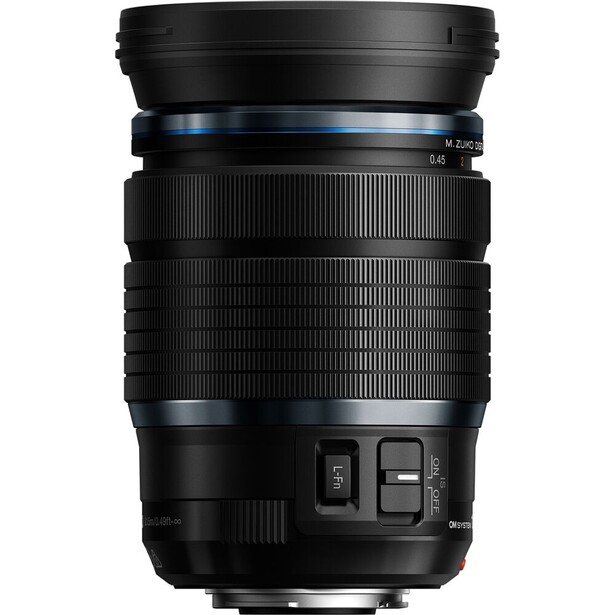
- Focal length: 12-100mm (24-200mm equivalent)
- Maximum aperture: f/4, constant
- Stabilization: up to 6.5 stops with 5-axis Sync IS, 5 stops lens only
- Minimum focus / magnification: 0.15 m, 0.3x (0.6x equivalent)
- Weather-sealing: IP53-rated
- Filter size: 72mm
- Weight: 561 g
- Price: $1,499.99 (B&H)
Travel zooms are usually a compromise you apologize for. The 12-100mm f/4 IS PRO is not. It runs from 24mm to 200mm equivalent at a constant f/4, holds up optically across the entire range in a way no full frame 24-200mm does, and stays sealed to IP53 while doing it. At 561 g it is heavier than the 12-40mm, but it replaces two lenses and a lens change in the rain.
The stabilization is the headline. Paired with an OM System body that supports Sync IS, the lens and camera work together for up to 6.5 stops of correction, and on its own the lens manages 5. In practice that means hand-holding a 200mm equivalent frame at shutter speeds that read like typos, and shooting dusk cityscapes at a half second without support. A lot of owners genuinely leave the tripod at home for casual travel, though for landscape work at base ISO you still want one, and our tripod guide covers the ones worth carrying.
Close focus is the sleeper feature, 0.15 m at the wide end for 0.3x magnification, which puts it in the same near-macro territory as the 12-40mm. The f/4 aperture is the price you pay. Indoors, at a wedding reception, or under stage lighting, f/4 on a Four Thirds sensor is a real constraint, and this is a lens that wants daylight or a static subject. The design also dates to 2016, and while nothing has replaced it, that is worth factoring into a purchase at this price. If one lens has to cover a two-week trip, check the current price of the OM System M.Zuiko Digital ED 12-100mm f/4 IS PRO at B&H.
What We Like
- 24-200mm equivalent at a constant f/4, with no soft end of the range
- Up to 6.5 stops of Sync IS with compatible OM System bodies
- 0.15 m close focus for near-macro work
- Full IP53 sealing for genuinely bad weather
What Could Be Better
- f/4 is limiting indoors and after dark
- 561 g and a 72mm filter thread make it the bulky option
- An aging design at a premium price
Best for Portraits: Panasonic Leica DG Nocticron 42.5mm f/1.2 ASPH
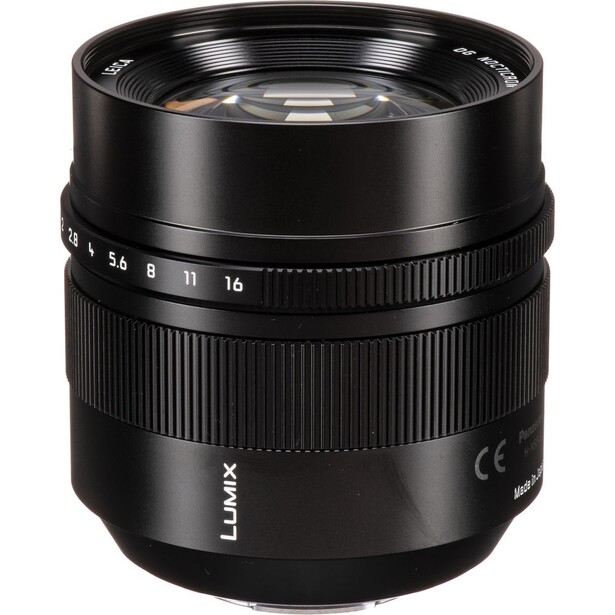
- Focal length: 42.5mm (85mm equivalent)
- Maximum aperture: f/1.2
- Stabilization: Power O.I.S. optical stabilization
- Minimum focus / magnification: 0.5 m, 0.1x (0.2x equivalent)
- Weather-sealing: none; Panasonic does not rate it dust or splash resistant
- Filter size: 67mm
- Weight: 425 g
- Price: $1,797.99 (B&H)
The Nocticron 42.5mm f/1.2 was announced in 2014 and still sits at the fastest aperture any autofocus lens on this mount reaches, tied with OM System's f/1.2 PRO primes. An 85mm equivalent at f/1.2 gives you roughly the depth of field of f/2.4 on full frame, which is the practical answer to the system's biggest complaint. It is not full frame f/1.2, and pretending otherwise is how people end up unhappy, but it is more than enough separation to lift a face cleanly off a background.
What has kept it in the lineup for over a decade is the rendering. Nine rounded aperture blades and a 14-element Leica-tuned design produce out-of-focus areas that fall away gradually rather than snapping to mush, and specular highlights stay round toward the edges rather than going lemon-shaped. It carries a physical aperture ring, which works on Panasonic bodies and is inert on OM System ones, and Power O.I.S., which pairs with Panasonic's Dual I.S. and is redundant on an OM System body with strong in-body stabilization.
The weaknesses are the ones you would expect from a 2014 design. At 425 g and 74mm across it is not a small lens on a small body, autofocus is quick but not the near-instant snap of the newest primes, and the 0.5 m minimum focus distance keeps you further from your subject than a modern short telephoto would. Panasonic also never rated it dust or splash resistant, which is a strange omission at this price and rules it out as a rainy-day lens. If you want most of the look for a third of the money, the Sigma 56mm f/1.4 DC DN Contemporary is a 112mm equivalent that punches enormously above its price, and the sealed OM System M.Zuiko Digital ED 45mm f/1.2 PRO is the pick if you shoot in weather. For the strongest portrait rendering the mount offers, check the current price of the Panasonic Leica DG Nocticron 42.5mm f/1.2 ASPH at B&H.
What We Like
- Ties the fastest autofocus aperture on the mount at f/1.2
- Gradual, well-behaved bokeh with round highlights off-axis
- Optical stabilization built in, useful on unstabilized bodies
- Physical aperture ring on Panasonic cameras
What Could Be Better
- No dust or splash resistance rating from Panasonic
- Large and heavy relative to the bodies it mounts on
- Autofocus speed shows its 2014 design
- 0.5 m minimum focus distance is restrictive for tight headshots
- Expensive for the depth-of-field effect it actually delivers
Best Wide Angle Prime: Panasonic Leica DG Summilux 9mm f/1.7 ASPH
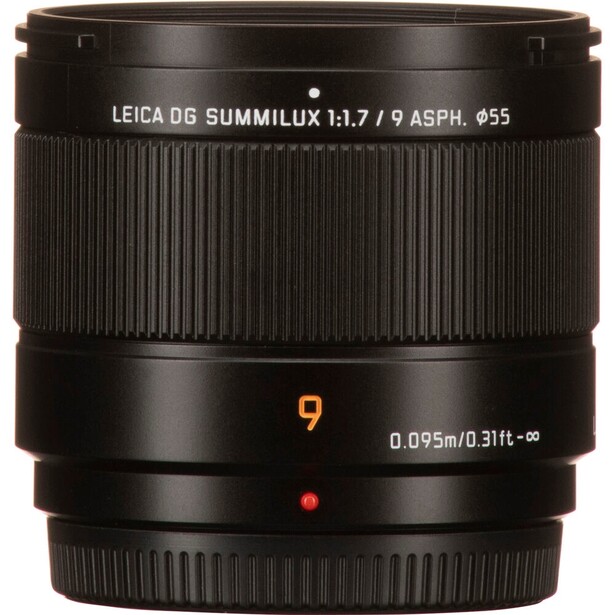
- Focal length: 9mm (18mm equivalent)
- Maximum aperture: f/1.7
- Stabilization: none
- Minimum focus / magnification: 0.095 m, 0.25x (0.5x equivalent)
- Weather-sealing: dust and splash resistant, freezeproof to -10 degrees C
- Filter size: 55mm
- Weight: 130 g
- Price: $497.99 (B&H)
A 130 g lens that gives you an 18mm equivalent view at f/1.7, seals against rain and cold, and focuses to 9.5 cm has no equivalent on any other mount. The Leica DG Summilux 9mm f/1.7 is the lens that makes the strongest case for Micro Four Thirds to a landscape or astro shooter, because the size and weight it saves are exactly the size and weight you notice at 3 a.m. on a trailhead.
The fast aperture is what earns it the astro slot. At f/1.7 you gather roughly four times the light of an f/3.5 ultra-wide zoom, which keeps exposures short enough to avoid star trailing and ISO low enough that a Four Thirds sensor still looks clean. Coma control at the corners is respectable rather than perfect, and stopping to f/2 tidies it up noticeably. The 0.25x close focus is half-macro in full frame terms, which is where the exaggerated foreground-to-background wide angle compositions come from.
You give up stabilization entirely, so on a Panasonic body without in-body correction you are relying on the short focal length to save you. There is also mild barrel distortion that the camera and most raw converters correct automatically, so anyone who insists on uncorrected files should know the geometry is not native. For night skies, tight interiors, and hiking, check the current price of the Panasonic Leica DG Summilux 9mm f/1.7 ASPH at B&H.
What We Like
- 18mm equivalent at f/1.7 for 130 g
- Sealed and freezeproof to -10 degrees C
- 9.5 cm close focus for dramatic foreground compositions
- Short exposures and low ISO for astrophotography
What Could Be Better
- No optical stabilization
- Corner coma needs stopping down to f/2 to clean up
- Relies on software correction for distortion
Best for Wildlife Reach: Panasonic Leica DG Vario-Elmar 100-400mm f/4-6.3 II
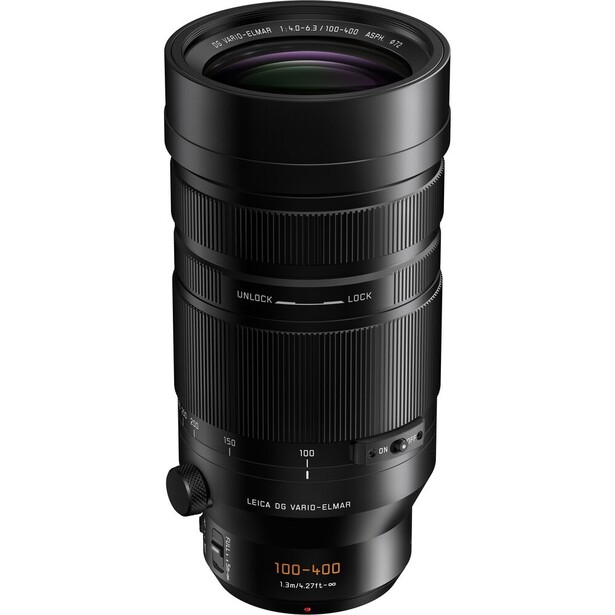
- Focal length: 100-400mm (200-800mm equivalent)
- Maximum aperture: f/4 to f/6.3
- Stabilization: Power O.I.S., works with Panasonic Dual I.S. 2
- Minimum focus / magnification: 1.3 m, 0.25x (0.5x equivalent)
- Weather-sealing: dust and splash resistant, freezeproof to -10 degrees C
- Filter size: 72mm
- Weight: 985 g
- Price: $1,597.99 (B&H)
Eight hundred millimeters of equivalent reach in a 985 g lens you can hand-hold all day is the clearest argument the format makes. The Leica DG Vario-Elmar 100-400mm f/4-6.3 II is the version to buy: the second generation trimmed the barrel, added compatibility with Panasonic's 1.4x and 2x teleconverters, and kept the Power O.I.S. that lets you shoot at 800mm equivalent without a monopod welded to your shoulder. Matching that reach on full frame means a 400mm f/5.6 prime and a 2x converter, which costs more and weighs more.
The specification sheet undersells its close focus. At 1.3 m and 0.25x magnification, this is a lens you can use on dragonflies and butterflies from a working distance that does not spook them. The built-in sliding hood and the removable tripod foot matter on a long day.
Be realistic about the aperture. At 400mm you are working at f/6.3 on a sensor with less low-light headroom than full frame, so this is a good-light lens, and by the time the birds go quiet at dusk you are pushing ISO harder than you would like. Autofocus is fast on Panasonic bodies and works well on OM System ones, though you lose Dual I.S. across brands. OM System's own M.Zuiko Digital ED 100-400mm f/5-6.3 IS II is the alternate to consider if you shoot an OM System body and want up to 7 stops of Sync IS, at the cost of 140 g more weight. For reach per gram, check the current price of the Panasonic Leica DG Vario-Elmar 100-400mm f/4-6.3 II at B&H.
What We Like
- 200-800mm equivalent in a 985 g hand-holdable package
- Optical stabilization plus Dual I.S. 2 on Panasonic bodies
- 0.25x close focus makes it usable on insects
- Teleconverter support added in the Mark II
What Could Be Better
- f/6.3 at the long end limits it to good light
- Dual I.S. does not work on OM System bodies
- Sliding zoom mechanism is stiffer than a modern internal zoom
Best Professional Telephoto Zoom: OM System M.Zuiko Digital ED 50-200mm f/2.8 IS PRO
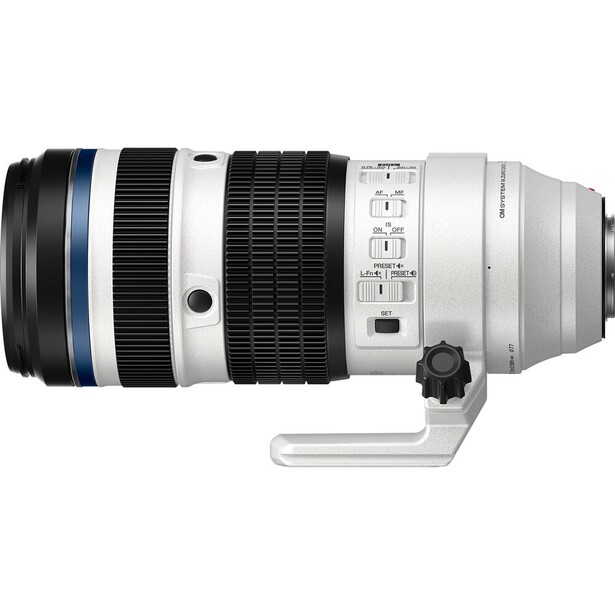
- Focal length: 50-200mm (100-400mm equivalent)
- Maximum aperture: f/2.8, constant
- Stabilization: up to 7 stops with 5-axis Sync IS, 5.5 stops lens only
- Minimum focus / magnification: 0.78 m, 0.25x at 200mm (0.5x equivalent)
- Weather-sealing: IP53-rated
- Filter size: 77mm
- Weight: 1,075 g, 1,250 g with tripod collar
- Price: $3,499.99 (B&H)
Announced in September 2025, the 50-200mm f/2.8 IS PRO is the lens that has no counterpart anywhere. No manufacturer sells a full frame 100-400mm zoom that holds f/2.8, because the front element required would be enormous and the price would be absurd. On Four Thirds it comes in at 1,075 g without the collar and is IP53-sealed against dust, splash, and cold down to -10 degrees C.
The practical effect for a sports or bird photographer is that the aperture stops moving. You set f/2.8, zoom from 100mm to 400mm equivalent, and neither exposure nor autofocus performance degrades as you extend, the exact moment a variable-aperture telephoto usually starts to hurt. Add the MC-14 and it becomes a 140-560mm equivalent f/4; the MC-20 makes it 200-800mm equivalent at f/5.6. Sync IS is rated up to 7 stops at 200mm on a compatible OM System body.
The price is the whole argument against it. At this money a full frame body and a fast 70-200mm f/2.8 become a real alternative, and many photographers will conclude the depth-of-field math favors the bigger sensor. That reasoning holds right up until you need 400mm equivalent at f/2.8 in the rain, hand-held, all day. It is also the heaviest lens here. Check the current price of the OM System M.Zuiko Digital ED 50-200mm f/2.8 IS PRO at B&H.
What We Like
- Constant f/2.8 to 400mm equivalent, which nothing else offers
- Up to 7 stops of Sync IS on compatible bodies
- Full IP53 sealing and freeze resistance
- Works with both the MC-14 and MC-20 teleconverters
What Could Be Better
- Costs as much as a serious full frame telephoto setup
- Heaviest lens here at 1,250 g with the collar
- Sync IS ratings assume a current OM System body
Best for Macro: OM System M.Zuiko Digital ED 90mm f/3.5 Macro IS PRO
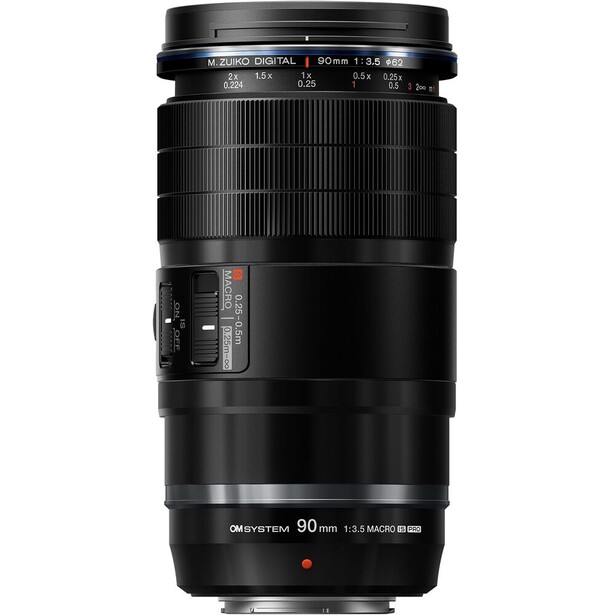
- Focal length: 90mm (180mm equivalent)
- Maximum aperture: f/3.5
- Stabilization: up to 7 stops with 5-axis Sync IS, 6 stops lens only
- Minimum focus / magnification: 0.25 m standard, 0.224 m in S-Macro; 1x standard, 2x in S-Macro (2x and 4x equivalent)
- Weather-sealing: IP53-rated
- Filter size: 62mm
- Weight: 453 g
- Price: $1,599.99 (B&H)
Macro is where Micro Four Thirds stops competing and starts winning. The 90mm f/3.5 Macro IS PRO reaches 1x in its standard range and 2x in S-Macro mode, and because the sensor is half the linear size of full frame, that 2x fills the frame the way a 4x lens would on a larger camera. Almost nobody makes a 4x-equivalent autofocus macro lens, and nobody else stabilizes one to 7 stops.
Stabilization is the reason this lens matters rather than merely impresses. High-magnification macro is normally tripod-and-rail work, because depth of field at 2x is measured in fractions of a millimeter and any movement ruins the frame. With Sync IS on a current OM System body you can walk up to a beetle on a leaf and shoot hand-held, and the camera's in-body focus stacking does the depth-of-field work for you.
The tradeoffs are real. f/3.5 is dim for a 180mm equivalent, so a flash becomes standard kit at high magnification, and the working distance at 2x is short enough that lighting the subject takes thought. At 453 g and 136mm long it is not a casual carry. The OM System M.Zuiko Digital ED 60mm f/2.8 Macro is the alternate if you want 1:1, faster focus acquisition, and 185 g instead of 453 g for a fraction of the price. If you want to get more out of a lens like this, Fstoppers' Mastering Macro Photography tutorial covers the shooting and stacking workflow in depth. Check the current price of the OM System M.Zuiko Digital ED 90mm f/3.5 Macro IS PRO at B&H.
What We Like
- Up to 2x magnification, equivalent to 4x on full frame
- Up to 7 stops of Sync IS makes hand-held macro genuinely practical
- IP53 sealing for wet fieldwork
- Takes both teleconverters for still greater magnification
What Could Be Better
- f/3.5 is slow, so a flash becomes near-mandatory
- Short working distance at maximum magnification complicates lighting
- Autofocus hunts more at high magnification than the 60mm does
- Expensive and long for a specialist lens
Best for Video: Panasonic Leica DG Vario-Summilux 10-25mm f/1.7 ASPH
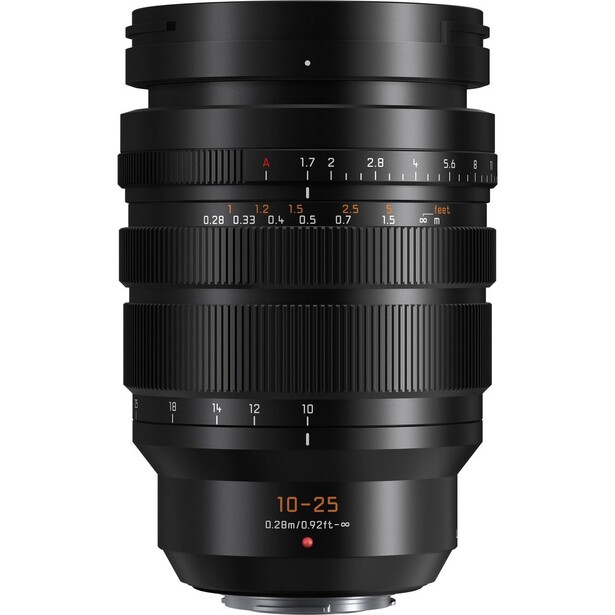
- Focal length: 10-25mm (20-50mm equivalent)
- Maximum aperture: f/1.7, constant
- Stabilization: none
- Minimum focus / magnification: 0.28 m, 0.14x (0.28x equivalent)
- Weather-sealing: dust and splash resistant, freezeproof to -10 degrees C
- Filter size: 77mm
- Weight: 690 g
- Price: $1,897.99 (B&H)
Every filmmaker who has worked with primes knows the tax: you stop, you swap, you re-light, you lose the moment. The Leica DG Vario-Summilux 10-25mm f/1.7 collapses a 20mm, 24mm, 35mm, and 50mm equivalent prime set into one barrel that never changes aperture. Focus breathing is minimal, the focus ring switches between linear manual and autofocus with a physical clutch, and the aperture ring is de-clicked for smooth pulls.
On a Lumix GH-series body this is close to a complete documentary rig. The constant f/1.7 gives a consistent look and a real low-light margin on a smaller sensor, and the 20-50mm equivalent range covers most interview, B-roll, and handheld coverage without a lens change. The build is dense metal, sealed, and freezeproof, and it balances properly on a gimbal.
It has no optical stabilization, so on a body without in-body correction you need a gimbal or a rig, and at 690 g with a 77mm filter thread it is not a run-and-gun lens for a tiny camera. Stills photographers should be honest that a pair of fast primes would be sharper, lighter, and cheaper. For anyone whose main work is video, check the current price of the Panasonic Leica DG Vario-Summilux 10-25mm f/1.7 ASPH at B&H.
What We Like
- Constant f/1.7 across a 20-50mm equivalent range
- Minimal focus breathing and a de-clicked aperture ring
- Manual focus clutch with linear response
- Sealed, freezeproof, and gimbal-friendly balance
What Could Be Better
- No optical stabilization at all
- 690 g is heavy on a compact body
- Hard to justify for stills-only shooters
Best Ultra-Wide Value: Laowa 7.5mm f/2 MFT
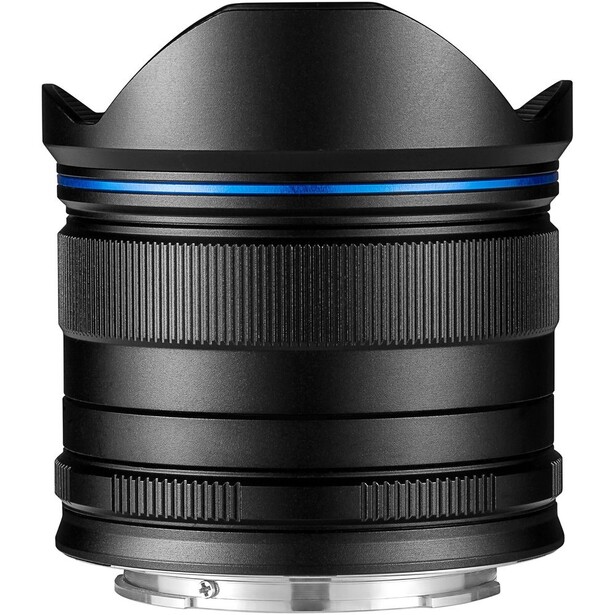
- Focal length: 7.5mm (15mm equivalent)
- Maximum aperture: f/2
- Stabilization: none
- Minimum focus / magnification: 0.12 m, 0.11x (0.22x equivalent)
- Weather-sealing: none
- Filter size: 46mm
- Weight: 170 g standard, 150 g lightweight version
- Price: $389 (B&H)
Manual focus scares people off, and on a 15mm equivalent lens it should not. Set the Laowa 7.5mm f/2 to f/5.6, put the focus ring near the hyperfocal mark, and everything from about a meter to the horizon is sharp. There is nothing left to focus. What you get for that small concession is a 110-degree field of view at f/2 in a 170 g barrel with a normal 46mm filter thread, which is unusual for a lens this wide.
It has become a cult lens among astrophotographers for a reason: f/2 at 15mm equivalent gathers enough light for short exposures, and its corner coma is far better than a lens at this price has any right to be. Drone builders strip the mass down further with the 150 g lightweight version.
There are no electronics, so no autofocus, no aperture control from the camera, no EXIF data, and no weather-sealing. Distortion is modest but there is no in-camera correction profile the way there is for native Panasonic and OM System lenses. If you want a wider, rectilinear alternative with distortion engineered out, the Laowa 6mm f/2 Zero-D MFT reaches a 121.9-degree field of view for more money and more weight. For a cheap, tiny, genuinely fast ultra-wide, check the current price of the Laowa 7.5mm f/2 MFT at B&H.
What We Like
- 15mm equivalent at f/2 for 170 g and a fraction of native-lens money
- Strong corner performance for astrophotography
- Standard 46mm filter thread despite the wide view
- All-metal build and a 150 g lightweight version for drones
What Could Be Better
- Fully manual, with no electronic contacts or EXIF data
- No weather-sealing
- No in-camera distortion correction profile
How to Choose a Micro Four Thirds Lens
Start by doing the crop-factor math honestly, because it applies to depth of field as well as to field of view. A 25mm f/1.7 on Four Thirds frames like a 50mm and blurs backgrounds like an f/3.4 lens on full frame. That is the deal, and it is why Micro Four Thirds is a poor choice for someone whose goal is melted backgrounds and a strong choice for landscapes, wildlife, macro, or documentary work where more depth of field is a feature. Buy an f/1.2 lens here for its light-gathering and its rendering, not because you expect it to look like an f/1.2 on a bigger sensor.
Then decide which brand's stabilization you are buying into, because this is where mixing systems costs you. OM System's Sync IS pairs an in-lens unit with the body's five-axis system for ratings up to 7 stops, and Panasonic's Dual I.S. 2 does the same thing with its own bodies and lenses. Cross the brands and both fall back to whichever single system is present. A Panasonic lens on an OM System body still stabilizes, and vice versa, but you have paid for a capability you will not fully use. If you own an OM System camera, lean toward M.Zuiko PRO glass; if you own a Lumix body, lean toward Panasonic and Leica DG.
Weather-sealing deserves more attention than it gets. OM System publishes real IP ratings on its PRO lenses: IP53 means tested against dust and against water spraying at an angle, not a marketing adjective. Panasonic uses "dust and splash resistant" language with a freezeproof rating to -10 degrees C, which is meaningful but not certified to a standard, and some of its most expensive lenses (the Nocticron included) carry no rating at all. Either way, the sealing only works if the body is sealed too.
The specification that matters more than people think is minimum focus distance. Several lenses here (the 12-40mm and 12-100mm at 0.3x, the 9mm and the 100-400mm at 0.25x) get close enough to work as casual macro lenses, which quietly removes a lens from your bag. The one that matters less than people think is maximum aperture on a telephoto: an f/2.8 zoom at 400mm equivalent is spectacular, but if you shoot birds in daylight, an f/6.3 lens at roughly half the price and 90 g lighter gets you the same photograph. Match the lens to the light you actually shoot in.
What We're Looking For
We selected these lenses on optical performance at the resolutions current Micro Four Thirds sensors deliver, on whether the size and weight exploit the format's advantage rather than fight it, on build and sealing, and on whether the lens does something that would be difficult on a larger format. Every specification here was verified against the manufacturer's current spec page and a current retailer listing, and each lens was confirmed still in production. Where our writers have not put a lens through a full hands-on Fstoppers review, we wrote from verified specifications rather than implying testing we have not done.
Frequently Asked Questions
Is Micro Four Thirds still worth buying in 2026?
Yes, if you shoot the things it is good at. For wildlife, macro, travel, and video, the reach, magnification, stabilization, and weight advantages are real and unmatched. For low-light portraiture and maximum background blur, full frame is the better tool, and no amount of clever lens design closes that gap.
Do Panasonic lenses work on OM System cameras?
Yes. Micro Four Thirds is a shared mount, and any Panasonic, OM System, Olympus, Sigma, or Laowa MFT lens will mount and function on any MFT body. What you lose across brands is the coordinated stabilization: Panasonic's Dual I.S. 2 and OM System's Sync IS both need a matching lens and body, and cross-brand pairings fall back to a single stabilization system.
What does the 2x crop factor actually mean for my lenses?
Double the focal length for field of view, and double the f-number to estimate depth of field and equivalent noise. A 42.5mm f/1.2 frames like an 85mm and blurs backgrounds roughly like an 85mm f/2.4 on full frame. Exposure is not affected, so f/1.2 still meters as f/1.2.
Which lens should I buy first?
A fast normal prime, almost always. The Panasonic Lumix G 25mm f/1.7 costs little, weighs nothing, and teaches you more about light and composition than an expensive zoom will. If your kit zoom already covers the range and you want an upgrade rather than an addition, the 12-40mm f/2.8 PRO II is the lens most owners keep on the camera permanently.
Are older Olympus-branded lenses still fine to buy?
Generally yes. OM System is the same company under a new name, and lenses like the 45mm f/1.2 PRO and 60mm f/2.8 Macro still sell new under Olympus branding on the barrel without any functional difference. Be more careful with pre-2015 Panasonic and Olympus kit zooms, which can look soft on the 20 MP and 25 MP sensors in current bodies.
Fstoppers may earn a commission from purchases made through links in this article. Our picks are made independently by our editorial team.