
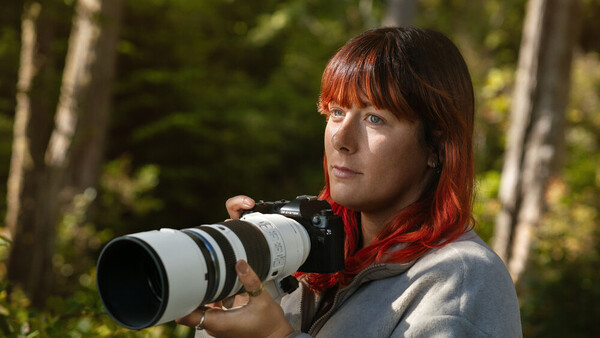
Micro Four Thirds has been declared “dead” so many times you’d think it was a cat working its way through nine lives. Year after year, people predict its collapse, citing smaller sensors and the dominance of full frame. And yet, here we are in 2025, with OM System unveiling one of the most audacious lenses in recent memory. The M.Zuiko Digital ED 50–200mm f/2.8 IS PRO doesn’t just extend the format’s lifespan; it makes a strong case that Micro Four Thirds might be the most interesting platform in photography right now.
The argument isn’t just about hardware. Sure, this new lens is wild, covering a 100–400mm equivalent range at a constant f/2.8, something no other system offers. But what makes Micro Four Thirds unique is the way OM System has leaned into computational photography. Live Composite, Live ND, Pro Capture, Handheld High-Res, Starry Sky AF: these are features you simply won’t find bundled together anywhere else. It’s not about fighting full frame on its turf. It’s about redefining what a camera can do. And that is where the conversation gets much more interesting, because once you stop comparing spec sheets and start comparing experiences, Micro Four Thirds looks like it might be leading the charge.
Micro Four Thirds has always thrived when it leaned into its differences rather than tried to copy full frame. Where larger formats tout shallow depth of field, OM points to greater portability and innovative features. Where competitors focus on massive glass, Micro Four Thirds builds tools that maximize what a smaller sensor can do. The result is a platform that consistently surprises with its versatility, often outperforming expectations in situations where weight, mobility, and creative features matter more than brute-force specs. For many photographers, that difference is the deciding factor: Micro Four Thirds makes the shots possible that other systems make too cumbersome.
The Myth of a Dead Format
For years, critics have painted Micro Four Thirds as a format without a future. The argument usually goes something like this: why settle for a smaller sensor when full frame or even APS-C are available, with better dynamic range and cleaner high-ISO performance? In an industry obsessed with sensor size, it was easy to dismiss Micro Four Thirds as compromised. If you wanted to be taken seriously, you bought a bigger sensor. And with larger sensors dominating headlines and marketing campaigns, it felt inevitable that Micro Four Thirds would fade away quietly.
But the so-called weaknesses of Micro Four Thirds have also been its biggest strengths. Smaller sensors mean smaller lenses, greater depth of field at the same aperture, and stabilization systems that outperform anything in the full frame world. These aren’t flaws—they’re features, especially for photographers who prioritize portability and versatility over chasing razor-thin depth of field. This is why Micro Four Thirds has always had a loyal community of birders, hikers, and adventurers who simply cannot get the same results without breaking their backs or their budgets.
And while critics kept writing its obituary, the system quietly built a loyal following. Bird photographers embraced the reach. Hikers and travelers appreciated the lightweight. Macro shooters enjoyed having depth of field to spare. For them, Micro Four Thirds wasn’t a compromise; it was the system that let them get the shots they wanted without hauling an anchor of gear. And that loyal base kept pushing OM and Panasonic to innovate in ways that full frame companies never had to, because for them the margins were safe and the sales numbers were steady. The irony is that the system with the smallest sensor has ended up with some of the boldest ideas.
OM System understands this. Instead of trying to play the same game as Canon or Nikon, it doubled down on what makes Micro Four Thirds different. The 50–200mm f/2.8 IS PRO is proof of that strategy: a lens that wouldn’t even make sense in another system, but feels perfectly aligned with the ethos of Micro Four Thirds. It is a kind of lens that full frame shooters would scoff at on paper, only to realize later that they would need a small suitcase and an extra $10,000 to build something equivalent in their system. That is the value proposition of Micro Four Thirds: surprising practicality wrapped in ambition.
The Lens as Proof of Life
Let’s pause and look at this lens for what it is. The M.Zuiko 50–200mm f/2.8 IS PRO offers a 100–400mm equivalent focal range with a constant f/2.8 aperture. On its own, that’s extraordinary. Add the 2x teleconverter and you’re looking at an 800mm equivalent at f/5.6, all in a package that weighs about 1,075 grams. That’s lighter than many full frame 70–200mm zooms, and it’s giving you double the reach. In the field, that is the difference between capturing the moment and watching it pass while you’re still setting up a tripod.
This lens is built for the field. It’s weather-sealed to IP53 standards, freezeproof to -10°C, and coated to resist water and dust. Wildlife shooters and travel photographers can take it places where full frame shooters would need sherpas. It’s not a compromise; it’s an entirely different way of thinking about long glass. A lens like this demonstrates that Micro Four Thirds doesn’t need to compete head-to-head with full frame. It simply needs to be excellent at what it does best: portability, ruggedness, and flexibility.
What stands out is how this lens embodies OM’s philosophy. It’s not about hitting a checklist or duplicating what the competition has already done. It’s about taking a bold swing at something no one else will build. In that sense, it’s not just a lens release. It’s a statement of intent, proof that OM believes in the future of its format enough to invest in optics that defy convention. Even if it doesn’t sell in massive numbers, it builds prestige, and it shows that OM is playing the long game.
More importantly, it shows that OM System isn’t afraid to go bold. This isn’t a safe lens aimed at the mass market. It’s a statement piece, designed to remind the industry that innovation doesn’t only happen at the high end of full frame. If you thought Micro Four Thirds was done, this lens should make you think again. This is the sort of lens that, even if most people don't buy, it gets them considering Micro Four Thirds for themselves.
Computational Photography: The Real Differentiator
Hardware is only half the story. What makes Micro Four Thirds so fascinating is how it pairs exotic optics with computational features that change the way you shoot. Live Composite, for instance, lets you capture star trails, fireworks, or traffic streaks in real time without overexposing the frame. You watch the effect build on the screen like magic, no Photoshop required, and suddenly a technique that used to demand advanced post-production becomes accessible to anyone willing to try it.
Then there’s Live ND, which simulates neutral density filters in-camera. Want silky waterfalls or blurred oceans in bright daylight? No need to carry glass filters. The camera does the math, layering exposures to mimic the look. For travel shooters, that’s the difference between packing light and lugging a full accessory kit. It also means that spur-of-the-moment shots that would have been impossible without planning can suddenly be captured on a whim. That kind of flexibility isn’t just nice. It can be transformative.
Other systems have high-speed modes, but OM’s Pro Capture was one of the first to buffer frames as soon as you half-press the shutter, so when the decisive moment comes, you’ve already captured it. Pair that with Handheld High-Res, which uses sensor-shift technology to produce giant, detailed files without a tripod, and you’ve got tools that blur the line between traditional photography and computational wizardry. Add Starry Sky AF for astrophotography and focus stacking for macro, and suddenly Micro Four Thirds looks less like a compromise and more like the most forward-thinking platform in the game. It’s not about sensor size; it’s about giving photographers a toolkit that lets them approach their craft differently.
The key here is that these aren’t gimmicks. They’re genuinely useful, field-ready tools that solve real-world problems. Want to shoot fireworks without blowing highlights? Live Composite does it. Want long exposures without a bag of filters? Live ND handles it. Want to nail the exact instant a kingfisher hits the water? Pro Capture ensures you don’t miss. These features expand creative possibilities in ways that bigger sensors can’t replicate, because no one else is willing to build them. If photography is about expanding what’s possible, then OM has staked out some of the most fertile ground in the industry.
Why It Matters in the Field
The practical applications of this combination are staggering. Wildlife photographers can carry an 800mm equivalent setup that’s light enough to handhold, with stabilization strong enough to keep subjects locked in frame. Macro shooters can lean on focus stacking to capture depth-rich images of insects or flowers without carrying rails and rigs. Travelers can shoot landscapes with Live Composite at night, then blur waves with Live ND in the morning, all with one body and a couple of lenses. The efficiency is remarkable: one bag, one system, endless possibilities.
Astrophotographers, long underserved by camera makers, get tools tailored to their needs. Starry Sky AF locks onto stars without the endless hunting that plagues other systems. Live Composite lets them watch star trails build in real time. That accessibility matters. It makes creative techniques that once required hours of setup or heavy post-processing available to anyone willing to experiment. And because the system is lighter, astrophotography setups can be carried into the field without turning into a logistical nightmare.
The field advantage isn’t just about saving weight. It’s about making advanced techniques less intimidating and more spontaneous. When you can set up a star trail shot in minutes instead of hours, or carry one telephoto instead of three, you’re more likely to actually try. That shift matters more than another stop of ISO performance (for most people). Photographers spend more time shooting and less time prepping, and that’s the kind of shift that creates new work, not just better pixels.
This is what makes Micro Four Thirds so compelling. It’s not just about megapixels or dynamic range charts. It’s about changing the shooting experience itself. OM System isn’t asking you to spend more time in front of a computer. It’s inviting you to do more in the field, in the moment, with the gear you already carry. It’s a creative philosophy as much as it is a technological one, and that might be the most interesting part of all.
The Market Contrast
OM System is taking risks with a clear philosophy in mind: if you can't beat 'em on specs (or just sensor size), beat 'em on innovation. A constant f/2.8 100–400mm equivalent is the kind of lens no one else would attempt. Computational tools like Live Composite or Pro Capture aren’t just marketing fluff; they’re genuinely useful features that differentiate the platform. Micro Four Thirds doesn’t need to “catch up” to full frame because it’s playing a different game entirely. And that game is about creativity, not conformity.
That’s the irony. For a format many declared obsolete, Micro Four Thirds is actually delivering some of the freshest ideas in the industry. OM System is carving out a niche defined by portability, computational smarts, and creative freedom, not unlike how Fujifilm carved out their niche by avoiding full frame entirely when almost everyone else was fighting an intense battle for 35mm supremacy.
Conclusion
Micro Four Thirds may never win the spec wars for shallowest depth of field or cleanest high ISO. But that’s not the point. The system offers something no other platform does: a blend of exotic optics, unmatched stabilization, portability, and computational tools that let photographers shoot in ways full frame simply can’t replicate. If you want something new, something inspiring, something that feels like it’s pushing photography forward instead of laterally, this is where you’ll find it.
The M.Zuiko 50–200mm f/2.8 IS PRO is the latest proof. It’s a lens that wouldn’t exist anywhere else, paired with features no other camera maker offers. Far from being dead, Micro Four Thirds might actually be the most interesting system in photography right now. And if this is what a “dying” format looks like, the rest of the industry should be paying attention. Because once you step outside the spec race and start asking what cameras can do for creativity, it becomes clear that Micro Four Thirds is playing a very different game—and winning it.
Micro Four Thirds may not dominate the sales charts, but it’s winning when it comes to imagination. The system’s ability to deliver unique experiences, not just incremental improvements, is what makes it compelling. In an industry that often feels stagnant, Micro Four Thirds is reminding us that cameras can still surprise, and that might be the most interesting thing of all.


Join the Fstoppers community for free
-
Post comments and join in the discussions
-
Browse the site ad-free
-
Share your work and get featured in the community
-
Compete in the photo contests for fun and prizes
102 Comments
I couldn't tell if you were touting the OM Systems camera or the lens. it seems many YouTube channels have been given this lens for review lately. Many of the features of the OM Systems Camera are really nice although not only limited to micro 4/3 sensors, and I would like to see some of these features (e.g. internal ND) in other cameras including those with full frame or APS-C sensors. Lastly, a 200 mm lens is not a 400 mm lens. You are paying for a 200mm lens on a small (or cropped) sensor and you barely mention issues of depth of field and high iso image quality that many feel are important to know.
I'm an OM user, I switched from Canon. You are quibbling.
Focal length -- what matters is angle of view or angle of view, not the focal length stated on the lens. For the OM 50-200mm lens cited, the angle of view is 24° to 6.2°. For a Canon 100-400mm lens used on a FF camera, the angle of view is 24° to 6° 10'. Virtually the same, and it correlates to what one sees when one looks through the appropriate camera and lens. What you see is what matters.
High ISO -- this matters more to commenters and reviewers than to people who take photographs. I shoot my OM-1m2 at ISOs of 3200 to 12800 frequently (I'm a wildlife photographer). I do what it takes to get the shot. If it's 'noisy' I'll fix that in post.
Depth of field -- ditto. Sometimes I want more DoF, sometimes I want less. I can manipulate DoF in a number of ways; it's up to me as a photographer to know what I'm trying to do.
"I'll fix it in post" flies in the face of Alex's entire article... As for less DoF, if you are focal length limited, no, you are not getting less DoF without swapping lenses.
No it doesn't - it contradicts one comment he made. It will never be true that any ILC will mimic a phone camera.
For the discerning photographer PP is just part of the workflow (and current NR programs such as Topaz, ON1 or DxO can do magic). The takeaway is that there is far less for the photographer to do in Post as functions such as Live Composite combine hundreds of frames in camera and spit out a combined RAW.
The point with equivalency is... it works both ways.
A 50-200 F2.8 will give you ISO and depth of field of F5.6, reach of 100-400.
At the telephoto side of things, size, price and portability are the deciding factors.
I see the size of a 100-400 MFT basically as the limit of what I can take to a journey. I look at the 150-600 FF sigma and all similar lenses and they are JUST too much. Of course they will give a better result than 100-400 MFT leica, but they are just too large.
I think the point is each user has to define what is their range of price, size, dimensions, reach and acceptable IQ, then buy whatever checks that.
The advantage of MFT is that, once equivalency is reached, the cameras with advanced features tend to be cheaper than the FF.
Then in FF you are left with the higher IQ under ISO800 (except pixel shift sometimes) and the availability of glass at the top tier professional level of bokeh/noise.
Concerning price. The OM systems 50-200 is more expensive than the Canon RF 100-500 and much more expensive than the EF 100-400 II (which weighs 250 grams more than the OM , that doesn’t stop me getting up a mountain)
Definitely expensive! But comparing the EF 100-400 II to the OM 50-200 without tripod mounts: 1,570g - 1,075g = 495g (1.09lbs)
OM 50-200 also has better IS, better weather sealing, closer focus distance, higher magnification, and is an internal zoom lens.
I was wrong about the weight I see, and I do prefer an internal zooming lens. Weather sealing isn’t rated on the Canon lens, doesn’t make it worse, it’s mainly marketing imho. The 100-400 is also an older lens, I would prefer the rf 100-500 which is much more modern and still less expensive than the 50-200 OM.
On the WR. It isn't just marketing. OM send their lenses / cameras off to be officially and independently tested and rated, that's how you achieve an IPX rating - that's not something a manufacturer can just label. And it's why the mainstream manufacturers are not permitted to use the IPX label and probably why they also claim 'WR' not waterproof.
Not that I have had any problem with my Pentaxes, Nikons or Sonys but the OM takes WR to a whole new level.
Insofar as the OM lens is a fixed aperture, which generally means that it is a higher quality lens, I think that your two stated lenses are not exactly comparable. I see folks comparing the OM 150-400 f4.5 to variable aperture full frame lenses, and that also is not the same thing.
There is no question that OM lenses are expensive, but that is often not a massive difference, and they have a tested/rated water repellency.
Variable aperture doesn’t say anything about the quality, constant aperture are usually bigger and weigh more. If you set the aperture to f5.6 there’s no difference concerning dof and angle of view to the 50-200 f2.8. Canon L lenses are also weather sealed , and thoroughly tested in the fields by thousands of users, just not IP rated.
Copy/Paste from my post above.
On the WR. It isn't just marketing. OM send their lenses / cameras off to be officially and independently tested and rated, that's how you achieve an IPX rating - that's not something a manufacturer can just label. And it's why the mainstream manufacturers are not permitted to use the IPX label and probably why they also claim 'WR' not waterproof.
Not that I have had any problem with my Pentaxes, Nikons or Sonys but the OM takes WR to a whole new level.
Yeah honestly I am not making the point for this specific lens to be good value. I have the leica, and of course it is F4 at the long end, but it is ridiculously smaller, lighter and cheaper, and it takes well the 1.4 TC, being also supersharp.
But you can pick some FF lenses that are incredible bargains, it is always a case-by-case situation.
If you can stand next to someone shooting with a 400mm lens and get the same OFV. Is is equal to a 400mm lens. You just won't get the compression of a 400mm lens.
The lens aspect is really hurting them. When it comes to cameras, a crop is simply a crop, thus focal length equivalents are simply ways of interpreting the effective FOV due to the crop.
This means thay have a 50-200mm lens that uses smaller lens elements since it only needs to make a smaller image circle.
Overall this means that they have a lens that is significantly cheaper to make compatrd to even a XX-200mm APS-C lens, and certainly cheaper than a XX-200mm full frame lens.
Lens element size plays a large role in pricing, and this can be seen with entry level lenses where often a camera maker will offer a APS-C and a full frame version, and often the crop sensor version will be around 55% of the price of the full frame version (especially in the case of Nikon where they did many crop and full frame versions, especially on the older F mount).
Neyond that, equivalence has no monetary value. For example, a 70-300 crop DX lens has an equivalent reach/FOV as a 450mm lens on full frame, but it doesn't mean that the DX lens becomes more expensive than the FX version.
This is all really hurting the micro 4/3 industry since effectively, none of the savings are being passed onto the consumer.
with IC production, the cost increases exponentially with die size, and the image sensor is the most expensive part of an ILC camera. With that in mind, we can currently see that the OM-1 II cost more than the Nikon Z7 II, as well as the Sony A7 IV.
this is all while the lens is nearly $800 more expensive than competing full frame lenses.
The micro 4/3 should have been a camera system that attracted people with the full ILC experience along with a good balance of quality, but a fraction of the cost of a full frame camera setup.
According to sales figures in 2024 , people aren’t buying it , literally. For me the portability doesn’t outway the downsides. Live ND sounds nice but can’t reach 10 stops , so still need to stick on a filter. The equivalent of the 50-100 f2.8 isn’t that unique in full frame. Image stabilisation is the best, but Canon is just half a stop behind. The OM system equipment is very nicely made and feels absolutely solid, but the downsides of the smaller sensor do not make me leave my full frame system.
According to whose sales figures? The OM System brand is owned OM Digital Solutions (OMDS). OMDS is a private company. It is not compelled to nor does it disclose sales figures. Considering that the former owner, Olympus, ceased camera manufacture altogether for a period of 5 years, before starting a green fields digital operation, any market share is a bonus foot hold.
BCN. And watch this https://www.youtube.com/live/y5ca7f5CE50?si=EARYa80fnqxhz_9C
Robin Wong had a long association with Olympus and even worked for Olympus in marketing. He became an Olympus Visionary. There was a falling out around the time of the genesis of OM System. I would take anything he says about OM System with a grain of salt.
But still, sales in Japan are okay and increasing for OM, but world wide there’s no surge in sales and are even going down. It’s not like the whole photography world is switching to M43. People think I hate m43 and go against anything m43 related, that’s simply not true. I can see the advantages, I even advised my nephew who hikes and travels a lot and is going to buy a camera to look into the m43 systems because it suits him. I just get so tired of people overrating the system like it’s gods gift to mankind. It has its place but is not the best at everything, no system is.
Ruud, what people don't tell you is that LiveND also has shutter speed limitations. The fastest you can go on LiveND64 mode is 1/2 second. Sometimes that's *too much* exposure and then you have to stop the m4/3 lens well into visible diffraction zone.
On 'claimed' IS stops. My Sonys claim almost the same as my OM cameras, however that is not reality. It is simply physics that it's FAR easier to stabilise a smaller sensor than a much larger one.
I struggle to get sharp shots at ½ second from my Sony A7r5, whilst in my OM1i and OM3 I can EASILY get 3 secs or more ('more' may need a few takes). Now think of the creative possibilities.
Lots of examples on my IG for the disbelievers (as purely a FF user until 2 years ago I also would have dismissed that as fantasy until I experienced and proved it myself).
The difference with the Sony is that it has three times the amount of pixels, you need more stabilisation or higher shutter speeds to get sharp images.
Of course. I mentioned exactly that in another post here. However that isn't the point. The point is that in the real world I can get 5-6 times longer hand-held exposures with my OM1 or OM3 than with my A7r5. Opening up a whole new creative world that FF shooters aren't privy to.
A whole new creative world sounds a lot like marketing fluff. It surely can be handy for indoor shots where no tripod is allowed and certain handheld slow shutter effects. But for me, in the work I produce it’s not a unique selling point.
It might sound like 'marketing fluff.' to you but that's because a) you've never used it and b) you seem to lack the imagination to use it! I'm sure if you drop your bias and put your mind to it for a moment you could see the potential.
I have used Olympus Cameras (not OM) an EM1 mk2, feels solid and well build, but too small and fiddly for me, and that’s a personal thing.
And be honest “ a whole new creative world” is a bloated term. Just like a creative dial makes you creative.
It's not really the number of pixels but that the sensor is 4X as large so about 4X as heavy. If my physics is correct, that would take about 4 squared, that is 16X the energy to shake it around to the same extent as a 4/3 sensor. It can be done if the battery is big enough.
The number also does matter. I don’t know how to put it to words. I was at a presentation about sensors with high pixel counts (it was about the Canon eos 5Ds r ) and they showed an illustration of a part of an image covering just one pixel , it would be razor sharp, but if the camera moves a bit, it would smear out across more photosites and make a smudged image. With lower and bigger pixels you’re less likely to spill over in other sites. Don’t know if this makes sense, but it did to me when I saw the illustration. It must be somewhere on the web.
Google sad it this way “ Higher-resolution sensors with more pixels have smaller individual pixels, making them more susceptible to detecting motion blur from camera shake or subject movement. To avoid capturing these fine details as blurry smudges, a higher pixel count necessitates a faster shutter speed for sharpness, which freezes movement more effectively.
F=m * a So the force is linear with the mass , not exponential. So yes you need a beefier motor
Quite right, thanks for correcting me.
"It is a kind of lens that full frame shooters would scoff at on paper, only to realize later that they would need a small suitcase and an extra $10,000 to build something equivalent in their system. That is the value proposition of Micro Four Thirds: surprising practicality wrapped in ambition."
Huh, what? A 70-200 f2.8 full frame is not that big and if we talk about real equivalence a 100-400mm f5.6 is not that big either... And for price, the OM 50-200 is maybe the more expensive of the 3... I guess that they implicitly compare it to a FF100-400 f2.8 which would gather 4 times more light and would have completely different background separation...
4 times more light but the same shutter speed
Your statement: "would gather 4 times more light" is misleading IMO. Yes, it gathers 4 times the light, but has 4 times the area to cover, which is what John states.
So with the same megapixels larger photo sites, so better signal to noise and dynamic range. So raising the iso isn’t a problem
4 times the area is how it gathers 4x more light at the same intensity (aperture). So it's not misleading at all. Light intensity at f/2.8 is always the same given the same scene and fov, so to gather more light at the same relative aperture requires a larger sensor or piece of film or whatever back there. You stick a sensor that is 4x bigger back there then you essentially have two stops in hand.
Changing the sensor or the size of the film does nothing to change the physical attributes of a lens.
If you had an 80 mpix 35 mm sensor or a ~32 mpix APS-C sensor behind a 50-200 f/2.8 lens you'd have exactly the same reach and image quality as a 20 mp 4/3 sensor but with a wider fov (controlling for other sensor factors other than size). So you could crop down and get an identical image to the 4/3 camera.
“OM System isn’t asking you to spend more time in front of a computer”. You will if you shoot high iso and have to use AI denoise software.
It takes me much longer to edit (crop, adjust light and color levels, etc.) a photo than it does to denoise and/or sharpen it. It's all part of making a good final image.
Well, I habe been out with my sony FF camera, I had to raise ISO because its IBIS is not in par of m43, therefore spent my time with denoise software as well … what is your point?
That m43 has more noise in high iso images than full frame , it’s just physics. And IBIS doesn’t help with moving subjects so would have to raise the iso on m43 cameras as well when shooting low light moving subjects, with low light concerts for example
IBIS - actually yes of course it helps, the same as it does with a FF camera. If shooting say a bird that would need a SS of 1/1000 on my Sony (not BIF) then I can get away with 1/400 or less on my OM cameras, that being fast enough to freeze a slow walking or stationary bird (actually much lower SS in that case). I'm sure what you meant was below a certain threshold as it certainly can't help in every example.
Low light concerts : I shot the BTS for a promo band video earlier this year, in a basement club. No windows and no extra lighting or flash as I behind the videographer in tiny rooms. Using both OM and Sony FF. 90% of the shots were with the OM for it's IS keeping ISOs low and even the action shots (often at up to 25,600) cleaned up beautifully and the client was very happy with the results. All on my IG.
For many concerts there are spots on the band members most of the time anyway so super high ISOs are rarely required.
“For many concerts there are spots on the band members most of the time anyway so super high ISOs are rarely required”. You are clearly not shooting metal concerts in small venues.
And with concerts the shutter speed easily exceeds the 1/focal length rule, so IBIS doesn’t add anything.
Video is another story.
The BTS I mentioned shooting was exactly that - a metal band in a basement club of tiny rooms.
Video
The lack of ultra-wide rectilinear lenses - unless there's some nice AF 5mm or 5-12mm zoom lens hiding in some corner - makes M4/3 a no go for me.
I think the widest rectilinear lens for M43 is the Laowa 6mm f2
Which I have, it's a lovely lens I use a lot. Superb for interiors.
I just saw that today. That would work for a lot of people.
Why would you need AF at 5mm ! I have the Laowa 6mm f2 - excellent lens (12mm FF 'equivalent'). Very very few people need wider but if you're one of them then you've already found the gear you need so good luck with it.
I don't need AF but besides your 6mm, where are the selection ultra-wides for M4/3? Different note - I got the $289 Vitrox 9mm Z mount a couple weeks back for my Z50II - it's excellent - HIGHLY recommended. I have a Sigma 8-16 F mount, but the lens + FTZ adapter are pretty beastly.