
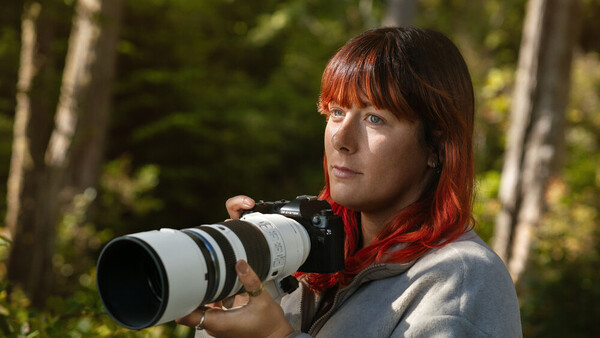
Micro Four Thirds has been declared “dead” so many times you’d think it was a cat working its way through nine lives. Year after year, people predict its collapse, citing smaller sensors and the dominance of full frame. And yet, here we are in 2025, with OM System unveiling one of the most audacious lenses in recent memory. The M.Zuiko Digital ED 50–200mm f/2.8 IS PRO doesn’t just extend the format’s lifespan; it makes a strong case that Micro Four Thirds might be the most interesting platform in photography right now.
The argument isn’t just about hardware. Sure, this new lens is wild, covering a 100–400mm equivalent range at a constant f/2.8, something no other system offers. But what makes Micro Four Thirds unique is the way OM System has leaned into computational photography. Live Composite, Live ND, Pro Capture, Handheld High-Res, Starry Sky AF: these are features you simply won’t find bundled together anywhere else. It’s not about fighting full frame on its turf. It’s about redefining what a camera can do. And that is where the conversation gets much more interesting, because once you stop comparing spec sheets and start comparing experiences, Micro Four Thirds looks like it might be leading the charge.
Micro Four Thirds has always thrived when it leaned into its differences rather than tried to copy full frame. Where larger formats tout shallow depth of field, OM points to greater portability and innovative features. Where competitors focus on massive glass, Micro Four Thirds builds tools that maximize what a smaller sensor can do. The result is a platform that consistently surprises with its versatility, often outperforming expectations in situations where weight, mobility, and creative features matter more than brute-force specs. For many photographers, that difference is the deciding factor: Micro Four Thirds makes the shots possible that other systems make too cumbersome.
The Myth of a Dead Format
For years, critics have painted Micro Four Thirds as a format without a future. The argument usually goes something like this: why settle for a smaller sensor when full frame or even APS-C are available, with better dynamic range and cleaner high-ISO performance? In an industry obsessed with sensor size, it was easy to dismiss Micro Four Thirds as compromised. If you wanted to be taken seriously, you bought a bigger sensor. And with larger sensors dominating headlines and marketing campaigns, it felt inevitable that Micro Four Thirds would fade away quietly.
But the so-called weaknesses of Micro Four Thirds have also been its biggest strengths. Smaller sensors mean smaller lenses, greater depth of field at the same aperture, and stabilization systems that outperform anything in the full frame world. These aren’t flaws—they’re features, especially for photographers who prioritize portability and versatility over chasing razor-thin depth of field. This is why Micro Four Thirds has always had a loyal community of birders, hikers, and adventurers who simply cannot get the same results without breaking their backs or their budgets.
And while critics kept writing its obituary, the system quietly built a loyal following. Bird photographers embraced the reach. Hikers and travelers appreciated the lightweight. Macro shooters enjoyed having depth of field to spare. For them, Micro Four Thirds wasn’t a compromise; it was the system that let them get the shots they wanted without hauling an anchor of gear. And that loyal base kept pushing OM and Panasonic to innovate in ways that full frame companies never had to, because for them the margins were safe and the sales numbers were steady. The irony is that the system with the smallest sensor has ended up with some of the boldest ideas.
OM System understands this. Instead of trying to play the same game as Canon or Nikon, it doubled down on what makes Micro Four Thirds different. The 50–200mm f/2.8 IS PRO is proof of that strategy: a lens that wouldn’t even make sense in another system, but feels perfectly aligned with the ethos of Micro Four Thirds. It is a kind of lens that full frame shooters would scoff at on paper, only to realize later that they would need a small suitcase and an extra $10,000 to build something equivalent in their system. That is the value proposition of Micro Four Thirds: surprising practicality wrapped in ambition.
The Lens as Proof of Life
Let’s pause and look at this lens for what it is. The M.Zuiko 50–200mm f/2.8 IS PRO offers a 100–400mm equivalent focal range with a constant f/2.8 aperture. On its own, that’s extraordinary. Add the 2x teleconverter and you’re looking at an 800mm equivalent at f/5.6, all in a package that weighs about 1,075 grams. That’s lighter than many full frame 70–200mm zooms, and it’s giving you double the reach. In the field, that is the difference between capturing the moment and watching it pass while you’re still setting up a tripod.
This lens is built for the field. It’s weather-sealed to IP53 standards, freezeproof to -10°C, and coated to resist water and dust. Wildlife shooters and travel photographers can take it places where full frame shooters would need sherpas. It’s not a compromise; it’s an entirely different way of thinking about long glass. A lens like this demonstrates that Micro Four Thirds doesn’t need to compete head-to-head with full frame. It simply needs to be excellent at what it does best: portability, ruggedness, and flexibility.
What stands out is how this lens embodies OM’s philosophy. It’s not about hitting a checklist or duplicating what the competition has already done. It’s about taking a bold swing at something no one else will build. In that sense, it’s not just a lens release. It’s a statement of intent, proof that OM believes in the future of its format enough to invest in optics that defy convention. Even if it doesn’t sell in massive numbers, it builds prestige, and it shows that OM is playing the long game.
More importantly, it shows that OM System isn’t afraid to go bold. This isn’t a safe lens aimed at the mass market. It’s a statement piece, designed to remind the industry that innovation doesn’t only happen at the high end of full frame. If you thought Micro Four Thirds was done, this lens should make you think again. This is the sort of lens that, even if most people don't buy, it gets them considering Micro Four Thirds for themselves.
Computational Photography: The Real Differentiator
Hardware is only half the story. What makes Micro Four Thirds so fascinating is how it pairs exotic optics with computational features that change the way you shoot. Live Composite, for instance, lets you capture star trails, fireworks, or traffic streaks in real time without overexposing the frame. You watch the effect build on the screen like magic, no Photoshop required, and suddenly a technique that used to demand advanced post-production becomes accessible to anyone willing to try it.
Then there’s Live ND, which simulates neutral density filters in-camera. Want silky waterfalls or blurred oceans in bright daylight? No need to carry glass filters. The camera does the math, layering exposures to mimic the look. For travel shooters, that’s the difference between packing light and lugging a full accessory kit. It also means that spur-of-the-moment shots that would have been impossible without planning can suddenly be captured on a whim. That kind of flexibility isn’t just nice. It can be transformative.
Other systems have high-speed modes, but OM’s Pro Capture was one of the first to buffer frames as soon as you half-press the shutter, so when the decisive moment comes, you’ve already captured it. Pair that with Handheld High-Res, which uses sensor-shift technology to produce giant, detailed files without a tripod, and you’ve got tools that blur the line between traditional photography and computational wizardry. Add Starry Sky AF for astrophotography and focus stacking for macro, and suddenly Micro Four Thirds looks less like a compromise and more like the most forward-thinking platform in the game. It’s not about sensor size; it’s about giving photographers a toolkit that lets them approach their craft differently.
The key here is that these aren’t gimmicks. They’re genuinely useful, field-ready tools that solve real-world problems. Want to shoot fireworks without blowing highlights? Live Composite does it. Want long exposures without a bag of filters? Live ND handles it. Want to nail the exact instant a kingfisher hits the water? Pro Capture ensures you don’t miss. These features expand creative possibilities in ways that bigger sensors can’t replicate, because no one else is willing to build them. If photography is about expanding what’s possible, then OM has staked out some of the most fertile ground in the industry.
Why It Matters in the Field
The practical applications of this combination are staggering. Wildlife photographers can carry an 800mm equivalent setup that’s light enough to handhold, with stabilization strong enough to keep subjects locked in frame. Macro shooters can lean on focus stacking to capture depth-rich images of insects or flowers without carrying rails and rigs. Travelers can shoot landscapes with Live Composite at night, then blur waves with Live ND in the morning, all with one body and a couple of lenses. The efficiency is remarkable: one bag, one system, endless possibilities.
Astrophotographers, long underserved by camera makers, get tools tailored to their needs. Starry Sky AF locks onto stars without the endless hunting that plagues other systems. Live Composite lets them watch star trails build in real time. That accessibility matters. It makes creative techniques that once required hours of setup or heavy post-processing available to anyone willing to experiment. And because the system is lighter, astrophotography setups can be carried into the field without turning into a logistical nightmare.
The field advantage isn’t just about saving weight. It’s about making advanced techniques less intimidating and more spontaneous. When you can set up a star trail shot in minutes instead of hours, or carry one telephoto instead of three, you’re more likely to actually try. That shift matters more than another stop of ISO performance (for most people). Photographers spend more time shooting and less time prepping, and that’s the kind of shift that creates new work, not just better pixels.
This is what makes Micro Four Thirds so compelling. It’s not just about megapixels or dynamic range charts. It’s about changing the shooting experience itself. OM System isn’t asking you to spend more time in front of a computer. It’s inviting you to do more in the field, in the moment, with the gear you already carry. It’s a creative philosophy as much as it is a technological one, and that might be the most interesting part of all.
The Market Contrast
OM System is taking risks with a clear philosophy in mind: if you can't beat 'em on specs (or just sensor size), beat 'em on innovation. A constant f/2.8 100–400mm equivalent is the kind of lens no one else would attempt. Computational tools like Live Composite or Pro Capture aren’t just marketing fluff; they’re genuinely useful features that differentiate the platform. Micro Four Thirds doesn’t need to “catch up” to full frame because it’s playing a different game entirely. And that game is about creativity, not conformity.
That’s the irony. For a format many declared obsolete, Micro Four Thirds is actually delivering some of the freshest ideas in the industry. OM System is carving out a niche defined by portability, computational smarts, and creative freedom, not unlike how Fujifilm carved out their niche by avoiding full frame entirely when almost everyone else was fighting an intense battle for 35mm supremacy.
Conclusion
Micro Four Thirds may never win the spec wars for shallowest depth of field or cleanest high ISO. But that’s not the point. The system offers something no other platform does: a blend of exotic optics, unmatched stabilization, portability, and computational tools that let photographers shoot in ways full frame simply can’t replicate. If you want something new, something inspiring, something that feels like it’s pushing photography forward instead of laterally, this is where you’ll find it.
The M.Zuiko 50–200mm f/2.8 IS PRO is the latest proof. It’s a lens that wouldn’t exist anywhere else, paired with features no other camera maker offers. Far from being dead, Micro Four Thirds might actually be the most interesting system in photography right now. And if this is what a “dying” format looks like, the rest of the industry should be paying attention. Because once you step outside the spec race and start asking what cameras can do for creativity, it becomes clear that Micro Four Thirds is playing a very different game—and winning it.
Micro Four Thirds may not dominate the sales charts, but it’s winning when it comes to imagination. The system’s ability to deliver unique experiences, not just incremental improvements, is what makes it compelling. In an industry that often feels stagnant, Micro Four Thirds is reminding us that cameras can still surprise, and that might be the most interesting thing of all.




Join the Fstoppers community for free
-
Post comments and join in the discussions
-
Browse the site ad-free
-
Share your work and get featured in the community
-
Compete in the photo contests for fun and prizes
102 Comments
I think that aps-c is the best for travel. Good image quality and low weight.
Whenever Micro Four Thirds gets written about Full Frame Trolls leap in with spurious equivalencies.
I don't care at all for what Full Frame delivers.
In camera club competitions, Full Frame wild life photographers are beginning to receive the epitaph, 'oh another bird on a stick.' Shortly before the judge moves on.
What judges and the public don't want to see is some pictures that wouldn’t look out of place as a line drawing in a field guide book on birds.
What is now wanted is wildlife incontext, actually doing something.
MFT delivers both with Pro capture, Photo from 4k and post focus.
MFT isn’t the only system with those features anymore. And full frame or APS-C shooters are well capable of shooting flying birds. (Like Alan Murphy )
You're right. Pre-Capture has been copied by Canon, Nikon and Sony - though mostly only in their top end cameras costing thousands more (I think Canon has it in one of their lower cost models), it is in every OM camera though.
Tech copied from M43 - they should have copyrighted it (or maybe they did but there's some way of circumventing it)!
You forgot Panasonic also has it on their full frame cameras. And Panasonic was also the first with IBIS in their video cameras, Minolta (2004), Pentax (2006), Olympus (2007) later put ibis in still cameras.
I was clearly referring to Pre-capture. Not IBIS.
Panosonic has pre-capture on their full frame cameras. And the ibis mention was in reply to tech copied by camera compagnies
Well, not all of us full-frame people are trolls. If birds and wildlife were my photographic passion, M4/3 is what I would be using. Seems like the logical tool for the job. I wish the format well, and hope that it hangs in there; we would be poorer without it.
I know several pro landscape photographers using m43, outdoor magazines are using their photos …
I am not surprised. And just yesterday I saw some really fine astrophotography done on m4/3. Demonstration of real results beats theory-based objections.
Malcolm, it was literally the author who brought Full Frame equivalence into the argument.
"The M.Zuiko 50–200mm f/2.8 IS PRO offers a 100–400mm equivalent focal range with a constant f/2.8 aperture."
You gave the equivalent focal length but not the equivalent aperture. It doesn't bode well for the platform that marketing points still hinge upon consumers misunderstanding equivalence.
There's no full-frame equivalent lens that exactly matches those specs, but Canon has a FF 100-400 f/5.6-8 that's a stop slower on the long end but half the weight and 1/5 the cost. The Nikon FF 100-400 f/4.5-5.6 is ~2/3 stop faster on the wide end, 30% cheaper, and ony 14% heavier (comparing the B&H spec weight).
MFT is doing some interesting things and I'm glad it still exists - like Alice Camera is definitely the most interesting camera of the decade and it's an MFT camera. But I can't find anything particularly compelling about this new lens, especially considering the OM cameras are still limited to 20 megapixels.
Tony, an FF, or any kind of f5.6 lens is not a stop slower, but exactly 4 times slower than an f2.8 lens, if by slowness you mean speed aka shutter speed.
Regarding aperture, m43, apsc and FF are not equivalent indeed, the advantage is taste dependent here, with long focal lengths I prefer the smaller sensors' deeper d.o.f. , others the opposite.
lol, the RF 100-400mm f/5.6-8 is a consumer grade lens with no weather sealing, doesn't include a lens hood or tripod collar (if I'm not mistaken), slower AF, is a much slower lens, and is made of plastic. of course it's going to be cheaper and lighter. :P
Hi Tony,
An F stop is the relationship between the apperture and focal length of a lens.
That’s why you can quote an F stop across all cameras regardless of sensor size.
I'm unsure if you just don't get this or willfully chose to confuse.
Smaller sensors give greater depth of field. The public like pictures showing where the subject of the photograph is. That's why several billion mobile phone users take trillions of photographs.
I wonder why Full Frame camera makers haven't broken past the 80mp sensor, which afterall is only the equivalent pixel density of a 20mp MFT sensor. Perhaps it's because the cost of Full Frame lenses to adequately deal with an 80mp sensor would be too prohibitive.
I can take 80mp photographs with OM System cameras. Can you take a 320mp photograph with a full frame camera.
I am a dedicated DSLR user and am sticking with them. However, if I ever got a second system it would be MFT.
MFT is the only mirrorless system that lives up to the promise of lighter and smaller.
750g for Fuji’s macro lens or over 400g for a Nikon Z nifty fifty? And the prices of some of those lenses are in line with their weight!
And MFT also has a pretty well rounded collection.
I'm using OM System and Canon full frame, depending on what I'm doing. Both excel in different areas.
There's no doubt computational photography can help make it easier and faster to get a certain type of shot.
This is the right answer.
I don't know why some FF users feel threatened by M43 encroaching on their particular playground.
It's always horses for courses and in some instances M43 will be the more suitable format, especially with the robustness and computational functions they encompass. For some genres FF will be the better tool, there's not one format that is superior for all genres/situations.
I feel like "reach" gets misused a lot. What "reach" really describes is pixels on target at any given focal length. A 200 mm lens is a 200 mm lens regardless of what is capturing the image behind it, be it a 4/3 sensor or an 8x10 piece of sheet film. A 20 mp OM-3 only gives more "reach" at 200 mm than a 35 mm sensor if that 35 mm sensor is less than 80 mpix (which is all of them, currently). But it only gives more reach than about a 30 mpix APS-C sensor. And there's plenty of APS-C cameras with more mpix than that.
By 'focusing' on focal length you miss the real issue. What matters is angle of view, not the focal length stated on the lens. For the OM 50-200mm lens cited, the angle of view is 24° to 6.2°. For a Canon 100-400mm lens used on a FF camera, the angle of view is 24° to 6° 10'. Virtually the same, and it correlates to what one sees when one looks through the appropriate camera and lens. What you see is what matters, not the stated focal length.
Photo publications (hint, hint, F-Stoppers) could do us all a service by reminding readers of angle of view in their lens reviews.
Sometimes when I get to read some of the articles I just shake my head because photography is just not that technical as this article makes it seems. Any sensible photographer knows that you can have all the latest cameras and lenses there is, but if you don't have the skills to make a photo capture the eye using light and composition then its all moot. Technology has it place, but simplicity takes its place !!!
A little too simplistic Douglas as that goes without saying. However an artist must still select the right tool for the job and luckily as photographers we have access to a wide variety - and M43 is definitely one of them offering something different.
I have used MFT, APS-C, full frame and medium format systems for decades. Each has its place. 9 times out of 10, I prefer my results from full frame over all the others. The simple truth is that MFT has been bumping up against the ceiling of physics for the past 10 years. Increasing MFT sensor resolution beyond 20-25mp causes an exponential increase in noise and loss of DR under the current technology. Full frame cameras won't hit the same wall until 100mp. Perhaps some new sensor tech will allow all cameras to push beyond those limits in the future. But today MFT is severely limited by the resolution of its sensors.
To compensate for the sensor handicap, MFT must use higher and higher quality optics which are larger, heavier and more expensive than equivalent lenses for larger formats. This completely defeats the supposed goal of MFT.
Keep up the good work on getting the word out Alex. I've been a big fan of MFT cameras, first Lumix but now fully converted to OM System, since 2015. I'm alway amazed how many full frame shooters suggest the only way to go is with the larger sensor cameras. In the same conversation they pull out there phone and start raving about what an amazing job it does at capturing images. And the OM System sensor is a massive upgrade from their phone yet small sensors don't cut it they say. Simply uneducated. Here's just one example of the power of the OM System wit the 150-400mm lens. A wild Macaw from Brazil.
No camera system is perfect. I know because I like many others reading I own and have owned too many cameras to count. In the past few months I have shot a Nikon FM3a, Leica M8, Nikon D40 infrared, Nikon D850, OM System M1Mk ii and Panasonic G9 M2. I just went on a long sailing trip. I took the OM System body. Why? It and its lenses are light and small. An equivalent full frame kit would have weighted at least twice as much. The lenses I own are superb and several, along with the camera body are weather sealed (and lived up to this on the ocean). Camera and lens synced stabilization is superb. I have not scratched the surface of the OM System body's capabilities. High ISO noise can be an issue, but Topaz DeNoise in batch edit works wonders. For all genres of photography that interest me, this system works perfectly. Does the image quality match that of my D850? No. Do I carry the M43 system more? Yes.
My worthless 2 cents (that some out there might strongly disagree with). As a polycamerous person who sold photo gear:
Use whatever you want. Every camera and lens has a niche where it performs its best, and one should try to match the photographer working in that niche to the gear that fits them best. My direct experience was that Oly/OM cameras usually found their home with people north of retirement age, usually because older folks can’t carry as much weight and are preternaturally drawn to birds (as soon as my beard got its first few grey hairs the same avian affliction befell me hah).
Lumix M4/3 was the opposite, lots of people in their 20-30s doing video. Which seems like what you’d expect.
Canon was pretty generalist demographic wise, Nikon as well but skewed older (probably due to the focus on telephoto lenses and their utility in wildlife photography), Sony also pretty broad but averaged younger, probably due to video. Fuji was pretty solidly dudes in their late 20s to early 40s.
With a view on the entire market I can’t say that I’d consider M4/3 especially “interesting” in a broad sense, although I suspect the article itself is meant to attract eyeballs and comments more than it means to make that case to the ends of the earth. The releases haven’t been that frequent, nor have they been especially innovative compared to what’s coming out of other companies. Global shutters, internal terabyte storage, borderline black-magic tracking AF, never before seen lenses, plucky Chinese lens companies challenging the established players at fractions of the price. There’s a lot going on out there, and I’m not sure that what’s essentially a 70-200mm F/2.8 with a 2x crop is that broadly compelling in comparison. Some of the computational stuff would come in handy every so often, but none of it seems “daily driver” level for me. Which is to say, I wouldn't go out of my way to pay for it if it were magically offered as a paid upgrade on some other camera I was using. The stabilization on the other hand I find very compelling, in some cases can spare you bringing a gimbal or a tripod with you. But given the market share spread out there… well it’s fair to say that people seem to prefer other systems by a large margin.
This one’s a pet peeve: no shade on OM, but as an avid astrophotographer I’m sorry to report that those handful of gimmicks aren’t something I’d ever actually want to use. The occasional star trail shot is fine and all, but I’d much rather have full processing control and then run it through StarStaX to simultaneously create the necessary frames for a time lapse. The 5 seconds Starry AF would save if it actually works also isn’t that compelling, and the system just isn’t built to excel at astro in general.
Ugh, this turned into a boring ramble.
Best down to earth comment I’ve read about this subject
Cheers, mate.
Anecdotally, I'm a 36 year old that shoots OM. In the dealings I've had with people on FB marketplace to buy or sell lenses and a camera body, they've all been under 40. One being an astrophotographer in his 20s.
Not sure if it's more recent, but I am yet to interact with an M43 shooter that's anywhere near retirement age.
Just my (maybe also worthless) 2 cents.
Everyone’s experience is valid, brother. I’d say sample size plays a role here, and while in 2025 Facebook might be known for mostly being the social media of older folks marketplace definitely leans younger in my experience. When I’m buying or selling used off marketplace it’s usually (but not always) someone in their 20s or 30s on the other end. In contrast, at retail we’d see a much higher proportion of people north of middle age. I’d reckon that for people in their 60s or 70s buying new with a warranty is a bit more attractive than meeting up with some guy in a parking lot, but that’s just my interpretation. At the time, we also were OM‘s largest account nationally.
At any rate, just sharing my experience since I was in a position to see what people were buying with a large sample size. Whether or not that’s broadly applicable globally is anyone’s guess.
Maybe in the used market Matthew, but if you talk to retailers or check message boards, the m4/3 demographic skews quite a bit older than other brands.
Same here :)
Well, I am far from retiring age, but I have kids, and on long trails my FF camera weight is a pain, thať’s why I am using m43
Ok? It’s valid for you to use and like whatever camera you want, your personal preferences are yours alone to have.
There’s nothing wrong with being retirement age, or any age for that matter. I’m not sure why people keep feeling the need to tell me they aren’t old?
No, no interest.
Hi Robert, thank you for the reply. I assume this means you have no interest in the M 4/3 system? If so, understood completely. L.
Nice looking hardware, but I love my Z8 and GFX 100s.
No interest in your opinion
Don't care.
Comments like this make people appear defensive, which reinforces stereotypes that folks have about users of this or that brand of camera.
What is going on for you personally that would trigger you to make an unnecessary slight against another person for something as inconsequential as “no, no interest” in reference to a consumer product in a sea of consumer products?
As an Olympus user and glad to see OM come out with a lens they developed. Gives me hope of continued life of the system. I don’t worry about all the arguments of equivalence, etc, etc. Spend my time just out taking pictures.
After reading the article and reading all the comments I’ve come to the conclusion that I really don’t care what others think about the camera system I use. It’s full frame , it suits me, I like it and it gets the results I want. And if others think their camera is better, maybe it is for them and that’s fine.
Can we now have more articles about photography and reviews that are not sponsored in any way and not by the brand ambassadors. Oh, and not the same lens three times. Thank you.
These articles bring in the eyeballs unfortunately, and thus ad revenue. As with Pentax before it, M4/3 (Olympus/OM mainly) has a small but passionate fan base that’s eager to jump into the fray.
-Publish positive article about M4/3
-Supporters will rush in to add praise
-Some others will be critical
-Arguments ensue
-Profit
My experience is that OM people, much like Pentax people, lean towards an older demographic. And older people are less likely to run an ad blocker. Ergo, we end up getting lots of articles that lean into a false dichotomy (often central to gear), so that people keep clicking, commenting, checking, replying, checking, replying.
Edit: Matthew and Susan, I’d love to hear what you disagree with and why.
Honestly none of it really matters as long as I take great pictures with any camera I use I really don't care about the specs I really don't care about who uses what I just really don't care what I really care about is the professionalism of my photography. That's the only thing I care about which system you going to shoot with and how good the system is just totally up to you. Buy me personally I'm a stick to my Canon EOS 90D I don't want to change my system because it does something different or it's more important to others. I don't chase the norm that goes outside the norm and my Canon 90D goes outside the normal photography specs. Give me three more months and I'mma order a new one I'm that guy Cannon for life. As long as I can keep pulling images like this I honestly don't care what camera you use I'm not going to argue with you speckheads I'm not going to argue with you om shooters if that's what you choose to shoot with more power to you.
All of the compensations for micro 4/3 are also possible on other platforms.There is nothing stopping the use of computational photography on APC-C and full frame, and even medium format.
In addition to that, the main issues with Micro 4/3 has nothing to do with the smaller sensor size, lower dynamic range and more noise, instead, it has to do with the price. Often what we see are micro 4/3 cameras with high end full frame pricing.
In addition to that, the lens pricing is also often well in the range of full frame glass, even though with lens glass, the cost increases exponentially with the size of the elements.
Simply put, it is a platform that has limited their market share by seeking massive profit margins.
Micro 4/3 has has numerous benefits, especially in the area of macro photography, but the pricing makes the platform an overall bad value.
If this market was translated into the PC hardware space, it would be like in a market of AMD and Nvidia making making high end $1000 video cards, and then another company stepping in and making a $1000 video card that performs like a $300 video card, but they try to market it for $1000 anyway and justify it be claiming that they added a newer video encoder that is 1% faster than NVENC.
Simply put, an setup with an OM-1 camera and lenses, will cost a similar amount to a Sony A7 IV or a Nikon Z7 II and equivalent lenses.
I would offer a different explanation for the pricing disparity as someone who came to know the margins after a stint selling cameras. Companies are indeed profit minded and often greedy but they still have to operate sustainably. Banal “greed” is incongruent with that, depending on context.
For example, the pricing structure you see with low market share brands like OM or Pentax are explained quite well by the economics of scale. As production volumes decrease, costs stay more or less the same while revenue decreases. This puts upward pressure on end user prices because the per-unit production costs increase as volume goes down. The cost of a machine that grinds lens elements doesn’t change simply because you’re producing half what you used to, for instance.
In the case of Olympus, they offloaded their camera division to Japan Industrial Partners (private equity) precisely because it wasn’t operating profitably for them. In Japan you apparently can’t just do mass layoffs so shuttering the operation wasn’t an option. What ends up happening in these types of situations is that a business will be sold off to what’s essentially a private equity chop-shop, who’ll extract as much profit as possible with minimal investment. So in the case of JIP it’s not so much that they’re price gouging, it’s that they’re likely trying to milk as much revenue as they can while keeping investment to a minimum. Same with Pentax under Ricoh’s ownership.
So they surely aren’t rolling in 80% profit margins or anything, the margins are likely “normal” above what the production costs are. But you’re perhaps correct in that any reduced R&D investment will join with higher per-unit production costs to create products that at the end-user level don’t display innovation that’s keeping pace with asking prices. Hence your observation of decreasing value.
I’m sure I’ll get flak or thumbs-down from OM partisans but it is what it is. It’s fairly clear at this point that JIP isn’t flooding OM with R&D funds, given how many years it took this latest lens to see the light of day and how many other products are being white-labelled or released with barely any hardware changes from the previous iteration.
Well said. Panasonic has already incorporated every feature Alex mentioned except LiveND/LiveGrad and Starry AF on their Lumix full frame cameras. They even pipped OM System on HHHR, because Panasonic incorporates motion compensation.
I went with M43 after a lot of analysis. A Full Frame Flagship camera body cost 3.5x the cost of a Flagship M43 camera body. They may have come down since, but I doubt it.
When I compared equivalent focal length pro grade glass between the two systems FF was again much more expensive.
In all, at the time I moved into M43, I saved between $£20,000 to 30,000, on the kit I wanted.
Usually the full frame flagships are not the most technically sophisticated cameras, instead they are often highly specialized in a single area. for example, the Sony A9 III ($6800) has lower dynamic range, lower SNR, and less low-light performance than the Sony A7 IV ($2100). The A7 IV managed to offer a higher resolution and better low light performance and better dynamic range (if needed play with the sample raw files on DPreview).
The A9 III still has its more niche market because its global shutter and faster NAND interface and more RAM allowing it to be especially well suited for sports, compared to the rest of the product line, it has the most tradeoffs, but where it excels at, it does so by a massive margin, making it desirable for certain professions, but not well suited as an all round camera.
For a given focal length micro 4/3 is often significantly more expensive. And equivalent focal lengths does not justify a price difference, as that concept is not applied anywhere else. For example, the example, a 70-300 for APS-C is cheaper than the full frame version of the 70-300, even though the on an APS-C camera, a 300mm focal length gives an equivalent of a 450mm field of view.
With a lens, and sensor, a crop is nothing but a crop, and it is impossible to attach a price premium to a 2X crop. Everywhere else, lenses are not priced on equivalent focal length, instead they are priced on lens element size and process technology used. A full frame lens costs significantly more to make than one designed for APS-C
Alex, counter point: everything except LiveND/LiveGrad and Starry Sky AF is available on Panasonic's Lumix S full frame cameras. In fact, Panasonic does Handheld High Res better than OM System, as they have motion compensation.