
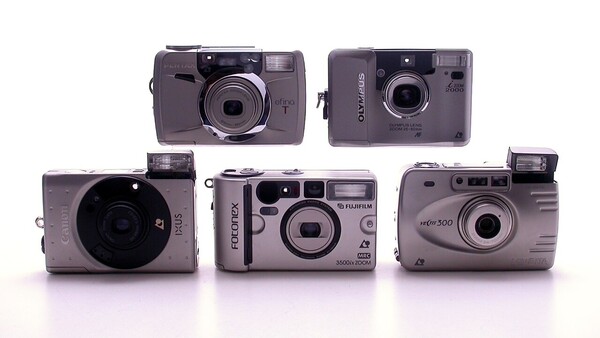
In February 1996, five of the biggest names in photography, companies that spent the rest of the century trying to bury each other, walked onto one stage in Las Vegas and formally launched a film format they had built together in secret. The five of them had already sunk around $500 million into it between them and expected to spend roughly that much again. Fifteen years later almost nobody remembered it existed.
The Big Five Called a Truce
The Advanced Photo System started as a Kodak project in the mid-1980s. The company had watched two of its own consumer formats, the 126 Instamatic and the tiny 110 cartridge, prove that people would trade image quality for a film they could drop into a camera without threading a leader. The problem was that those formats looked terrible. Kodak wanted the convenience without the grainy, muddy prints, and it spent close to a decade in the lab trying to get there.
What made APS strange was who built it. Somewhere around 1991 and 1992, Kodak brought in its single fiercest rival, Fuji Photo Film, plus three of the largest camera makers on earth: Canon, Minolta, and Nikon. These five became the System Development Companies, or as the trade press called them, the big five. They agreed to share the cost, agree on one standard, and launch together. For an industry that fought over every half-stop and every millimeter of a lens mount, it was an unusual peace.
They kept it quiet for years, previewed the new photofinishing equipment in October 1995, and formally announced the full system on February 1, 1996, at the Photo Marketing Association show in Las Vegas. Consumer products reached stores worldwide on April 22 of that year. Kodak's chairman, George M. C. Fisher, told the industry the group had already spent on the order of $500 million and expected a comparable sum ahead before anyone could measure whether it had worked. That is roughly a billion dollars, in 1996 money, bet on the idea that film had one more reinvention left in it.
Each company put its own badge on the same underlying standard. Kodak sold its film as Advantix, Fuji as Nexia, and two more film giants who signed on afterward gave it their names too, Agfa as Futura and Konica as Centuria. On the camera side you got Canon's IXUS line, Nikon's Nuvis, Minolta's Vectis, and Fuji's Endeavor. The licensee list eventually ran well beyond the founders, pulling in the likes of Olympus, Pentax, Contax, Yashica, and even Leica, which tells you how confident the industry was that this was the future. When most of the camera business lines up behind a single standard, it is easy to believe the standard has already won.
What Was Actually in the Cartridge
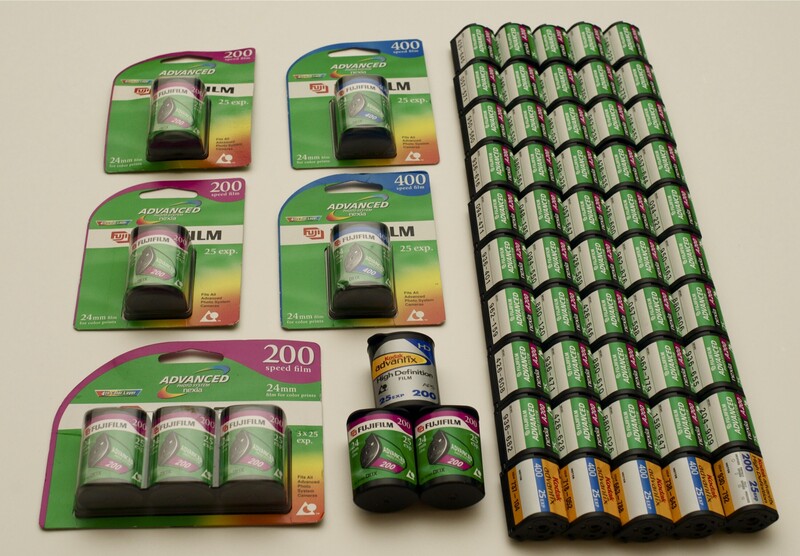
Open up the pitch and APS was genuinely clever. The film was 24mm wide instead of the 35mm every serious camera used, and the whole standard went by the designation IX240. The film base was polyethylene naphthalate, a plastic that is thinner, stronger, and flatter than the acetate 35mm rode on. That flatness matters more than it sounds. Film that sits perfectly flat in the gate is sharper corner to corner, and a stronger base let the engineers wind the whole roll inside a sealed, light-tight cartridge.
That cartridge was the best idea in the system. You dropped it into the camera, closed the door, and the camera did the rest. No threading a leader onto a take-up spool, no ruined first frames, no film yanked off the sprockets by a five-year-old. The camera controlled a locked door so you physically could not pop it open and fog your pictures. Better cameras added mid-roll change: you could pull a half-shot roll out, load a different film, and drop the first one back in later, and the camera would wind past the frames you had already used and pick up where you left off. No mainstream 35mm camera did that.
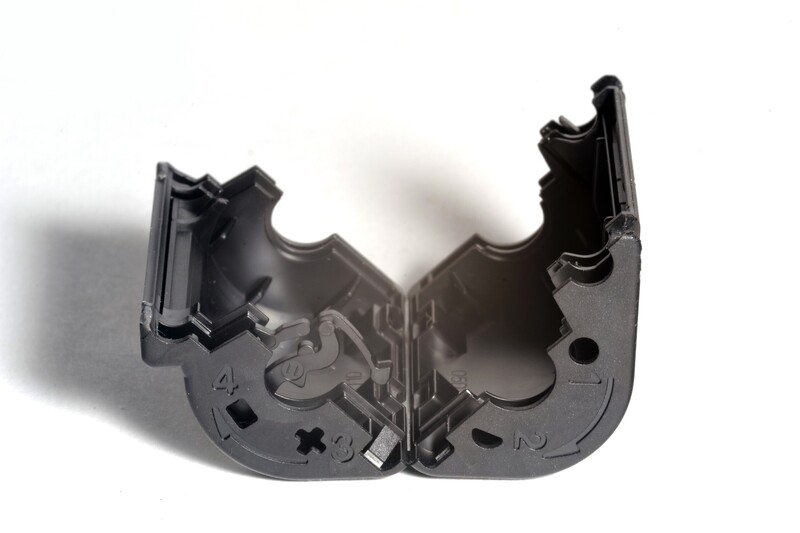
When your prints came back, the film came back too, but not in the flimsy sleeved strips every 35mm shooter knows. It rewound into the same cartridge, protected, and every order shipped with an index print, a small contact sheet of thumbnail images so you could see the whole roll at a glance and reorder by number. The cartridge itself carried a little window with four symbols that told you its state at a glance: a full circle for unexposed, a half circle for partly shot, an X for shot but not yet developed, and a rectangle for a roll that had already been processed. It was, in the small ways, a thoughtful piece of industrial design.
Pick Your Aspect Ratio After the Shot
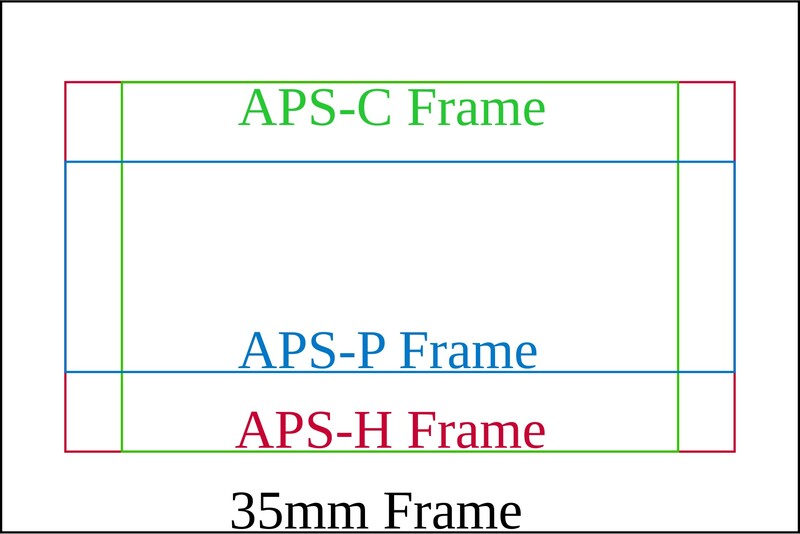
Here is the feature APS built its whole marketing campaign around. Every frame could be printed three ways. Classic, marked C, was the familiar 3:2 shape that came back as a 4x6 print. High Definition, marked H, was a wide 16:9 that printed at 4x7. Panoramic, marked P, was a dramatic 3:1 sliver that printed at 4x11. You flipped a switch on the camera, shot by shot, and told the lab which crop you wanted.
The honest version is a little less magic than the ads suggested. On most cameras the lens actually exposed the full wide H frame every time, and the format switch just recorded a note telling the printer how to crop it. Panoramic was not a wider picture at all. It was the same negative with the top and bottom thrown away. You were paying for a big print of a small slice of your own frame. Still, the flexibility was real, and being able to change your mind about aspect ratio at the counter was something 35mm never offered.
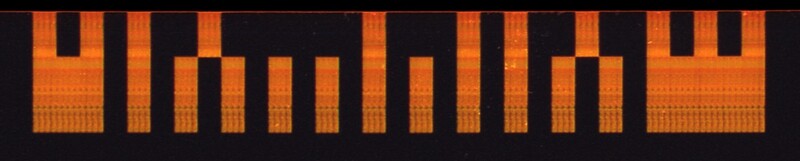
The cropping instruction was one entry in the system's real party trick, at least on the cameras built to use it fully. Running the length of the film was a transparent magnetic coating, the same idea as the stripe on the back of a credit card, and higher-end cameras wrote data onto it frame by frame. That is what the IX in IX240 stood for: Information Exchange. On those cameras it could store the date and time, the aspect ratio you chose, exposure details the lab could use to make a better print, print-quantity requests, and a short line of text you could title the shot with. Cheaper and single-use models used optical marks instead and generally recorded only the print format you had selected, not the fuller set of data. The dream, on the cameras that supported it, was a smarter photofinishing chain where the camera told the lab exactly how to handle each picture. It was, in a real sense, metadata written onto film, years before EXIF became something every photographer took for granted.
Where APS fell short for anyone who cared about pictures was the film menu itself. You could buy color negative film in ISO 100, 200, and 400, and a faster ISO 800 stock arrived a few years after launch. There was a chromogenic black-and-white film that developed in standard color chemistry, and a thin, hard-to-find selection of slide film that topped out around ISO 100. What never existed was a true traditional black-and-white stock, or the deep catalog of specialty emulsions 35mm shooters took for granted. If you wanted to do more than make snapshots, the format simply did not stock the shelf for you.
The Cameras Were the Best Part
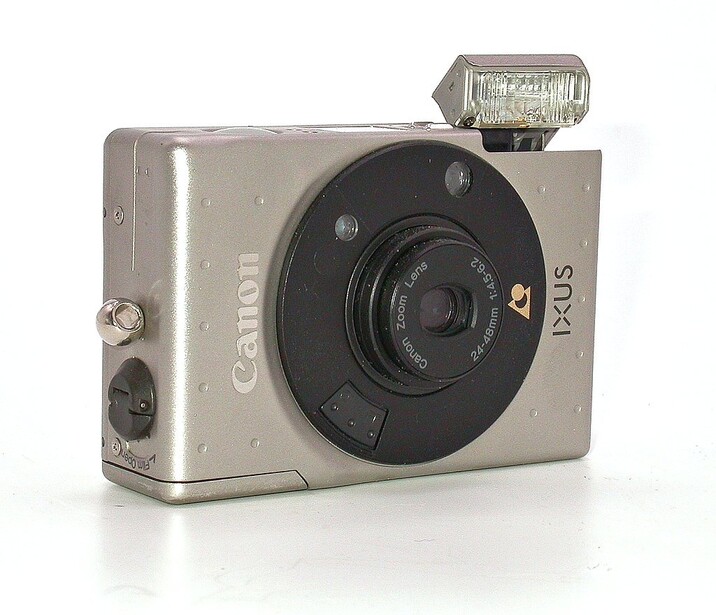
If APS is remembered fondly for anything, it is the hardware. A smaller negative meant a smaller film chamber, and designers used every millimeter they saved. Canon's entry, sold as the ELPH in North America, the IXUS in Europe, and the IXY in Japan, arrived in April 1996 and was billed as the smallest autofocus zoom compact in the world. It had a jewel-like stainless steel body that felt like a piece of luxury hardware, and it sold. By January 1999, Canon had shipped around 2.2 million of them, and it became one of the format's signature cameras. You can still see the original on Canon's museum site. Nikon answered with the compact Nuvis line, Minolta with the Vectis, and every one of them leaned into the same pitch: this is the camera you can actually carry.
The strangest chapter is the one nobody expected. The big camera makers built real single-lens reflex systems around a consumer snapshot format. Canon released the EOS IX in October 1996, and it kept the standard EF lens mount, so every Canon autofocus lens fit and worked, cropped to about 1.25 times tighter than on a 35mm body. Nikon's Pronea 600i did something more forward-looking. It took Nikon's F-mount lenses, but Nikon also designed a small line of dedicated IX-Nikkor lenses with a deliberately smaller image circle, sized to cover only the little APS frame. The rear elements sat so far back they could not safely mount on a 35mm Nikon at all. If that sounds familiar, it should. Nikon's own history calls the IX-Nikkor lenses a direct ancestor of the DX lenses it would build for digital a decade later. Minolta went furthest and invented a brand-new V-mount for its Vectis SLR, a lens family it would later bolt onto one of its first digital SLRs.
These were serious cameras chasing a market that turned out not to want serious APS cameras. But the engineering was not wasted. The people building tiny image circles and crop-factor lenses for a 24mm frame in 1996 were, without quite knowing it, rehearsing the digital camera everyone would carry in 2010.
The Problem Nobody Fixed: Your Corner Lab
For all the engineering, APS carried a flaw baked into its own design. The corner drugstore and the one-hour minilab, the places where most film in America actually got developed, could not simply drop an APS cartridge into the equipment they already owned. The film was a different width, wound differently, returned to a different housing, and carried a magnetic layer a standard 35mm machine had no way to read. The chemistry itself was ordinary C-41, but extracting, handling, reading, and reloading the narrower film in its cartridge took APS-specific gear that a lab had to add before it could accept the format at all. Plenty of operators looked at the added cost and handling and decided it was not worth it, and a great deal of APS work was routed to centralized labs instead.
Plenty of labs did not bother. That pushed a lot of APS processing to centralized plants, which meant your one-hour photos were no longer one hour, and sometimes not one day. A format sold on convenience quietly became slower and more expensive to develop than the 35mm it was supposed to replace. For a snapshot shooter, waiting longer to see worse-looking pictures was a hard sell no marketing budget could fully cover.
Because that is the other half of it: the pictures did look worse to a critical eye. A standard APS Classic negative had less than half the area of a full frame 35mm negative, so making a same-size print meant enlarging the image more, and enlarging more means more visible grain and less fine detail. Herbert Keppler, the veteran magazine columnist who had seen every format come and go, tried a pre-production system and judged it a clear step above the old 110 and 126 cartridges, but he would not say it would replace 35mm. Working professionals never seriously considered it. A wedding or a magazine cover was not going onto a negative smaller than a postage stamp when full frame film sat right there. APS was, from the start, a format for the family album, and it priced and paced itself out of even that.
Digital Was Already at the Door
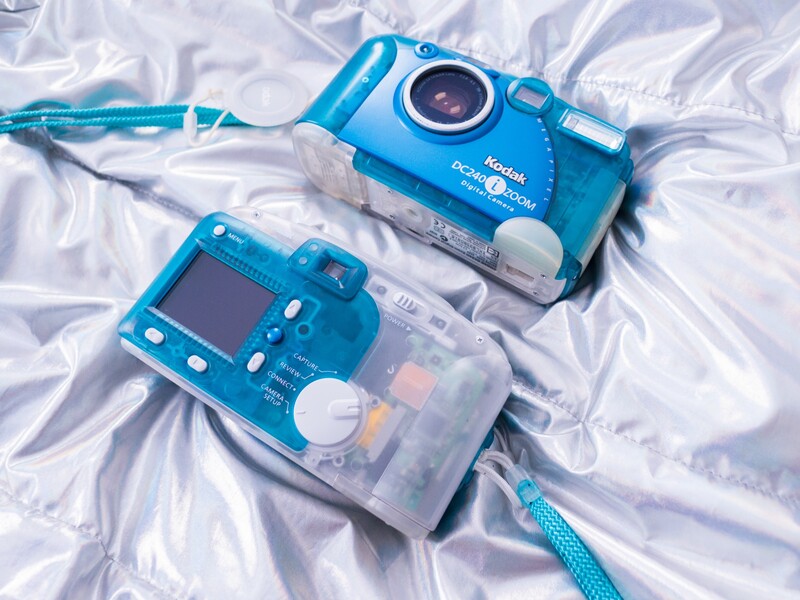
Timing killed APS more than any single flaw. The big five spent a decade and a billion dollars perfecting the ideal analog snapshot, and they finished it at the exact moment the analog snapshot stopped mattering. Kodak, of all companies, released a consumer digital camera the same year APS launched. By 2000 you could buy a one to two megapixel digital camera for under $1,000, and Nikon had already put the professional D1 on the market in 1999. Digital offered the one thing APS could only fake: you saw the picture instantly, and you never paid for a print you did not want.
APS did try to answer. At Photokina in 2000, Kodak showed the Advantix Preview, a film camera with a small 1.8-inch color screen on the back, which sounds like the future until you learn what it did. A tiny sensor grabbed a low-resolution copy of each shot so you could see it on the LCD, but the actual photo still went onto film, and the screen existed mainly to help you decide how many prints to order. It was a film camera wearing a digital camera's face, and it satisfied nobody. Enthusiasts wanted a real digital camera; snapshot shooters did not want to pay extra for a preview that could not save them a trip to the lab.
The numbers tell the rest. Manufacturers had predicted APS would take a large majority of new camera sales by 2000, on the order of 80 percent. By most accounts it peaked around 15 percent. APS SLR sales fell off a cliff after 2000, and camera magazines that once ran pages of APS listings had quietly swapped them for digital SLRs by 2002 and 2003. Kodak announced it was done making APS cameras in January 2004. Konica had already dropped its Centuria APS film by 2006. Kodak and Fuji stopped manufacturing the film itself in 2011. Fresh supplies dwindled after that, though expired stock remained available for years and still turns up today. The format that five giants built together died almost without a headline.
The Format That Refused to Die
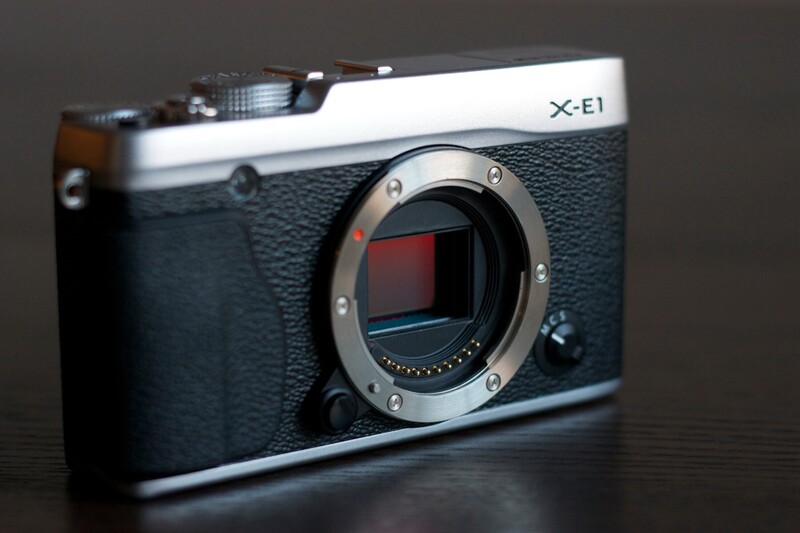
Here is the twist that makes APS worth remembering instead of mocking. You are probably holding its ghost right now. When the same companies started designing digital sensors, cutting a full frame sensor was expensive, so they made smaller ones. They needed a name for a sensor roughly the size of the old APS Classic negative, and they reached for the obvious one: APS-C. A large share of the affordable interchangeable-lens cameras made in the last twenty years use a sensor named directly after that failed 1996 print format.
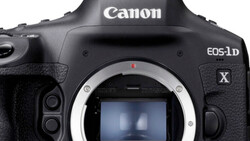
The lineage is not just a name. A modern APS-C sensor measures about 23.6 by 15.7mm and gives you a 1.5 times crop, or 1.6 on Canon bodies, the same kind of tighter framing APS shooters got on film. Canon even built an APS-H sized sensor, named for the old wide H format though not an exact match to that film frame, into its early professional EOS-1D bodies. Pick up a Fujifilm X-T5, a Sony a6700, or a Canon EOS R7 today and you are shooting a frame that owes its name, and roughly its size, to a format a consortium built to sell your parents a better point-and-shoot.
The idea about lenses survived too. Nikon's DX line in particular owes a direct debt to those weird little IX-Nikkor lenses, which Nikon itself has described as a forerunner of DX, and Minolta's V-mount glass pointed the same way, engineers designing for a film format the public rejected. Smaller image circles were not invented by APS, but the modern crop-sensor lens ecosystem, worth billions, still carries the trace of a format most people forgot by 2005.
APS lost the war it was built to fight. It never came close to replacing 35mm, and digital erased both of them from the mass market inside a decade. But the frame lives on anyway, standardized and multiplied across tens of millions of cameras that never held a strip of film. The negative you were talked out of buying in 1996 is very likely the sensor hanging around your neck today.
Lead image: five APS point-and-shoot cameras from the format's late-1990s heyday, a Canon IXUS, a Minolta Vectis 300, a Fujifilm Fotonex 3500ix, an Olympus i Zoom 2000, and a Pentax Efina T, all found unloved in charity shops years later. Photograph by John Nuttall, CC BY 2.0. Source.




.jpg)


.jpg)

.jpg)
Join the Fstoppers community for free
-
Post comments and join in the discussions
-
Browse the site ad-free
-
Share your work and get featured in the community
-
Compete in the photo contests for fun and prizes
2 Comments
Nice job, Alex. I was working for Fuji Hunt when APS was introduced. APS made the introduction of Disc film look like a walk in the park. All the one hour labs, who were all ready having a tough time, never had a chance.
Great article, Alex. I always coveted the Fujifilm Tiara, for some reason. Clearly not marketed at me with its champagne colour and effeminate name, I still think it's a dope camera.