

Photography is full of surprising history, weird technical quirks, and fascinating stories that even experienced photographers might not know. From the mathematical precision behind f-stops to cameras abandoned on the moon, these facts reveal just how wild the world of photography really is.
1. The F-Stop Numbers Are Based on the Square Root of 2
Ever wondered why the f-stop scale is such a "weird" set of numbers? It's not random. The progression is based on √2 (approximately 1.414). Here's why: when you want to double the amount of light hitting your sensor, you need to double the area of your aperture. To double the area of a circle, you multiply its radius by √2. Since the f-number is calculated by dividing the focal length by the aperture diameter (and diameter is twice the radius), this same √2 relationship creates the standard f-stop progression.
Going down the scale doubles the light at each step:
-
f/2.8 → f/2 (÷1.4) = double the light
-
f/2 → f/1.4 (÷1.4) = double the light
-
f/1.4 → f/1 (÷1.4) = double the light
Going up the scale halves the light:
-
f/1 → f/1.4 (×1.4) = half the light
-
f/1.4 → f/2 (×1.4) = half the light
-
f/2 → f/2.8 (×1.4) = half the light
It's pure math, which is why the numbers are what they are. This is also why third-stop increments (like f/1.8, f/3.5, or f/6.3) seem even weirder. They're just dividing that √2 progression into smaller steps. The whole system is elegantly logical once you understand the geometry.
2. The First "DSLR" Cost $20,000 and Required a 10-Pound Shoulder Pack
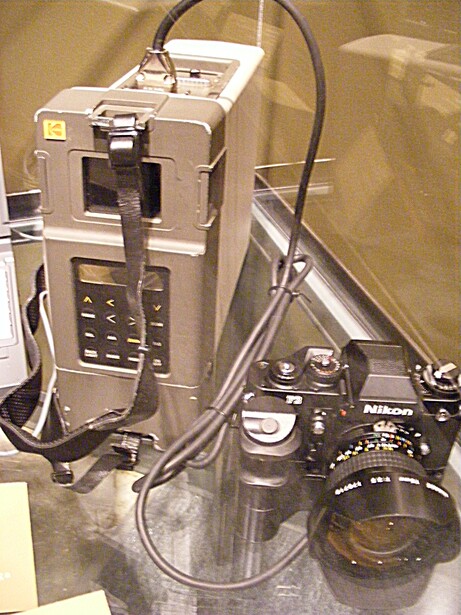
The first commercially available DSLR was the Kodak DCS 100, released in 1991. It was a heavily modified Nikon F3 body with a 1.3-megapixel CCD sensor. The camera couldn't store anything internally. You had to wear a "Digital Storage Unit," a shoulder pack with a 200 MB hard drive that held about 156 uncompressed images. The camera system itself weighed about 3.4 pounds, and the complete rig with the shoulder pack totaled roughly 15 pounds.
3. There Are 12 Hasselblad Cameras on the Moon
When the Apollo astronauts landed on the moon, they used heavily modified Hasselblad 500EL cameras to document their missions. To save weight for the return trip (to bring back more moon rocks), they were instructed to leave everything behind. They removed the precious film magazines, which held the photos, and left the camera bodies and lenses behind. From Apollo 11 through Apollo 17, a total of 12 Hasselblad camera bodies with lenses were left on the lunar surface. The most expensive abandoned gear in history.
These weren't standard Hasselblads either. They were extensively modified by NASA, stripped of all non-essential parts, painted silver to handle extreme temperature swings, and fitted with special film magazines that could survive the vacuum of space. The Reseau plates (glass plates with cross-markers) were added to the cameras to provide reference points for measuring distances and sizes in the photographs. These cameras shot some of the most iconic images in human history, and now they sit on the Moon, exposed to the harsh lunar environment.
4. The Technology for Your Camera's Sensor Won a Nobel Prize
The "CCD" (Charge-Coupled Device), which was the foundation of digital photography for decades, was invented at Bell Labs in 1969. The inventors, Willard Boyle and George E. Smith, were working on "Picture-Phone" concepts and solid-state memory when they conceived it. Their breakthrough in creating this imaging semiconductor circuit earned them the 2009 Nobel Prize in Physics. Pretty impressive for what began as an exploratory project.
What's remarkable is that Boyle and Smith sketched out the basic concept in just a few hours during a brainstorming session. Within a week, they had a working prototype. They originally envisioned it as a memory device, not an imaging sensor. It was only later that they realized its potential for capturing images. While most cameras today use CMOS sensors instead of CCDs (due to lower power consumption and cost), the CCD's invention was the critical breakthrough that made digital imaging possible.
5. The First Color Photograph Was a "Tartan Ribbon" Taken in 1861
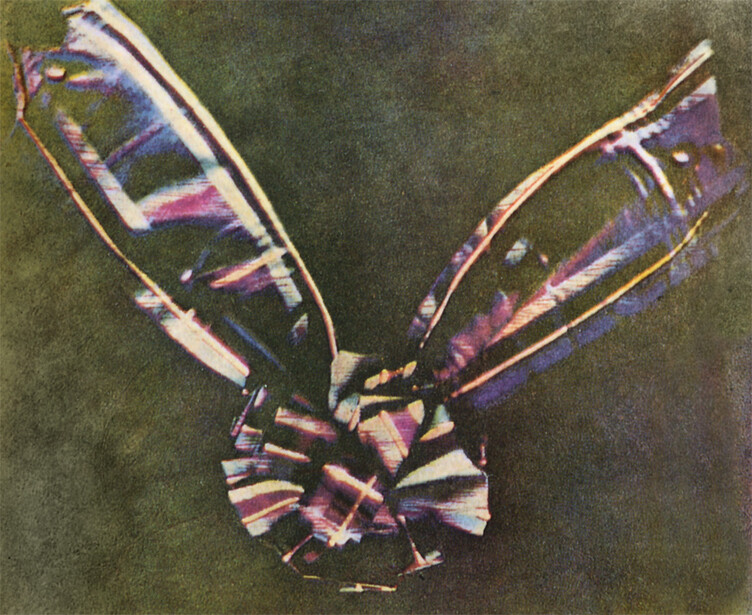
Physicist James Clerk Maxwell created the first permanent color photograph as a way to demonstrate his theory of three-color vision. The process required photographing a tartan ribbon three times using black-and-white film: once with a red filter over the lens, once with green, and once with blue. When Maxwell projected these three monochrome images simultaneously, each through its corresponding colored filter, they combined to recreate the ribbon in full color. It's the same basic principle your camera uses today.
6. In Japan and South Korea, Phones Sold Domestically Must Make an Audible Shutter Sound
This isn't a law against users, but a requirement for manufacturers. To combat covert photography and "upskirt" voyeurism (known as "molka" in Korea), both countries have implemented measures, though in different ways.
In South Korea, regulations require that camera phones emit a shutter sound in the range of 60-68 decibels, enforced at the manufacturer and device certification level. Phones that allow this sound to be disabled cannot be sold domestically. In Japan, the requirement comes from industry self-regulation among carriers and manufacturers rather than a statutory volume specification. The result in both countries is the same: on domestically sold models, the built-in camera app is configured so the shutter sound can't be muted, even in silent mode.
Some photographers find this frustrating in situations where silence is preferred (like museums or concerts), but the privacy protection is considered more important. Interestingly, the behavior can depend on region and SIM configuration. An international model phone may behave differently when used with a Japanese or Korean SIM than when used elsewhere, since the requirement is based on where the phone was sold and how it's configured.
7. Old Color Photos Turn Red Because the Cyan Dye Is Unstable
Ever wonder why old family photos from the 70s and 80s have a strong magenta/red cast? It's a chemical failure. In "Type C" color prints, there are three dye layers (Cyan, Magenta, and Yellow). The Cyan dye is notoriously unstable. Over time, it fades away, leaving only the Magenta and Yellow dyes, which combine to create a reddish-orange cast. Your childhood memories are literally chemically degrading.
This is why archival storage matters. Heat, humidity, and light all accelerate cyan dye fading. Photos stored in albums in climate-controlled environments last much longer than those stuck to refrigerators or left in attics. Modern inkjet prints using pigment-based inks are far more stable, with some manufacturers claiming print longevity of 200+ years under proper storage conditions. But those old drugstore prints from the 80s? They're on borrowed time.
8. Kodak's Failure Wasn't "Hiding" the Digital Camera. It Was Misunderstanding It
The popular myth is that Kodak "buried" the digital camera. The truth is, they used it. The DCS 100 was their product. Kodak's failure was one of imagination. They were a chemical company and saw digital as a "pro-only" tool that would support their film business. They couldn't imagine a world where "film for the masses" would disappear, because they saw film, not photos, as their product. A classic case of being unable to see past your own business model.
Kodak actually dominated the professional digital camera market in the 1990s with their DCS line. They were making money from digital. But they believed consumers would always want prints, and prints meant photo paper, which they also sold. They were partially right: people did want prints. They were just wrong about needing Kodak to make them. Home printers, online print services, and eventually the shift to purely digital sharing killed their business model from multiple directions at once.
9. A Frenchman in Brazil Also Invented the Word "Photography" (But No One Noticed)
We credit Sir John Herschel, who coined "photography" in 1839. But in 1833, a French-Brazilian inventor named Hercule Florence was living in an isolated village in Brazil, conducting his own experiments. His notes show he independently invented a camera and a chemical process and, amazingly, he called his process "photographie." His work was completely unknown to the world until it was rediscovered in the 1970s.
Florence wasn't just coining terms. He was actually making photographs using silver salts, independent of Daguerre and Talbot in Europe. He even experimented with using his process to print labels and documents, essentially inventing an early form of photographic reproduction. But his work remained completely isolated. It's a reminder that innovation often happens simultaneously in different places, but recognition goes to whoever has the better PR.
10. The World Takes Over 1.5 Trillion Photos Per Year (and 92% Are on Smartphones)
At the peak of the film era in 2000, we took an estimated 80 billion photos in that single year. We now take that many photos every two weeks. Current estimates put the total number of photos taken annually at over 1.5 trillion, and the vast majority (over 92%) are captured not with Canons or Nikons, but with smartphones. To put this in perspective: we now take almost as many photos every year as were taken in roughly half of the entire 20th century.





Join the Fstoppers community for free
-
Post comments and join in the discussions
-
Browse the site ad-free
-
Share your work and get featured in the community
-
Compete in the photo contests for fun and prizes
7 Comments
All very interesting! As for the f/#'s if you do bracketing it will help to have a printed chart for to know limits when doing 5 at +/- 3EV a setting I use to get a very sharp moon above a house or city. The fist shot is the clear and sharp moon SS 125 and a f/8-f/11 for focus and ISO 800 but your starting point is SS .5s this way 30s will be your last. you can make all faster if you just go up in SS but keep the same f/. I used to use a Promote Control where I could use any SS, f/ or ISO when using my Canon T2i. A reason I went Sony A7SM1 for it would do 5 at +/- 3EV but only two editors Nik HDR Efex was free years ago and saved by Dxo. But hard to blend and keep the moon sharp for the size lens mm used.
Understanding f/#'s as well as SS's and ISO's and how they mix and with a chart of all you can play and learn more.
1. using bracketing you can see inside or from inside to outside and the f/ is very important.
2. yes it looks like the moon is coming down but really the moon is rising, this is before a merge of images.
Also to add to see dust on your sensor use the highest number f/ or the smallest hole and do a long exposure while moving camera in a circle then you will see the dust that will be needed to be cleaned. for those who capture with the lowest f/ you may never see the dust on the sensor, lastly if you see a big blob on the image it is the dust on the back of the lens, keep it clean, no way to remove it off the image.
Thanks for mentioning the square root of two for ƒ-stops.
You mention "1/3rd stops", but neglected to mention that their relationship is the 6th root of two.
Also interesting, the frequency relationship between adjacent notes on the chromatic musical scale of 12 notes is the 12th root of two.
Yep! 12-tone equal temperament chose that ratio because it makes all 12 keys equally in tune.
As JS Bach promoted in "The Well-Tempered Clavier".
But it is a compromise. From A 440 to E is a perfect 5th at 660Hz. But an equally-tempered E is 659.25Hz.
Bach’s title is a bit misleading in modern terms. “Well-tempered” in his era wasn’t equal temperament; it referred to a family of temperaments that still kept some intervals pure and others slightly adjusted so each key had its own color. True 12-tone equal temperament came later. An equal-tempered e is 659.25 Hz [440*2^(7/12)]. 622 Hz is e-flat.
Thanks. I must have slipped a semitone when I looked on the chart. I recall thinking that wal excessive when I wrote it.
I've corrected my comment with your info.
The first DSLR I used was a loaner from my college in the late 90s. Not quite the size of the one pictures but it was also an SLR with a big box bolted on the bottom. I think I remember that it cost the school somewhere around 25k and the pics were about as good as a nokia flip phone from 2005