
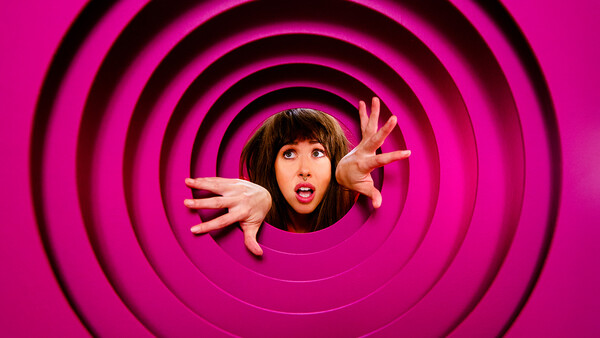
As AI tools improve, we all have to ask: What kind of creativity do we value most? Is it the idea? The process? The perfection or the imperfections? That’s not a bad thing. It’s a sign that art is still evolving.
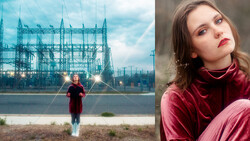
My creative partner and I combine photography with set design to take colorful, surreal photos. We recently posted a behind-the-scenes reel from one of our older photoshoots, expecting it to be a casual glimpse into our process. What we didn’t expect? A full-blown debate about whether it was “worth it” to build a set by hand in 2025.
You can check out the behind-the-scenes of the set build and photoshoot in the video above.
To be clear, this wasn’t a new shoot. It was from late 2023, and we’d already shared the final photos, process videos, everything—and it was very well received. This time around, the response started off similarly positive. But now, with AI tools like Midjourney, Firefly, and Photoshop's Generative Fill dominating creative conversations, our same post triggered a totally different and very unexpected reaction.
Suddenly, people weren’t just reacting to the final image. They were questioning the entire process. "Why bother building something real when you could generate it digitally?" "This seems like a waste of time." "Looks cool, but AI could do it faster." "You should have done it in post."
That shift in perception says a lot about where we are creatively right now. It feels like the idea of making something with your hands is starting to feel outdated to some people. The rise of AI is reshaping what we value in art: speed, efficiency, perfection. But what happens when we start measuring creativity by those metrics alone?
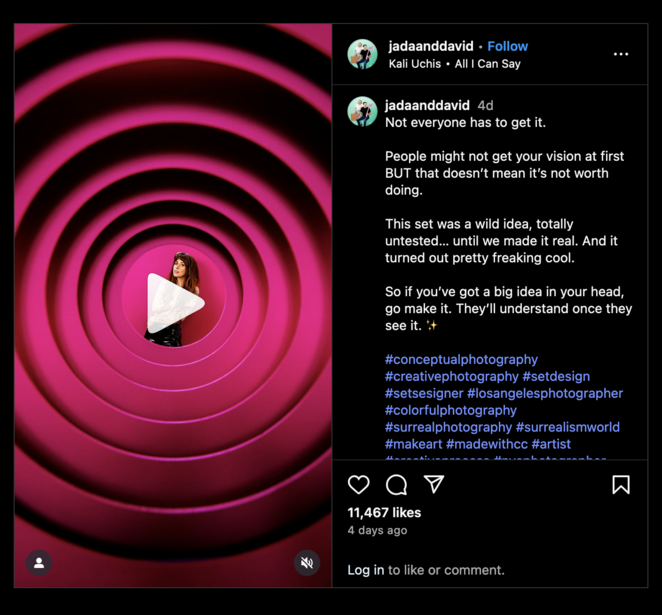
Click here to view the behind-the-scenes viral reel that started the debate.
Here’s what I know: There are a thousand ways to create a single image. Digital tools are valid. AI can be exciting. But the method matters. Not because one is better than another, but because the process shapes the outcome.
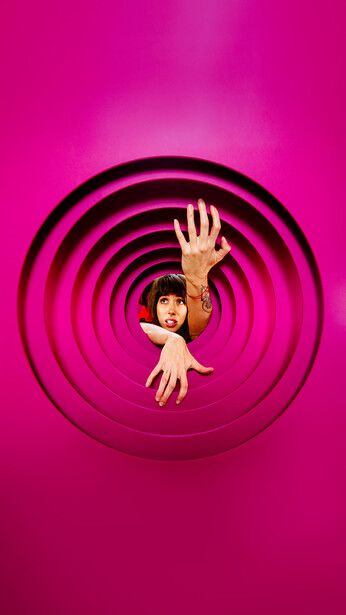
For us, physically building environments and inviting people to interact with them isn’t just a preference. It’s part of the emotional and visual storytelling that defines our work.
When someone steps onto a real set, it changes them. Their posture shifts. Their expressions soften or sharpen. The way light hits real textures can’t fully be faked. All of that subtle energy becomes part of the final photo. And it’s not just about aesthetics. It’s about the emotional and physical reaction that the space creates.
I’m not anti-AI. We use digital tools. We’ve played with AI. But what we keep coming back to is this: Creativity doesn’t have one right path. Just like you can paint the same scene with watercolor, oil, acrylic, or spray paint—there’s no single right way. But each process and material changes the end result in its own way.
The value of making something isn’t always in the output. Sometimes, it’s in the doing. In the tactile, unpredictable process of taking an idea from sketch to physical creation.
So what does it say about our creative culture if we start dismissing that kind of work just because it takes longer? Or because it’s messier? Are we moving toward a version of creativity where "good enough" and "fast" become the standard?
The backlash we received wasn’t about the art. It was about the effort. And that’s the conversation we think is worth having and the thing that surprised us most.
I'm not here to tell anyone how to make their art. But I will say this: Critique the image if you want—but don’t dismiss the process. It’s not about being better. It’s about being different. And different is where new ideas are born.
Art is something deeper, and there is no one-size-fits-all approach. The process is just as much a part of the art as the final product. AI is a tool. But it is not the only tool, nor should it be. There is value in all of it.
So wherever your creativity takes you, whether it’s digital, physical, or somewhere in between, don’t let the internet talk you out of doing what feels meaningful. Especially now, when the world needs more wild ideas, not fewer.
Because in the end, it’s not just about how fast we can create. It’s about what we’re choosing to say through the work we make.


Join the Fstoppers community for free
-
Post comments and join in the discussions
-
Browse the site ad-free
-
Share your work and get featured in the community
-
Compete in the photo contests for fun and prizes
11 Comments
I think its a really interesting topic, though people can, of course, be complete asses in how they engage it.
But I always look back to a talk by Joel Grimes like 20 years ago about his composite work. It was never that he couldn't achieve the same thing on location but always about making spectacular images accessible to his clients. The cost of shipping a team to some spectacular location to shoot the image in real life like how say an Eric Almas does it means each shoot needs to be a $100,000 production but with the help of compositing, you can achieve very similar results for 5% of the cost thus allowing you to lean into your creative vision being the driving force of the outcome and not your budget.
As a photographer who does a LOT of composite work I always try to use this mantra is my guiding star. Integrating AI into my workflow hasn't changed that at all. I leverage those tools to better convey my creative vision and execute the creative needs of the person I am working with. AI has allowed me to do it faster than the old way of buying stock images to use as background but fundamentally its the exact same thing.
That said, when I get the chance to work with a real set I always adore it because I find just the act of being in a physical space opens up creative opportunities that would never have come up when compositing. I also find that models "engage" better with the setting when they are actually in it.
These days, I post WAY more before/after BTS than I ever did back in the day because if I don't people just assume my work is AI generated. I am seeing this in all genres of photography; anyone "good" just gets accused of faking it with AI now. Thats the world we now live in.
As for the viral video, I saw it pop up on my IG a while back. I thought it was cool. I remember thinking: "Getting all those circles perfectly centered must sure have been a pain"
I totally agree with your point about accessibility. I also love what you said about physical space unlocking unexpected ideas. That’s exactly what keeps drawing me back to set-building.
Also, YES to needing to post BTS now more than ever. I’ve definitely felt that shift too. People assume anything that looks polished must be AI. It’s wild how quickly that perception has taken over.
Yeah exactly. It doesn't bother me so much because my work has a style to it that can be reminiscent of AI and there is absolutely overlap so I can see why people would be confused with my work. (Though I also do recognize this might make me more replaceable so I need to also evolve)
Where it bugs me is when I see spectacular work by world class photographers that isn't even remotely AI such as beautiful landscapes or amazing wildlife photography, then you go to the comments and every second comment is something just saying its AI. That, kinda grinds my gears, as not only is AI replacing creatives but its creating this sentiment among the general public that creatives don't even exist anymore and that all the work is just AI.
It really is! And that is sad to see. It's weird that people are beginning to judge creativity through the metrics of time and perfection.
I had a hard time with the comments saying it was a "waste of time" - because yes, things can be done in AI or in post. But we are incredibly fast and wood at woodworking. Plus I'd rather be making something with my hands for 2 hours than sitting at a computer.
It all goes back to the process for me. And just because something similar can be created digitally doesn't mean it needs to be. Art for arts sake should always exist in my opinion
Yeah, its a catch 22, if you don't use AI people will tell you that you are wasting your time but if you do use AI others will tell you that you are a fraud and not a real photographer. There is no winning in the minds of the anonymous social media critics.
The only rational response is: "Keep doing what you love, how you love to do it and to hell with the commenters"
Interesting point, Ryan.
In fact, I believe AI isn't actually shifting the paradigm in terms of what we consider a photograph, not entirely at least. Compositing already took a good part in that, and then of course, post-processing in the darkroom even before that.
The real question is what we consider a photograph or, to put it simply, if and when compositing should be considered acceptable.
so true. that is a really interesting question to ask. I think that is going to keep changing over time.
Happiness is not the destination, happiness is the journey !
Absolutely! That’s how I try to approach my work too. Enjoying the process as much as the outcome.
let's separate the content from the photography, I would say
Curious what you meant by that—can you explain a little more? It’s been super interesting hearing how different people think about the connection between process and the final image.