











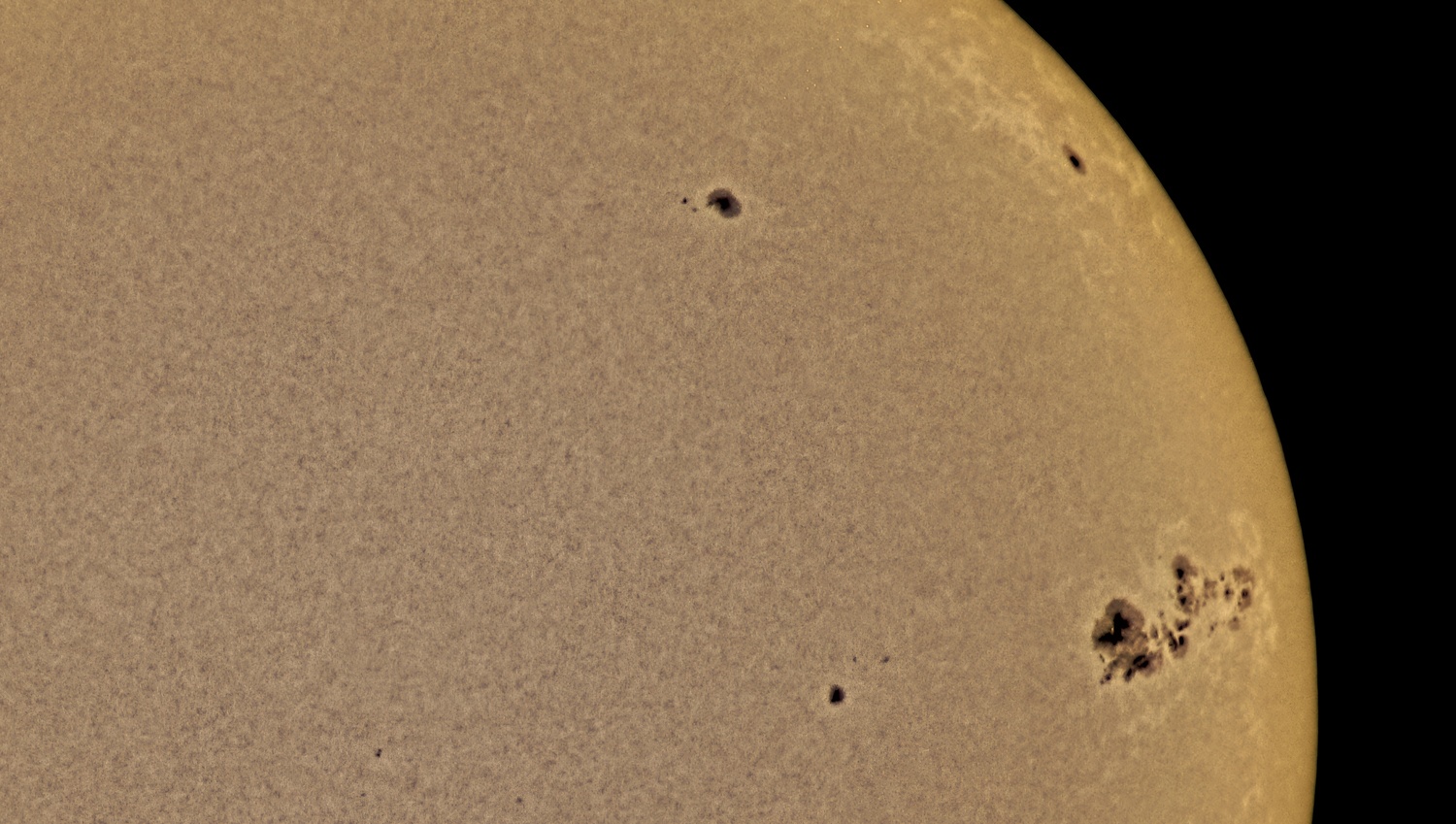
Your looking at a section of the Sun with Sun-Spots visible. I was preparing for the Solar Eclipse in 2024, this shot was taken with the same equipment and technique and my Mylar style white-light filter.
In order to make sure the Focus is good for The Sun, is not so easy. It's not just go to 'Infinity' and expect that will be good. I actually attach an extra plastic-ring on my focus-ring, and remove the collar on my Tamron lens. See this video: https://youtu.be/thsCypJSgUM?si=wqmEV3JavwHLlKI9 Where I explain how to focus the sun with a long-zoom lens, and I attach a Gear ring. On a literal shoestring budget.
Then since I haven't purchased a tripod that has a auto-mechanical tracker... I have to manually keep the 'Sun' in frame. Which is also not so easy at 840mm. (Plus it's an APC crop) I have to find the Sun at 500 to 600mm then zoom-all-the-way in, then use that focus method in the video...
Then I have my phone and larger tablet screen hooked up. I don't rely on the rear-LCD screen or a View-Finder. You must see it in a larger screen to be able to determine if your manual-focus has been achieved. Then use 5x to 10x, and look at a sun-spot.
Then I use my cell-phone attached via-bluetooth, and take a plethora of shots usually in the 100s. At a couple of different Shutter-Speeds... Probably only the 1/2000 was stacked in the end here though.
Then in Post-Processing I used Autostakkert to take many of those frames, and stack them together. After that step, I used the 1.5 drizzle method, and some cleanup was needed on the edges, which I used Topaz for. Then obviously the above shot is cropped, sharpened, artificially yellow colored, and the contrast was perfected.
Canon EOS M6 Mark II ƒ/9 1/2000 840mm ISO200
With the Tamron G2 150-600mm Extender 1.4x.
Taken near my home in Ypsilanti, MI.
Click on the thumbnails below to comment and rate each image.
Click here to learn about the Fstoppers rating system and what each star value means.
No comments yet